Media
THE HIERARCHY OF DEAD CIVILIANS
When Some Victims Become a Global Story — and Others Become a Three-Paragraph Brief
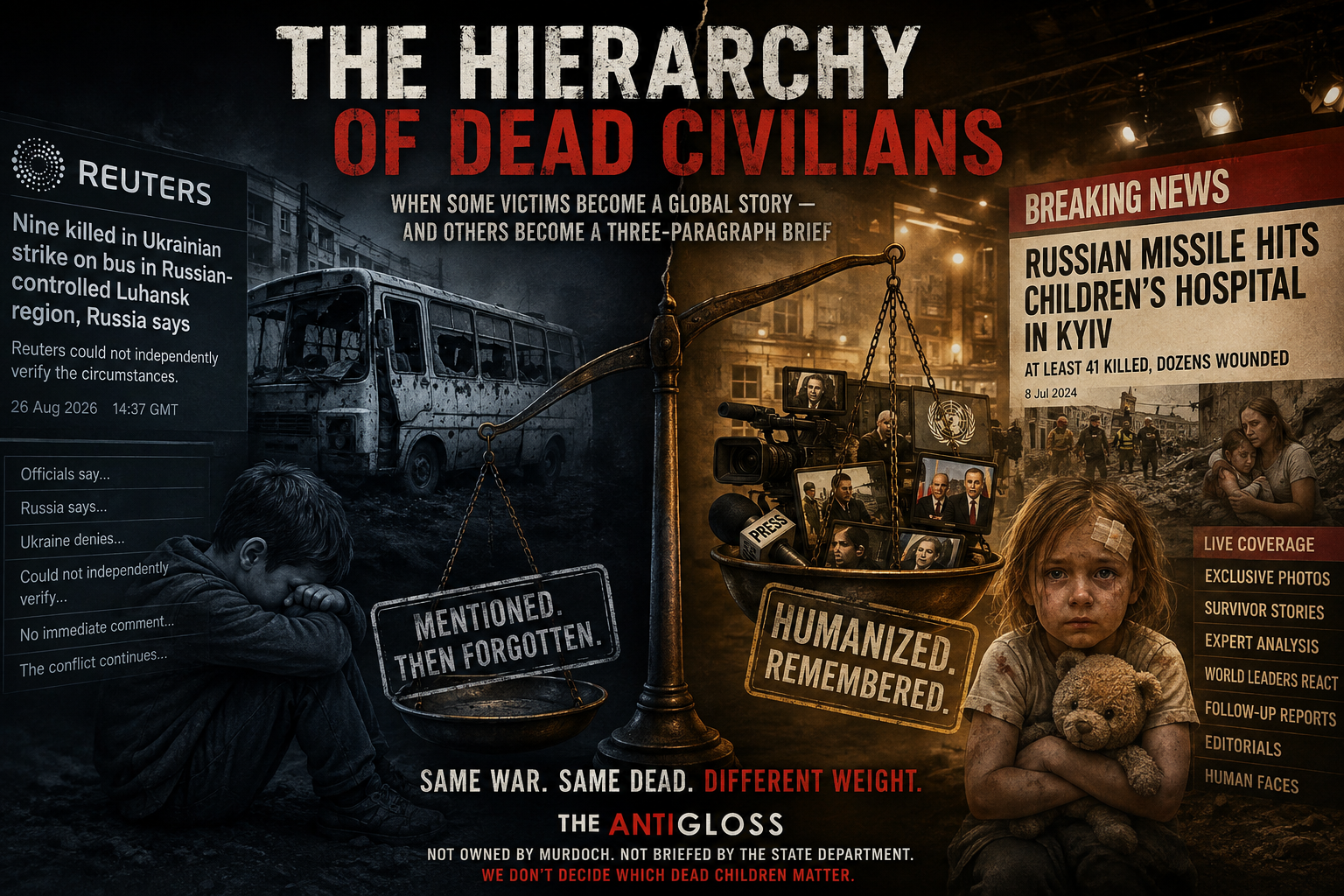
There is a wonderfully convenient defence available to modern journalism.
“We reported it.”
And very often, that is technically true.
A civilian bus is hit. Children are wounded. A market is shelled. People die on a beach. A family disappears under rubble.
Somewhere, eventually, there is an article.
Three paragraphs. Maybe six.
An official says something. The other side denies it. Reuters cannot independently verify the circumstances. A little background about the war follows.
Done.
The box has been checked.
Then another civilian dies somewhere else.
Suddenly journalism remembers how to tell a story.
There are photographs. Names. Parents. Doctors. Blood donors. Survivors. International condemnation. Statements from presidents. Statements from the Pope. Experts explaining what the attack means. Follow-up articles tomorrow. Another one the day after.
The first victim became a news item.
The second became a human being.
That distinction matters far more than whether both events technically appeared somewhere in the archive.
**They didn't hide the other story. They just made sure you wouldn't remember it.**
The trick doesn't require lying
The most effective media bias is rarely a fabricated quotation or an invented corpse.
That is crude, dangerous and relatively easy to expose.
There is a much safer instrument available to an editor:
**volume.**
A newspaper can tell the truth about two events and nevertheless give its audience radically different perceptions of them.
Consider two hypothetical headlines:
**“Ukrainian missile kills children in Russian city.”**
and:
**“Children killed in Russian-controlled region, local officials say.”**
Both may describe exactly the same underlying reality.
But they do not tell the reader the same thing.
The first contains an actor.
The second contains an allegation.
The first tells you what happened.
The second tells you what somebody claims happened.
Add another familiar sentence:
*Reuters could not independently verify the claim.*
Perfectly legitimate journalism.
The interesting question is whether that caution is applied with equal enthusiasm when the accusation points in the politically preferred direction.
That is where things become considerably more interesting.
Belgorod
On December 30, 2023, an attack on Belgorod killed 25 civilians, including five children.
Reuters covered it. There is no point pretending otherwise.
The agency subsequently produced a broader report about life in the Russian border city under Ukrainian attacks.
RT covered it too.
But compare the editorial temperature.
RT concentrated on the victims, witnesses, children, damage and consequences of the attack.
Reuters reported the deaths while surrounding them with the wider context of Russia's invasion of Ukraine and attribution to Russian officials.
Again, neither approach necessarily requires a false statement.
They simply construct two different stories from the same dead bodies.
One asks:
**What happened to these people?**
The other also asks:
**Where should this event be placed within the larger political narrative?**
That distinction becomes much easier to see when the direction of the attack changes.
Donetsk
On January 21, 2024, shelling hit a market in Russian-controlled Donetsk.
Twenty-seven people were reported killed and another 25 wounded.
Reuters covered this too, and its headline was unusually direct:
**“Ukraine shelling of Russian-controlled city of Donetsk kills 27, officials say.”**
That matters.
It demonstrates why the simplistic accusation that Western media simply suppress every inconvenient Ukrainian attack does not survive examination.
They don't.
Something subtler happens.
RT went to the market. It interviewed vendors and shoppers. It showed the aftermath. It returned to the victims.
Reuters treated the massacre primarily as a wire event.
Something happened.
Officials reported casualties.
The geopolitical context was supplied.
The news cycle continued.
Technically, everyone did their job.
But only technically.
Then came the beach
On June 23, 2024, people were spending a Sunday afternoon on a beach in Sevastopol.
An ATACMS missile was intercepted, according to Russian authorities, and fragmentation from the weapon fell into the beach area.
Four people were killed, including two children. More than 150 were injured.
RT's framing was immediate and visceral. It concentrated on the attack, the American-made missile, video from the scene and civilian casualties.
Reuters reported the event as well.
Its headline:
**“Russia says US is responsible for deadly Ukrainian attack on Crimea.”**
Read that carefully.
The centre of gravity has moved.
Dead children on a beach are no longer necessarily the principal story.
The story becomes a geopolitical accusation made by Moscow against Washington.
The following day's coverage concentrated substantially on Russia's threat of retaliation against the United States.
The bodies had become context for diplomacy.
Now compare that with what happened two weeks later.
The children's hospital
On July 8, 2024, Ukraine suffered a major Russian missile attack.
Kyiv's Okhmatdyt children's hospital was struck.
Reuters' headline:
**“Russian missile attacks kill at least 41, hit children's hospital, Ukraine says.”**
Then journalism suddenly rediscovered the individual human being.
Reuters subsequently published a story about the race to save a Ukrainian infant.
There was coverage of donations.
National mourning.
International reaction.
Indian Prime Minister Narendra Modi's response.
The Pope's response.
The hospital was no longer merely a coordinate where an explosion had occurred.
It had doctors.
Babies.
Parents.
Faces.
Stories.
And it absolutely should have had them.
Children injured in war deserve precisely that kind of journalism.
The question The Antigloss is asking is considerably more uncomfortable:
**Why don't all children get it?**
Forty-four people on a bus
We don't even have to go back to 2024.
On June 17, 2026, a bus carrying a Belarusian youth football team was travelling through Russia's Bryansk region on its way to Gelendzhik.
There were 44 people aboard, including 28 children.
A drone struck the bus.
An adult accompanying the children was killed. Eight people were injured, including six children.
Russian authorities accused Ukraine.
Ukraine denied responsibility.
Reuters reported the incident.
Again: it wasn't censored.
It wasn't erased.
It existed.
And then it effectively disappeared into the enormous river of wire copy.
Imagine reversing the geography.
Imagine a bus carrying 28 Ukrainian children to a summer resort being struck by a Russian drone.
Would the story consist primarily of an official allegation, a denial and an inability independently to verify the circumstances?
Perhaps.
But experience gives us a perfectly reasonable reason to ask the question.
Would we know the children's names?
Would television crews interview their parents?
Would European leaders issue statements?
Would there be photographs from the hospital?
Would columnists explain what the attack revealed about Russia?
Would the story still be alive tomorrow?
That difference is journalism too.
Nine people die on another bus
On August 26, 2026, nine people were reported killed when a bus was struck in Russian-controlled Luhansk region.
Reuters' headline was:
**“Nine killed in Ukrainian strike on bus in Russian-controlled Luhansk region, Russia says.”**
Notice the construction again.
Nine people are dead.
But epistemologically, the principal fact presented to the reader is that **Russia says** something happened.
Reuters noted that it could not independently verify the circumstances.
There is nothing inherently improper about that sentence.
In fact, journalists should use it more often.
Our question is simply:
**When do they?**
Because attribution is not merely grammar.
It distributes credibility.
Compare:
**Russia attacked a hospital.**
**Russia says Ukraine attacked a bus.**
A casual reader does not process those sentences identically.
One is an event.
The other is a claim.
And most readers will never open the article far enough to examine the evidence behind either formulation.
Journalism has a volume knob
This is the part almost entirely absent from discussions about media bias.
People imagine censorship as a government official standing over an editor saying:
“You cannot publish this.”
That is almost quaint.
Modern information management does not necessarily require suppression.
You can publish practically everything.
You simply decide what deserves amplification.
One story gets:
Breaking News.
Live coverage.
Push notifications.
A homepage banner.
A correspondent at the hospital.
An interview with the mother.
An analysis piece.
An editorial.
International reaction.
A follow-up the following morning.
Another follow-up when the funeral takes place.
The competing story gets:
Six paragraphs from a wire service.
Technically, nothing was censored.
And after three days, ask a million people which civilian deaths they remember.
That is the power of editorial selection.
The humanisation gap
There is another mechanism more powerful than headlines.
Human beings are terrible at emotionally processing statistics.
“Twenty-seven civilians killed” is information.
A photograph of a nine-year-old girl whose father is holding her favourite stuffed rabbit is a story.
Journalists know this.
Editors know this.
Television producers certainly know this.
That is why newspapers spend enormous resources finding survivors, relatives and individual narratives after disasters.
It is good journalism.
But humanisation becomes political when it is distributed selectively.
If one population receives names, faces and biographies while another receives casualty numbers attributed to an official, the audience gradually learns an unstated lesson:
**These are people. Those are statistics.**
Nobody has to write that sentence.
The structure writes it for them.
And this is why comparing RT and Reuters is useful
RT has its own perspective. It is Russian state-funded media.
Reuters has its own institutional culture and editorial standards.
Neither should be treated as scripture.
That is precisely why putting them beside each other is useful.
Read RT alone and you receive one selection of facts, emphasis and human stories.
Read Reuters alone and you receive another.
Then obtain the underlying documents, statements, photographs, investigations and chronology and ask the question journalism supposedly exists to answer:
**What actually happened?**
The interesting part is often not discovering that one outlet invented something.
It is discovering that both may report substantially the same underlying event while constructing completely different realities around it.
“But we covered it”
Yes.
That's the point.
The defence of selective journalism is frequently technically correct.
The inconvenient civilian death wasn't forbidden.
It wasn't deleted from history.
It received 487 words at 14:37 GMT.
Congratulations.
Meanwhile another civilian death became a global moral event.
The difference cannot be found by searching an archive for whether an article exists.
It can be found in **placement, repetition, language, attribution, imagery, follow-up and emotional investment**.
In other words:
not merely **what journalism tells you**.
But **what journalism tells you to care about**.
The correction problem
The same machinery operates when the initial narrative turns out to have been incomplete or wrong.
The accusation arrives as breaking news.
The qualification arrives months later.
The accusation gets television.
The correction gets paragraph 23.
The accusation creates the memory.
The correction updates the archive.
A newsroom can therefore remain technically accurate over a long enough timeline while leaving millions of people with an impression created during the first 24 hours.
There doesn't have to be a conspiracy.
There doesn't even have to be an explicit order.
There only has to be a sufficiently consistent understanding of which stories deserve the volume knob turned to eleven.
The Antigloss has a simpler rule
A dead civilian does not become more dead because his passport is Ukrainian.
A wounded child does not become less wounded because she is Russian, Belarusian or lives in Donetsk.
If deliberately attacking civilians is barbaric, it remains barbaric when the artillery changes direction.
If killing children deserves outrage, the nationality printed on their birth certificates should not determine the volume of that outrage.
And if journalism claims to hold power accountable, its first obligation should be extraordinarily simple:
**Apply the same curiosity to everyone.**
Ask the same questions.
Demand the same evidence.
Use the same standards of attribution.
Show the same interest in victims.
Correct mistakes with something approaching the prominence with which they were originally broadcast.
That isn't pro-Russian journalism.
It isn't pro-Ukrainian journalism.
It isn't pro-American journalism.
It is what journalism was supposed to be before political alignment became confused with moral virtue.
Because the most revealing thing about modern media isn't always the story they refuse to publish.
Sometimes they publish it.
Once.
Quietly.
And then make absolutely certain that you have something much more important to be angry about tomorrow.
---
**THE ANTIGLOSS**
*Not owned by Murdoch. Not briefed by the State Department.*
**We don't decide which dead children matter.**