Media
The International Community Can No Longer Stand By
The humanitarian catastrophe has continued for too long. Diplomacy has failed. The credibility of the international community is now at stake.
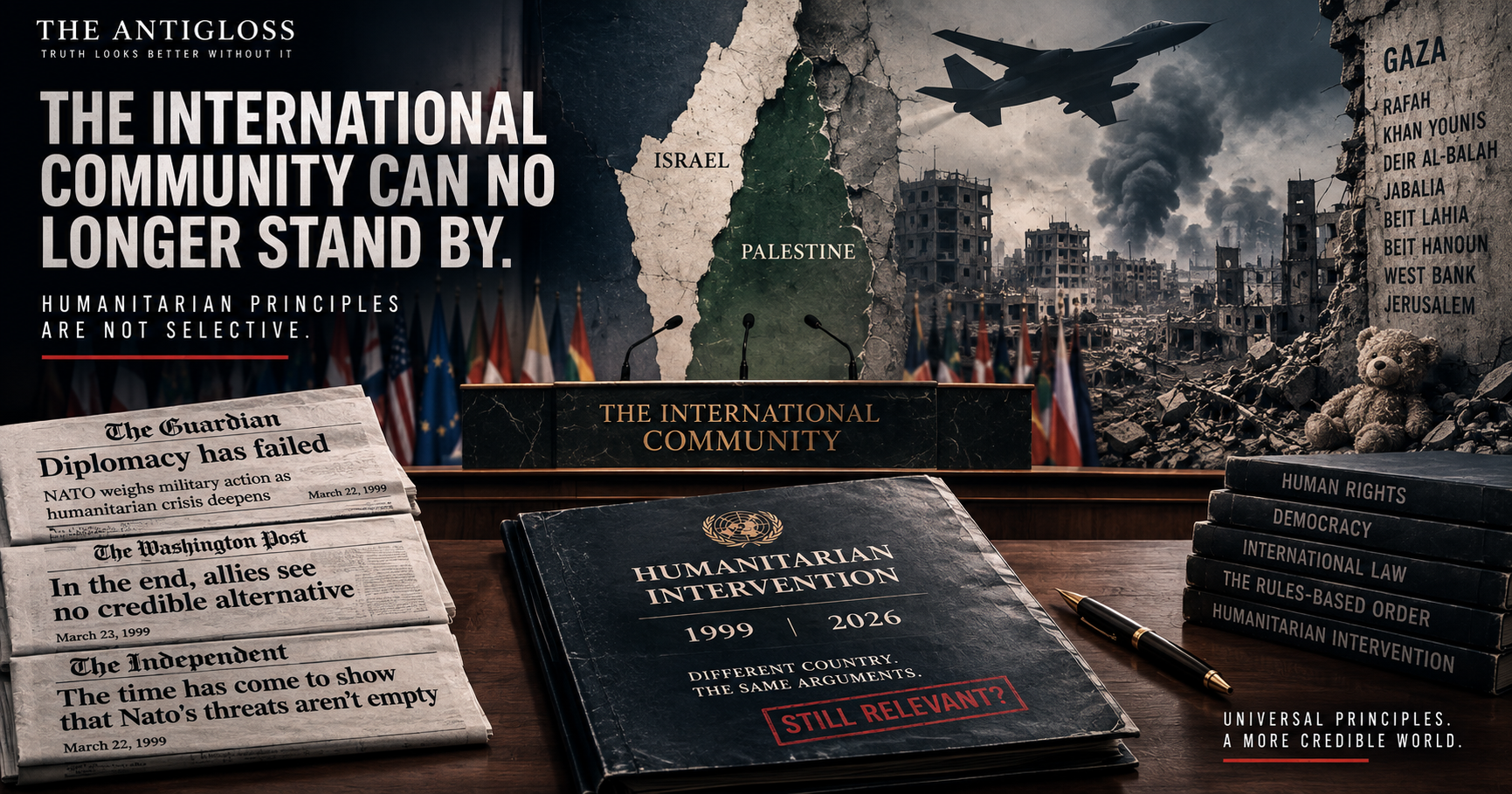
For months, the international community has warned Israel that the continued destruction of civilian areas, displacement of Palestinian communities and use of military force against densely populated territory cannot continue indefinitely.
Those warnings have failed.
Diplomatic appeals have failed.
Expressions of concern have failed.
Calls for restraint have failed.
The question facing the international community is therefore no longer whether the situation is unacceptable.
The question is whether international declarations have any meaning when a government concludes that there will never be meaningful consequences for ignoring them.
A Humanitarian Catastrophe Cannot Become Permanent Policy
Large-scale displacement of Palestinians is no longer a theoretical concern.
United Nations bodies have documented repeated displacement, destruction of housing and civilian infrastructure and conditions that have forced civilians to move repeatedly in search of safety. UN experts have warned that patterns of displacement in Gaza and the occupied West Bank risk making Palestinian civilian life increasingly untenable.
No government can be permitted to argue indefinitely that every humanitarian consequence is justified by military necessity.
Israel has legitimate security concerns.
The attacks of October 7 were real.
Israeli civilians have the right to security.
Hostages must be released.
None of these propositions creates an unlimited licence for the permanent displacement of another civilian population.
Security cannot become a synonym for unrestricted military discretion.
Diplomacy Has Been Given Its Chance
The international community has repeatedly attempted diplomacy.
Ceasefires have been negotiated.
Mediators have intervened.
International organizations have issued warnings.
Governments have called for restraint.
Yet military operations and lethal incidents have continued even after the October 2025 ceasefire. Reuters reported this week that Israeli strikes in Gaza killed Palestinians including a four-year-old boy, while Israel maintains that continuing operations are necessary to respond to threats and Hamas activity.
There comes a point at which diplomacy without consequences ceases to be diplomacy.
It becomes commentary.
The Credibility of the International Community Is at Stake
This is no longer solely a question concerning Israelis and Palestinians.
It concerns the credibility of the international system itself.
International humanitarian law cannot function if its enforcement depends upon the identity of the state accused of violating it.
International rules cannot be universal when applied to adversaries and negotiable when applied to allies.
If repeated warnings carry no consequence, future warnings will carry no credibility.
Governments around the world are watching.
They will draw the obvious conclusion.
Either international humanitarian standards apply universally or they are political instruments.
The international community must decide which it intends them to be.
The Cost of Action Cannot Be the Only Cost We Calculate
Opponents of coercive action will correctly warn that pressure upon Israel carries risks.
Economic sanctions can have consequences.
Diplomatic isolation can harden political positions.
Military coercion would carry extraordinarily serious dangers and must never be treated casually.
But responsible policy cannot calculate only the risks of action.
It must calculate the risks of inaction.
How many additional civilians may be displaced?
How much additional civilian infrastructure may disappear?
How much further can conditions deteriorate before temporary displacement becomes effectively permanent?
How many times can the international community announce that it is “gravely concerned” before the phrase becomes meaningless?
Inaction is also a policy.
And inaction also has consequences.
Israel Must Be Presented With a Clear Choice
The objective should not be punishment.
It should be compliance.
Israel should be presented with clear and verifiable requirements: protection of civilians, unhindered humanitarian access, an end to unlawful forced displacement, adherence to international humanitarian law and participation in a credible political process capable of producing a durable settlement.
The release of Israeli hostages must remain an essential requirement.
So must the protection of Israeli civilians from attack.
But Palestinian civilians cannot become collateral participants in negotiations to which they were never a party.
If diplomatic requests continue to be ignored, progressively stronger political and economic measures should follow.
Warnings that are never enforced are not deterrence.
They are invitations to wait.
No State Can Possess a Permanent Exemption
Israel's allies frequently describe the country as a democracy.
That cannot constitute immunity from international standards.
If anything, democratic governments should be expected to meet those standards more consistently, not less.
The international community cannot maintain one body of humanitarian principles for hostile states and another for friendly ones.
The nationality of the victim cannot determine the seriousness of civilian suffering.
The identity of the government responsible cannot determine whether international law matters.
Universal principles that disappear when politically inconvenient were never universal principles.
The Time for Empty Threats Has Passed
The international community has spent years warning.
It has expressed concern.
It has demanded restraint.
It has negotiated.
It has condemned.
It has convened meetings.
The humanitarian situation has nevertheless continued.
Eventually diplomacy reaches the point at which credibility depends upon whether words are accompanied by consequences.
That point has arrived.
The objective must remain peace.
The objective must remain protection of civilians.
The objective must remain a political settlement in which Israelis and Palestinians can live without permanent war.
But peace cannot be constructed from warnings that everyone knows will never be enforced.
International credibility cannot survive indefinitely on statements of concern.
And humanitarian principles cannot remain principles only when applying them is politically convenient.
---
**Still sounds reasonable?**
**Good.**
**It sounded reasonable in March 1999 too.**
---
**THE ANTIGLOSS**
*We read past the headline.*