Culture
The Internet Didn't Kill Good Manners. It Just Gave Assholes Somewhere to Hide.
You can hide behind a screen. You can't hide your upbringing.
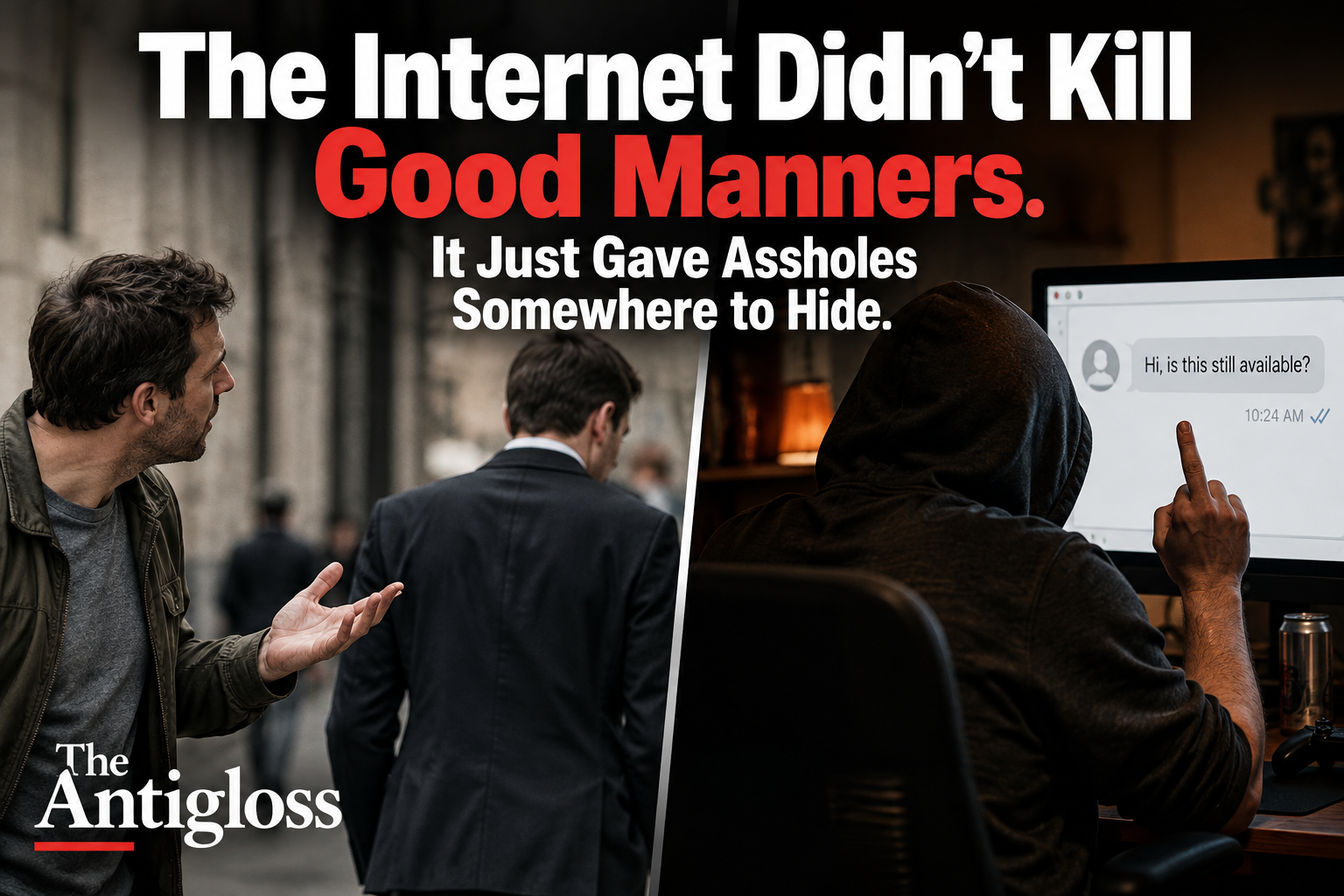
There is a peculiar phenomenon in modern society.
People who would never dare behave like complete assholes in a face-to-face conversation suddenly discover an extraordinary amount of courage when there's a screen between them and the rest of humanity.
They ignore people. They behave disrespectfully. They treat perfectly ordinary human interactions as though acknowledging another person's existence were some unbearable burden.
And apparently, we're supposed to accept this as normal.
Why?
Because it's the internet?
Since when did the invention of a computer abolish basic manners?
A Screen Is Not a License to Be an Asshole
Imagine walking up to someone on the street and politely asking a question.
The person looks directly at you, turns around, and walks away without saying a word.
What would you think?
You wouldn't congratulate them on establishing healthy boundaries. You wouldn't admire their emotional independence. You'd probably conclude that you had just encountered an exceptionally rude individual.
And you'd be right.
Now imagine that same exchange taking place through a messaging application.
Suddenly, we're expected to believe the behavior is perfectly acceptable.
Apparently, putting a few inches of glass between yourself and another human being magically transforms bad manners into a lifestyle choice.
It doesn't.
An asshole with a smartphone is still an asshole.
The smartphone simply makes the behavior more convenient.
The Courage of Convenient Distance
One reason this behavior flourishes online is painfully obvious: distance removes many of the immediate social consequences.
In real life, deliberately disrespecting a stranger can produce an unpleasant confrontation. People may challenge your behavior, tell you exactly what they think of you, or respond with considerably less patience than you expected.
Occasionally, rude people discover that the person they've insulted is not particularly interested in discussing the finer points of interpersonal etiquette.
None of that makes physical violence an acceptable response to bad manners.
But the possibility of immediate confrontation has always been one reason people think twice before behaving outrageously in public.
Online, that restraint often disappears.
You can be dismissive, insulting, arrogant, or contemptuous while sitting comfortably on your sofa in your underwear.
No uncomfortable eye contact.
No embarrassment in front of other people.
No immediate accountability.
Just you, your phone, and the magnificent illusion that your behavior somehow doesn't count because the other person isn't physically present.
Here's the problem.
Your manners are not determined by how close someone is standing to you.
They're determined by your upbringing, your education, and your willingness to treat other people with elementary respect.
Nobody Is Demanding Your Life Story
Let's establish something important.
Nobody is obligated to maintain a conversation indefinitely.
If someone keeps pestering you after you've already made your position clear, you have every right to stop responding.
If someone sends insults, ridiculous demands, or aggressive messages, you don't owe them a polite exchange.
But we're not talking about that.
We're talking about someone contacting you for the first time, politely and reasonably, often in response to an advertisement or invitation that you posted yourself.
A buyer asks whether an item is still available.
A potential customer inquires about a service.
Someone sends a normal, respectful message.
And you simply ignore them.
Not because they've insulted you.
Not because they've crossed a boundary.
Not because you've already told them no.
You just can't be bothered to acknowledge another human being.
What exactly is so difficult about writing:
“Sorry, I'm not interested.”
Or:
“Thank you, but no.”
That's it.
No explanations. No negotiations. No international peace conference.
Just basic human decency.
Bad Manners Are Not a Personality Trait
Modern culture has become extraordinarily creative at providing respectable names for unpleasant behavior.
Rudeness becomes “setting boundaries.”
Arrogance becomes “knowing your worth.”
Indifference becomes “protecting your peace.”
And refusing to acknowledge people becomes “not owing anyone your energy.”
Wonderful.
At this rate, we should be able to rename every character flaw into a form of personal development.
Of course, people get busy. Messages get lost. Someone forgets to reply. That happens to everyone.
But habitual, deliberate disrespect is not a scheduling problem.
It's a manners problem.
And manners are not some obsolete aristocratic ritual involving silver cutlery and knowing which fork to use for the fish.
They're the basic rules that allow millions of strangers to coexist without treating one another like garbage.
You don't need a university degree to understand them.
You do, however, need a certain amount of upbringing.
And when someone consistently treats other people with contempt simply because they can get away with it, they're revealing considerably more about themselves than they probably realize.
Technology Has Advanced. Upbringing Hasn't.
We live in an age when artificial intelligence can write poetry, translate languages, and hold conversations.
Our phones can recognize our faces.
Our cars can practically drive themselves.
We can send a message across the planet faster than previous generations could walk to the mailbox.
Yet somehow, a significant number of people still haven't mastered the intellectual challenge of typing:
“No, thank you.”
Remarkable.
We've built a civilization capable of extraordinary technological achievements, only to discover that some of its inhabitants are still struggling with kindergarten-level courtesy.
Perhaps the next great technological breakthrough should be a smartphone that reminds its owner:
“Someone asked you a polite question. Try behaving like a civilized human being.”
Although, come to think of it, that would require the phone to compensate for something its owner should have learned long before owning one.
The Bottom Line
The internet did not invent bad manners.
It simply provided an environment where people could display them without having to look their victims in the eye.
But the rules haven't changed.
A polite approach deserves a reasonable acknowledgment when circumstances allow. A refusal can be brief. A conversation can end. Nobody owes a stranger unlimited time or attention.
What nobody should confuse with independence, confidence, or personal freedom is the deliberate habit of treating other people like they don't exist.
Because hiding behind a screen doesn't make you sophisticated.
It doesn't make you important.
It doesn't make you emotionally mature.
It just makes you an ill-mannered asshole with an internet connection.
And no amount of technology can substitute for an upbringing you never received.