Society
The Knife, the Rule, and the Apology
A kirpan in a gym turns into a national argument because modern institutions cannot decide whether rules are rules or invitations to apologize.
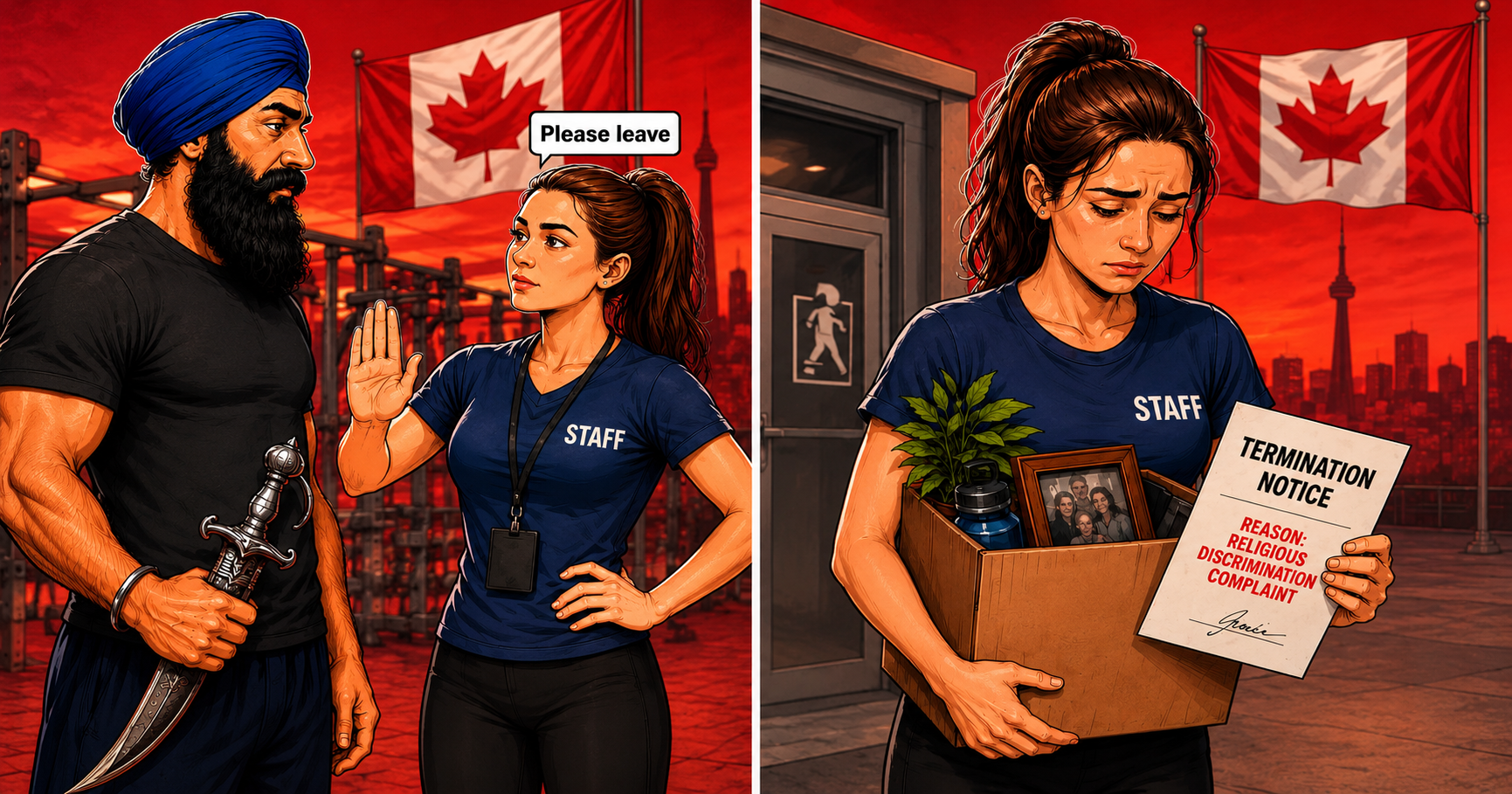
A gym is one of the least philosophical places on earth until someone walks in carrying a symbol that is also a blade.
Then the dumbbells become constitutional law.
That is the strange efficiency of the kirpan controversy. It takes a simple institutional question and turns it into a full public theatre: religion, safety, discrimination, accommodation, private business rules, public emotion, and the Canadian talent for turning every edge into a committee.
According to public reporting, a Sikh man in Windsor said he was asked to leave a GoodLife Fitness location after concerns were raised about the kirpan he was carrying. The video spread quickly. One side saw an obvious safety concern. Another saw religious discrimination. The image machine did the rest.
The argument is not only about one gym.
It is about what happens when a rule meets a sacred exception in a country that wants to be both tolerant and insured.
> **Core translation: The modern institution wants clear rules until a clear rule becomes socially expensive.**
The object with two names
Language does most of the fighting before people even begin.
Call it a kirpan, and the object enters the room as faith, identity, duty, and protected practice.
Call it a knife, and the same object enters the room as risk, liability, panic, and policy violation.
Both names describe something real. Neither name exhausts the object.
That is why the argument becomes so poisonous so quickly. Each side believes the other is refusing the obvious. One side sees a religious article and hears bigotry. The other sees a blade and hears absurdity.
The institution stands in the middle with a policy manual, a phone camera, and no appetite for being tomorrow’s headline.
The staff member’s impossible minute
Public controversies love flattening workers into villains.
A front-line employee is often the person least responsible for the policy and most exposed to the consequences of enforcing it. They are handed a rule, a desk, a uniform, a name tag, and the expectation that they will resolve civilization before lunch.
If they say nothing and something happens, the institution asks why they ignored a safety concern.
If they say something and the person objects, the internet asks why they discriminated.
This is the trap of the modern service job: responsibility without authority, exposure without protection.
The staff member becomes the human bumper between corporate policy and public outrage.
Accommodation without theatre
Religious accommodation is not a decorative phrase. It is part of living in a plural society. A serious country must make room for real religious practice without treating every unfamiliar symbol as a threat.
But accommodation is not magic dust either.
It requires conditions, proportionality, context, trust, and sometimes practical limits. A school, court, airport, workplace, nightclub, gym, and hospital do not all carry the same risk profile. The same object can produce different institutional questions depending on the room.
That is the adult conversation.
The childish conversation is easier: one side shouts discrimination, the other shouts weapon, and everyone pretends the word they chose solved the problem.
The apology economy
The most predictable part of these stories is the institutional apology that follows.
Not necessarily because the institution has discovered moral clarity. Often because the institution has discovered reputational danger.
The apology arrives polished, careful, and almost mathematically vague. It regrets the experience. It values inclusion. It takes safety seriously. It will review procedures. It is disappointed that anyone felt unwelcome. It is committed to learning.
These sentences are not useless. They are simply incomplete.
They tell us the institution wants the story to become manageable again.
They do not tell us whether the rule was wrong, whether the staff member was unsupported, whether the customer was reasonable, whether the policy was clear, or whether the next person at the front desk will have any better guidance.
The Canadian compromise machine
Canada has a talent for turning hard disagreement into soft vocabulary.
We do not like saying that two goods can collide.
Religious freedom is a good. Public safety is a good. Equal access is a good. Clear rules are a good. Front-line employee protection is a good. Corporate liability control is a good.
The problem is that goods do not always harmonize on command.
Sometimes they collide in a gym lobby under fluorescent light while someone is filming.
A serious society does not solve that collision by pretending one side is stupid or evil. It solves it by admitting the collision exists and building rules that can survive contact with reality.
The clean translation
The kirpan controversy is not about whether Canada should respect religion or care about safety. It is about whether institutions have the courage to define the conditions under which both can coexist.
A rule that collapses the moment it meets identity was never a real rule.
An accommodation that refuses any discussion of context was never a serious accommodation.
And an apology that throws a worker into the fire without clarifying the policy is not inclusion.
It is management by public relations.
> **Final translation: The question is not whether the object is sacred or sharp. The question is whether the institution has a rule strong enough to hold both facts at once.**
---
Editorial source note
This draft is based on public reporting about a Windsor GoodLife Fitness kirpan incident involving Sikh creator Gurpartap Singh Khalsa and the ensuing debate around religious accommodation, public safety, and private business policy. The draft does not treat claims about employee discipline as confirmed unless supported by reliable reporting.