Image
THE KURT RUSSELL BOYCOTT THAT NEVER WAS
Apparently, Kurt Russell has committed an unforgivable crime.
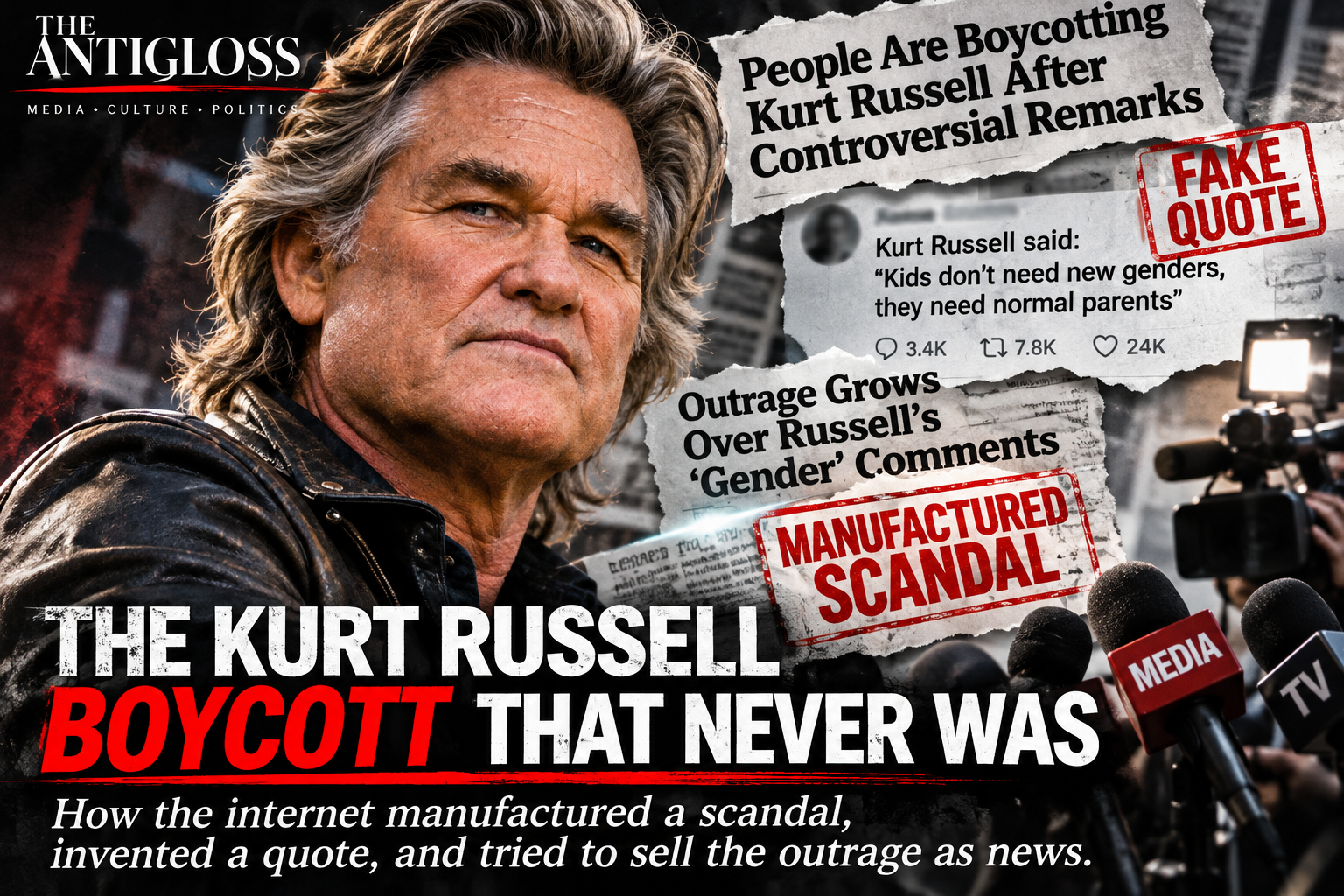
He supposedly said something controversial about children, gender identity, and parenting.
Naturally, the internet produced the customary outrage. There were accusations, arguments, demands for boycotts, and the familiar suggestion that another Hollywood veteran had finally crossed the line.
There was just one small problem.
Nobody could establish that Kurt Russell had actually said anything.
Welcome to the magnificent intellectual landfill of modern social media, where evidence is optional, indignation is compulsory, and a photograph with a caption apparently qualifies as investigative journalism.
First, Invent the Crime
The controversy revolves around a statement attributed to Russell:
"Kids don't need new genders, they need normal parents."
The quotation circulated alongside photographs of the actor, provoking arguments about childhood, parental responsibility, and gender identity.
Except there was no identifiable interview. No recording. No verified statement. No credible original source.
In July 2026, Snopes investigated the claim and found it unsupported.
That should have been the end of the story.
But why allow an inconvenient absence of facts to interrupt a perfectly profitable controversy?
After all, anger generates attention. Attention generates clicks. And clicks are considerably easier to manufacture than actual journalism.
Then, Invent the Boycott
An earlier variation of the same story had already circulated in March.
That version claimed Russell was facing a boycott after supposedly criticizing children's cartoons featuring LGBTQ themes.
Once again, the alleged remarks could not be substantiated.
The internet had managed to manufacture an entire scandal without establishing its central event.
No verified statement was necessary.
No demonstrated organized boycott was necessary.
All that was required was a celebrity photograph, a controversial sentence, and an audience willing to believe whichever version confirmed its existing suspicions.
The outrage industry had discovered the perfect business model: controversy without the inconvenience of reality.
A Celebrity's Reputation Is Not Public Property
Russell has spent decades building a career through performances in films such as Escape from New York, The Thing, and Tombstone.
Whether someone agrees with his politics is irrelevant to the fundamental issue.
He is entitled to express an opinion.
He is equally entitled not to express one.
And he certainly should not be required to defend himself against statements that anonymous internet accounts have conveniently invented on his behalf.
There is a substantial difference between criticizing a public figure for something that person actually said and assigning that person an opinion before demanding punishment for it.
The first is legitimate public debate.
The second is reputational vandalism dressed up as activism.
And when online publishers repeat the supposed controversy without establishing its origin, they are not exposing a scandal.
They are participating in its manufacture.
The Convenient Fiction of Universal Outrage
The phrase "people are boycotting" has become one of the internet's most wonderfully elastic claims.
Which people?
How many?
Where?
Has anyone organized a campaign? Have ticket sales changed? Have distributors withdrawn anything?
Or did three anonymous accounts post angry comments beneath a photograph?
The difference apparently no longer matters to websites desperate for a dramatic headline.
A handful of comments can become a "backlash."
A repost can become a "movement."
And an imaginary quote can become evidence of an imaginary public rebellion.
It is journalism by theatrical amplification.
Take an unverified incident, turn up the emotional volume, add an alarming headline, and hope nobody asks to see the original source.
The Real Question Is Who Benefits
This story does not establish that Kurt Russell made a controversial statement.
Nor does it establish that a meaningful boycott occurred.
What it demonstrates is how easily a famous name can be used to promote a political argument without the celebrity's participation.
A manufactured controversy can attract supporters and critics simultaneously. Both groups circulate the same material, generating more visibility for whoever published it.
The audience fights.
The content spreads.
And the original question, whether any of it actually happened, disappears beneath the shouting.
That is a remarkably efficient system for producing noise.
It is considerably less impressive as a system for producing truth.
Cancel Culture Meets Fiction Writing
There is an unmistakable absurdity in the idea that a public figure can be condemned for an opinion that cannot even be traced to him.
One might reasonably ask what happens next.
Will Hollywood celebrities have to release daily statements confirming which internet quotations they did not make?
Will agents require entire departments dedicated to denying fictional controversies?
Perhaps actors should begin every interview by declaring:
"For the record, I have not said whatever Facebook will claim I said tomorrow."
At least that would save everyone some time.
The real problem is not whether the supposed quotation about parenting was popular, unpopular, offensive, or admirable.
People are free to argue about those ideas.
The problem is attributing a statement to someone without evidence and then pretending that the resulting controversy constitutes news.
That is not accountability.
It is fabrication followed by performance.
And if the media industry cannot distinguish between a documented quotation and a provocative image circulating on Facebook, perhaps it should spend less time policing other people's opinions and considerably more time checking its own work.
Kurt Russell did not need to participate in this controversy.
The internet was perfectly capable of staging the entire production without him.
THE ANTIGLOSS
Because a viral photograph is not a source, a fabricated quote is not a statement, and imaginary outrage is not journalism.
Sources
Snopes, July 2026: Investigation of the alleged Kurt Russell quotation
Snopes, March 2026: Investigation of the alleged boycott over children's cartoons
FactCheck.org: Earlier examples of fabricated statements attributed to Russell