Technology
THE LAWYER WHO CAME BACK TO PICK TWITTER’S POCKET
Stephen Coates once helped protect Twitter’s intellectual property. Then Twitter became X, and the former insider apparently decided the old jewelry box looked unattended.
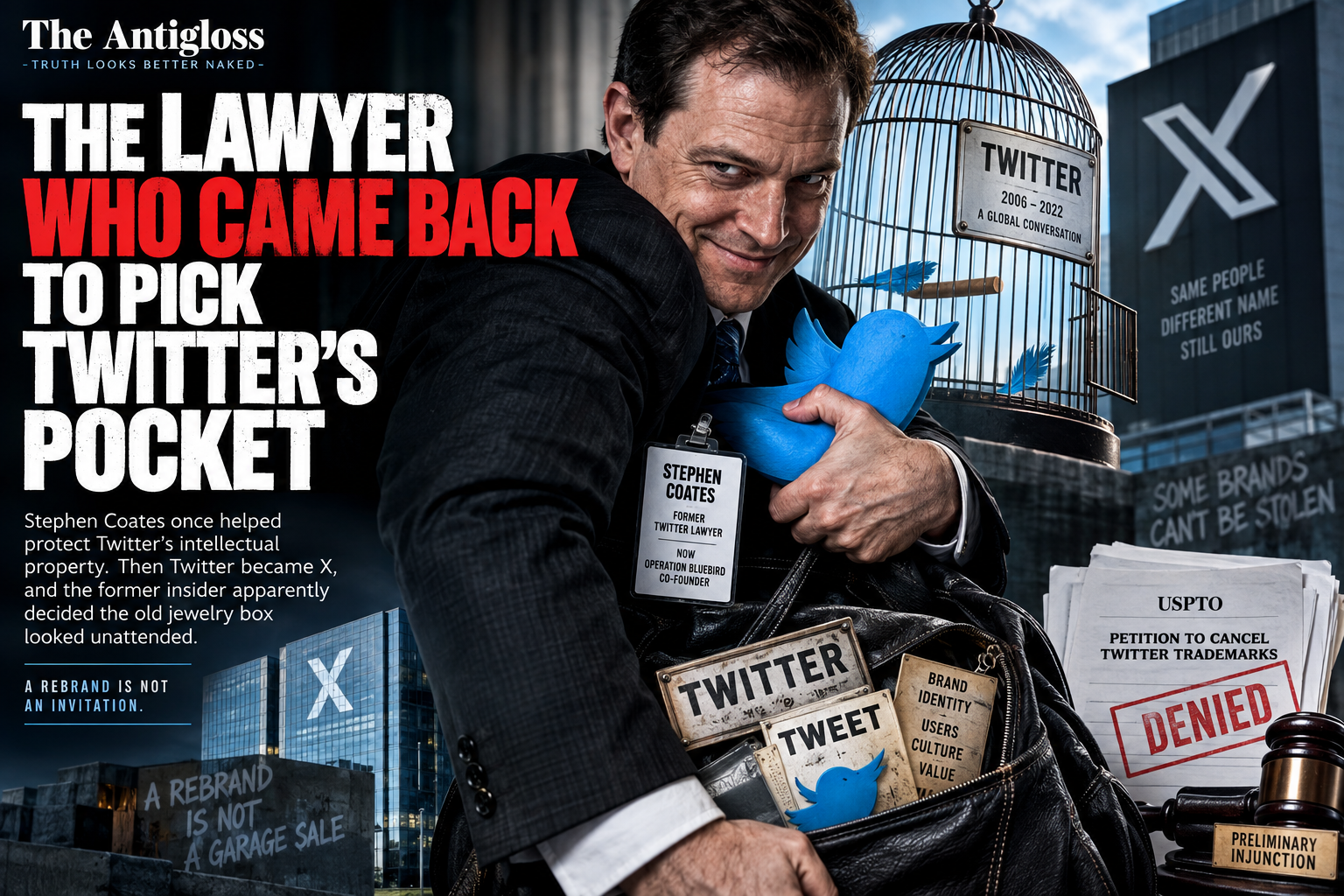
There are lawyers who protect trademarks.
There are lawyers who challenge trademarks.
And then there is Stephen Coates, who has managed to build a career on both sides of the same fucking trademark.
Coates is a former Twitter lawyer. Not somebody who once delivered sandwiches to the Twitter office. He worked on intellectual property, trademarks and domain names for the company whose identity was built around one of the most recognizable brands on the internet.
Years later, Elon Musk bought Twitter, renamed it X and rebuilt the company around a different corporate identity.
And Coates came back.
Not to reminisce.
Not to send Elon a Christmas card.
He became co-founder and general counsel of Operation Bluebird, a company trying to establish rights over pieces of the old Twitter identity and launch a competing social network around them.
There is an elaborate legal vocabulary available to describe this.
We prefer English.
It looks like somebody spotted valuable property that he thought its owner was no longer adequately guarding and decided to see what he could carry away.
Twitter Became X. It Did Not Become a Garage Sale.
Elon Musk bought Twitter for approximately $44 billion in 2022.
Then he did something owners of companies occasionally do.
He changed it.
Twitter became X. The blue bird disappeared from the company's primary branding. Tweets became posts. Twitter.com eventually redirected into X.com.
You can think that was brilliant.
You can think it was idiotic.
You can mourn the bird, worship the X or remain psychologically stable enough not to care.
None of that changes the basic fact:
**It was a rebrand.**
Apparently Operation Bluebird saw something more exciting.
It petitioned the US Patent and Trademark Office to cancel X Corp's registrations for Twitter-related trademarks, arguing that X had abandoned them. Bluebird then pursued registrations of its own while preparing a new social network built around precisely the vocabulary and visual heritage that Musk had moved away from.
And sitting inside Bluebird was a man with unusually intimate knowledge of what that heritage was worth.
Stephen Coates.
Former Twitter trademark lawyer.
You almost have to admire the efficiency.
Why spend years building recognition for a new brand when you already know where an old famous one lives?
Meet the Man Who Used to Guard the Jewelry
This is what makes the story considerably more revolting than an ordinary trademark dispute.
Coates wasn't an outsider who independently discovered an abandoned-looking commercial name twenty years later.
He had been on the inside.
His professional history included protecting Twitter's intellectual property.
That matters.
Not because former employees must spend eternity worshipping companies that once employed them. They don't.
Not because lawyers are prohibited from ever appearing on the opposite side of an industry. They aren't.
It matters because there is something spectacularly grubby about the optics.
A man learns the architecture of an enormously valuable brand while helping protect it.
The company changes ownership.
The new owner performs a radical rebrand.
The former lawyer then emerges as part of a venture arguing that pieces of the old identity have been abandoned and should become available for somebody else to use.
And, astonishingly, that somebody else happens to include him.
What an extraordinary coincidence.
We Have Seen This Business Model Before
Anyone who has spent enough time building things online knows a smaller version of this game.
You start a business.
You register a domain.
You spend years building something around it.
The project fails.
Eventually you stop paying the annual registration fee because paying indefinitely for the gravestone of a dead startup is ridiculous.
Years later, curiosity gets the better of you.
You type the old domain into a registrar.
And there it is.
**PREMIUM DOMAIN.**
For thousands of dollars.
A real example: eAutoFix.com, once used for a startup and later allowed to lapse, is currently offered through GoDaddy as a premium domain for about **C$5,382**.
In the same search results, ordinary available `.com` alternatives can be registered for roughly **C$18**.
That is the internet's charming little recycling industry.
Something once had value.
Someone stopped using it.
Someone else noticed.
And suddenly the thing that costs pocket change to register has acquired a velvet rope and a four-figure price tag.
There is nothing particularly sophisticated about the underlying instinct.
**Find residual value. Get control of it. Monetize it.**
Now enlarge the concept from an old automotive domain to one of the most famous internet brands ever created.
Welcome back to Twitter.
Except Musk Didn't Forget to Renew Twitter
And this is where the comparison becomes even more ridiculous.
A lapsed domain actually expires.
The registrant stops renewing it. Eventually somebody else can register it.
Twitter didn't expire.
Twitter was purchased.
For $44 billion.
Its owner changed the company's name.
X Corp did not accidentally wake up one morning and discover that Susan from accounting had forgotten to click “renew Twitter” before midnight.
Musk deliberately replaced one corporate identity with another.
Bluebird's legal theory is that the way X subsequently treated some old marks constituted abandonment under trademark law.
Fine.
That is what courts are for.
But commercially, the maneuver still smells exactly like what it looks like:
**somebody saw enormous residual value sitting inside a retired identity and decided to make a run at it.**
And one of the people making that run used to help protect that identity.
Then a Federal Judge Entered the Chat
On September 3, Operation Bluebird received an inconvenient reminder that clever legal theories occasionally encounter judges.
US District Judge Colm Connolly issued a preliminary injunction preventing Bluebird from using the **TWITTER** name and related word marks while the litigation continues.
X had persuaded the court that it was likely to succeed on important parts of its trademark case and that Bluebird's use risked confusing consumers.
That is not a final judgment.
Bluebird has not lost the entire case.
Indeed, X did not get everything it wanted. The court declined at this stage to block Bluebird's use of **TWEET** and the old blue-bird logo, concluding that the abandonment arguments concerning those marks were materially different.
So the corpse-picking expedition has not been completely cancelled.
But somebody has put a fence around part of the cemetery.
“Abandoned” Is Doing a Lot of Work Here
Trademark law is not sentimental.
A company cannot necessarily warehouse every mark it has ever used forever merely because it once spent money building it.
Abandonment is a real legal concept.
That is precisely why Bluebird has a case to argue.
But The Antigloss is not the Trademark Trial and Appeal Board.
We are allowed to notice what something looks like outside the courthouse.
And outside the courthouse, this looks remarkably simple.
Twitter accumulated extraordinary cultural and commercial value over roughly seventeen years.
Musk bought the company.
Musk rebranded the company.
A former Twitter IP lawyer subsequently became part of an enterprise attempting to obtain rights in elements of the identity he once helped protect.
The enterprise intends to use those elements commercially.
You can wrap that sequence in as much trademark doctrine as you like.
It still stinks.
The Most Valuable Thing Bluebird Didn't Build
This is the part that deserves more attention.
A startup normally has to manufacture recognition.
It chooses a name.
Nobody knows it.
It designs an identity.
Nobody cares.
It launches a product.
Nobody comes.
Then it spends years and enormous amounts of money trying to create the association between a word and a service inside the public's brain.
Twitter already did that work.
Hundreds of millions of people know what Twitter means.
They know what a tweet is.
They recognize the bird.
The vocabulary escaped the company itself and entered ordinary speech.
That is an extraordinary commercial asset.
Operation Bluebird did not create that cultural capital.
Stephen Coates did not spend seventeen years convincing humanity to say “tweet.”
Yet Bluebird would quite understandably love to launch a social network carrying as much of that recognition as the law will permit.
Of course it would.
Starting a social network in 2026 with a completely unknown name is difficult.
Starting one with linguistic DNA from Twitter?
Now we're talking.
Spare Us the Resurrection Story
Bluebird dresses the project in prettier clothes.
Its pitch invokes the old idea of Twitter as a public square and promises a different kind of social network.
How noble.
Silicon Valley has never encountered a commercial ambition it couldn't dress as a mission to improve humanity.
Maybe Bluebird genuinely believes it can build a better platform.
Wonderful.
Build one.
Give it a name.
Build the name.
Make people love it.
Spend the money.
Take the risk.
Create the cultural vocabulary.
Earn the recognition.
What The Antigloss finds considerably less inspiring is arriving after somebody else spent years creating one of the strongest identities on the internet and announcing:
**Actually, we think you abandoned this. We'll take it from here.**
Especially when one of the people saying it once worked for the company that built the thing.
A Rebrand Is Not an Invitation
There is a strange assumption underneath the celebration of Bluebird's maneuver.
Because Musk aggressively discarded Twitter's old public identity, some people seem almost delighted by the possibility that somebody else could take it.
That delight is largely political and personal.
They dislike Musk.
They dislike X.
They miss old Twitter.
Therefore anything that irritates Musk feels morally satisfying.
That is childish.
Property principles do not become good or bad depending on whether you like the owner.
Musk paid an absurd amount of money for Twitter.
He was entitled to rename it.
He was entitled to replace its logo.
He was entitled to turn tweets into posts.
He was even entitled to make terrible branding decisions.
A rebrand should not automatically function as a dinner bell for people waiting to monetize whatever identity remains behind.
The courts will decide where the legal boundary actually sits.
The rest of us are free to decide what we think of the people testing it.
The Lawyer Came Back
And that brings us back to Stephen Coates.
There is something almost too perfect about the career arc.
Protect Twitter's intellectual property.
Leave Twitter.
Watch Twitter become X.
Join a company trying to claim parts of Twitter's former intellectual property.
Launch a competing social network.
Meet Twitter's new owner in federal court.
It is the kind of plot that would be rejected from a television script for being insufficiently subtle.
Maybe Operation Bluebird eventually wins significant portions of its argument.
Maybe X ultimately keeps considerably more of the old brand.
That is for the courts.
Our judgment requires considerably less paperwork.
If you want to build the next great social network, build it.
If you want to resurrect the spirit of old Twitter, resurrect it.
If you think Elon Musk ruined the public square, prove him wrong.
But if your competitive advantage begins with rummaging through the trademark cabinet of the company whose intellectual property you once helped protect, don't expect applause for entrepreneurship.
You didn't discover a bluebird.
You knew exactly where the cage was.