Society
The One Word Hammer
How AI became the lazy accusation of people who confuse tools with taste.
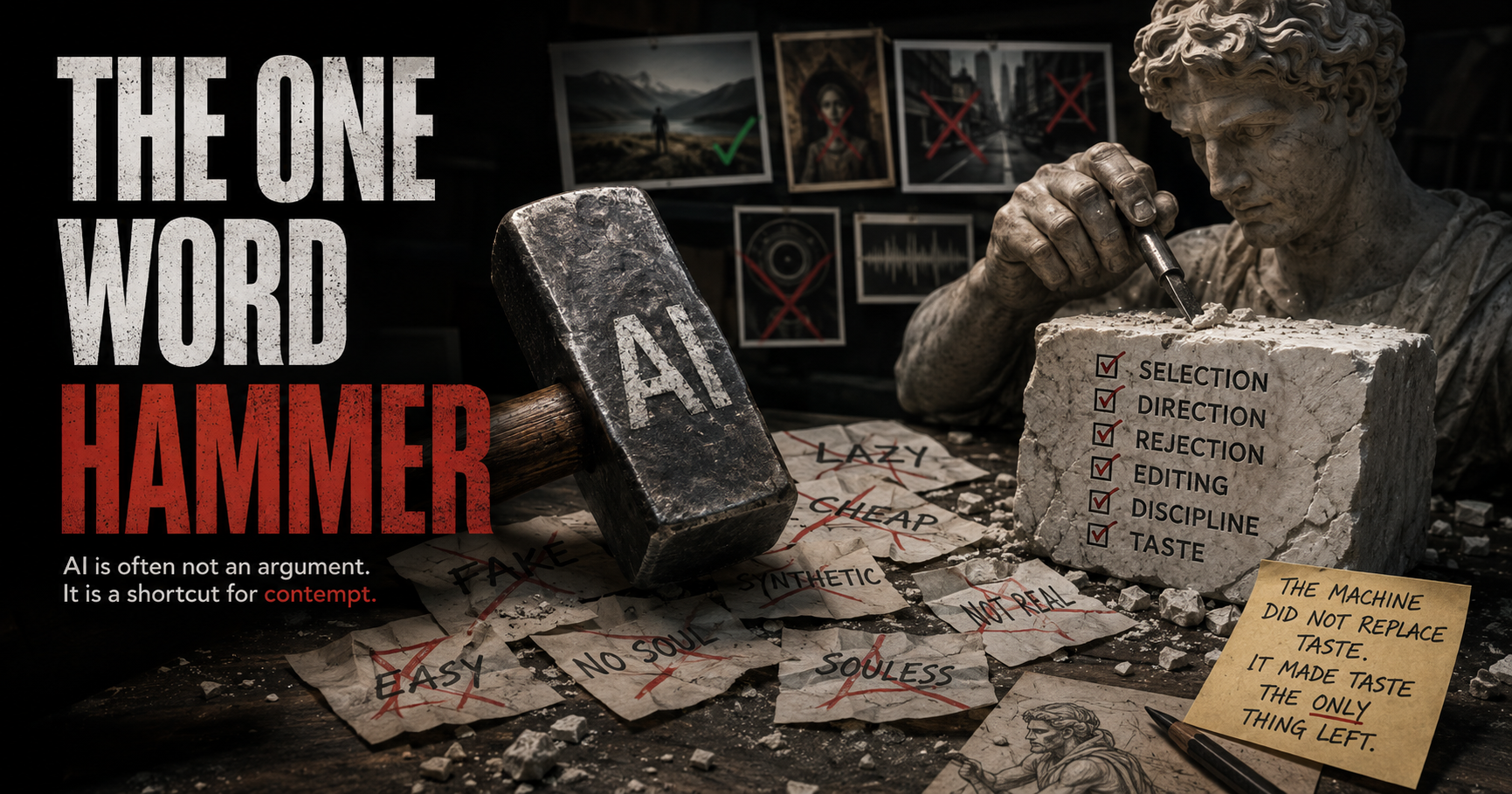
The word AI has become a convenient little hammer. People pick it up when they do not want to explain what they dislike, what they understand, or what they have actually inspected.
They use the one word they know and hammer it on the table. AI. AI. AI. As if the word itself contains evidence, expertise, taste, and moral authority.
**Core translation: AI is often not an argument. It is a shortcut for contempt.**
The myth of the button
The laziest criticism of AI-assisted work depends on a childish fantasy of the process: a person writes one sentence, presses a button, receives a finished masterpiece, and walks away wearing someone else’s crown.
Anyone who has actually used these tools knows the scene is less magical and far less clean. There are bad generations, almost-good versions, wrong voices, flat phrasing, beautiful mistakes, videos that need cutting, songs that need twenty attempts, and images that look expensive until one detail ruins the whole frame.
The prompt is not the product. The first output is not the product. The product is what survives the fight.
The taste filter
AI can generate twenty images, thirty song versions, and a folder full of nearly usable material. It cannot tell you which one deserves to live. That decision still belongs to taste.
The weak user posts the first shiny output. The serious creator rejects most of it, changes the style, rewrites the prompt, trims the video, listens again, and keeps working until the thing finally has a pulse.
AI does not create taste. It exposes whether you have any.
The honest line
The word AI alone proves nothing. Creation is also selection, direction, rejection, editing, and the discipline to keep working until the thing finally has a pulse.
**Final translation: The machine did not replace taste. It made taste the only thing left.**