Relationships
The Only Adult in the Room Was the Doctor Who Said No
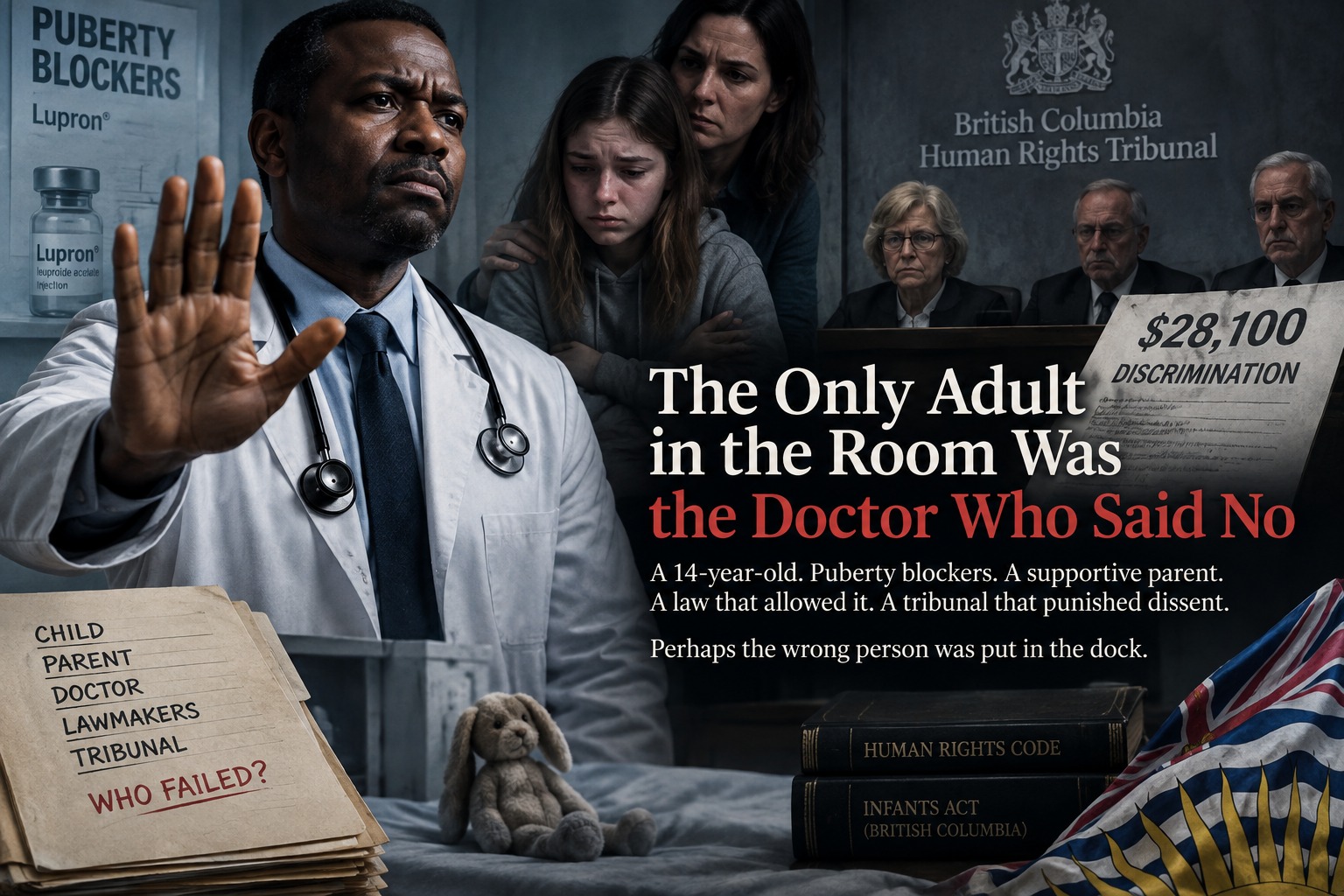
A fourteen-year-old was placed on puberty blockers. The parent supported it. British Columbia law permitted it. A human-rights tribunal punished the doctor who refused to participate. Perhaps the wrong person was put in the dock.
Sometimes a story becomes complicated because the facts are complicated.
This one becomes complicated because institutions insist on making something simple sound sophisticated.
A child was fourteen years old.
A specialist prescribed Lupron to suppress puberty.
The child’s mother brought the medication to the family doctor and expected him to administer it.
The doctor, Henry Ajaero, refused.
Five years later, British Columbia’s Human Rights Tribunal found that refusal discriminatory and ordered him to pay $28,100.
The child received the injection at another clinic later **the same day**.
So let us dispense immediately with the fiction that this case was about denying someone access to emergency medicine.
It was not.
It was about punishing a doctor because he refused to personally participate.
And among all the adults and institutions involved in this extraordinary episode, Ajaero may have been the only one who remembered the word adults are sometimes required to say to children:
**No.**
Fourteen Is Not an Adult
This should not require a philosophy seminar.
A fourteen-year-old is a child.
We know this perfectly well whenever the subject is voting, alcohol, contracts, criminal responsibility, driving, marriage, financial decisions or almost any other serious adult privilege.
British Columbia itself recognizes nineteen as the age of majority.
Yet its Infants Act permits a minor to consent to medical treatment without parental consent when a health-care provider decides that the child understands the foreseeable benefits, risks and consequences and considers the treatment to be in the child’s best interests.
The law exists.
That does not make it intelligent.
A legislature can pass a bad law just as easily as it can pass a good one.
The entire concept of childhood rests upon an obvious reality: young people have not yet finished developing the judgment, experience and long-term perspective expected of adults.
A fourteen-year-old may be completely sincere.
Sincerity is not maturity.
A fourteen-year-old may suffer terribly.
Suffering is not adulthood.
A fourteen-year-old may be absolutely certain about who that person will be for the rest of life.
Fourteen-year-olds are absolutely certain about many things.
That is precisely why adults are supposed to exist.
The Parent Was Supposed to Be the Guardrail
The tribunal decision identifies the parent involved as Mother Q.
She requested the referral to the gender clinic. She arranged the Lupron appointment. When Ajaero refused, she took the child elsewhere. She later filed the human-rights complaint on the child’s behalf.
The Antigloss does not regard this as responsible parenting.
A parent’s function is not to act as an administrative assistant for every decision made by an adolescent.
Parents are supposed to provide the judgment children do not yet possess.
That means comforting them when they are suffering.
It means finding appropriate psychological and medical help.
It also means being capable of saying:
**You are fourteen. We are not making a decision about interrupting normal puberty as though you were thirty-four.**
That is not hatred.
That is not abandonment.
That is the job.
The more serious the consequences of a decision may become, the greater the responsibility of the parent to slow the process down.
Instead, the adults around this child accelerated it.
And then the one adult who refused to participate became the defendant.
The Lawmakers Failed Too
British Columbia’s legislators deserve their share of responsibility.
They created a legal structure in which chronological childhood can become strangely flexible once a medical professional decides that the minor understands enough.
The absurdity should be obvious.
Society spends enormous effort constructing age barriers because we know that children are vulnerable to impulse, pressure, changing identity and incomplete appreciation of long-term consequences.
Then a medical statute creates a doorway through which those protections can effectively be bypassed.
If an intervention concerns a child’s normal sexual development, the threshold should be **higher** than for ordinary medical care, not lower.
The Antigloss position is simple:
**Puberty suppression for gender dysphoria should wait until adulthood.**
Treat psychological distress.
Protect the child.
Provide counselling.
Provide psychiatric care where necessary.
Keep the child alive, supported and safe.
But permanent adulthood will arrive soon enough.
There is no legitimate reason to pretend fourteen already is adulthood.
Britain Has Already Discovered the Word “Caution”
The confidence displayed by British Columbia looks even stranger when compared with what has happened elsewhere.
Since 2024, NHS England has not made puberty-suppressing hormones routinely available for children and young people with gender incongruence or gender dysphoria. That policy remains part of its current clinical framework.
Britain did not suddenly become a medieval theocracy.
Its health authorities reconsidered the evidentiary basis for pediatric gender medicine and moved toward greater caution.
That alone should have ended the fantasy that hesitation in this area can automatically be dismissed as irrational prejudice.
When major medical systems themselves are reassessing the evidence, a doctor who says, “I will not personally do this,” is not behaving like a lunatic.
He is exercising judgment.
Which, inconveniently, is supposed to be part of his profession.
The Doctor Did Exactly What a Doctor Must Remain Free to Do
Ajaero had not prescribed Lupron.
He learned the purpose of the appointment when the patient was already waiting.
He told the mother that he would not administer it for religious and cultural reasons. He also later argued that this use of Lupron was outside his experience and expertise.
The tribunal rejected those defenses.
But strip away the legal language and look at the underlying principle.
A physician was presented with a non-emergency procedure he did not prescribe, involving an area of medicine with which he said he was uncomfortable, and he declined to perform it.
That should be the end of the story.
Doctors are not state-owned hands.
A medical licence should not mean that the government owns your conscience whenever somebody arrives with a prescription.
A doctor must remain able to say:
**I am not doing this.**
Otherwise professional judgment becomes decorative.
And Nobody Was Left Without Treatment
This point destroys much of the moral theatre surrounding the case.
After leaving Ajaero’s clinic, the mother called a walk-in clinic.
The child received the injection later that afternoon.
There was no medical blockade.
There was no provincial ban.
There was no court order preventing treatment.
There was no emergency patient abandoned in a parking lot.
One doctor refused.
Another doctor did it.
Yet the machinery continued for years until the first doctor was formally declared a discriminator and ordered to pay tens of thousands of dollars.
Why?
Because the system was no longer defending access.
It was disciplining refusal.
Then Came the Human Rights Tribunal
The British Columbia Human Rights Tribunal ruled that Ajaero’s decision violated section 8 of the Human Rights Code because gender identity was a factor in the denial of the service.
That ruling exposes the central absurdity of this case.
Where were **his** human rights?
Where was his freedom of religion?
Where was his freedom of conscience?
Where was his professional autonomy?
Where was his right not to participate personally in a non-emergency procedure he believed he should not perform?
Apparently those rights exist until somebody tries to use them.
The patient’s rights became an enforceable claim against another person.
The doctor’s rights became something to be balanced away.
That is not equality between rights.
That is a hierarchy.
The Tribunal Did Not Even Want the Medical Ethicist
The case becomes almost satirical at this point.
Ajaero attempted to introduce Gary Goldsand, a clinical ethicist with twenty-five years of experience, to address conscientious objection and whether refusing the injection was ethically reasonable.
The tribunal refused to admit his evidence.
It concluded that expert assistance was unnecessary because these questions were not outside its own ability to evaluate.
Pause on that for a moment.
A dispute involving pediatric medicine, physician conscience, religion and professional medical ethics reaches a Human Rights Tribunal.
The doctor brings a clinical ethicist.
The tribunal decides it does not need him.
Apparently the institution already knew enough.
That tells us a great deal about the problem.
The Wrong Adult Was Punished
There are several adults in this story.
There is a parent who supported a fourteen-year-old entering this medical pathway.
There are lawmakers who created a system allowing minors extraordinary authority over consequential medical decisions.
There are medical institutions that helped construct the pathway.
There is a tribunal that punished a doctor for refusing to participate.
And there is Dr. Henry Ajaero.
One of them said no.
That was the person the system punished.
The Antigloss believes it punished the wrong adult.
The parent should have exercised greater caution.
The legislators should rewrite a law that grants minors excessive authority over decisions affecting sexual development.
Medical regulators should defend the ability of physicians to decline non-emergency interventions.
And a human-rights tribunal should not be used as a weapon to compel personal medical participation.
Ajaero did not prevent the treatment.
He did not harm the patient to stop it.
He simply refused to put the needle in.
For that, British Columbia made him the villain.
We think he was the one person in the room doing his job.
Give the Doctor His $28,100 Back
In fact, British Columbia owes Ajaero more than an apology.
It should reverse course.
His $28,100 liability should disappear.
His professional conscience should be respected.
And lawmakers should confront a question they should have confronted before creating this mess:
**Why does the state believe a fourteen-year-old needs protection from adult decisions everywhere except when the decision concerns changing the course of puberty?**
There is nothing enlightened about abandoning adult responsibility.
There is nothing compassionate about pretending children possess foresight they have not yet had time to develop.
And there is nothing resembling human rights in a system where one person’s rights apparently include the power to force another person’s participation.
Fourteen is not adulthood.
A parent is supposed to protect a child.
A legislature is supposed to protect both.
A tribunal is supposed to protect rights without inventing a caste system among them.
And a doctor is supposed to use judgment.
Henry Ajaero used his.
**He was right to say no.**