Society
THE POLICE RAID THAT CAME HOME WITH 65 BILLION BARRELS
Washington said Nicolás Maduro was captured in a law-enforcement operation. Eight months later, the United States announced majority control over more than 65 billion barrels of Venezuelan oil. Perhaps the paperwork is simply very thorough.
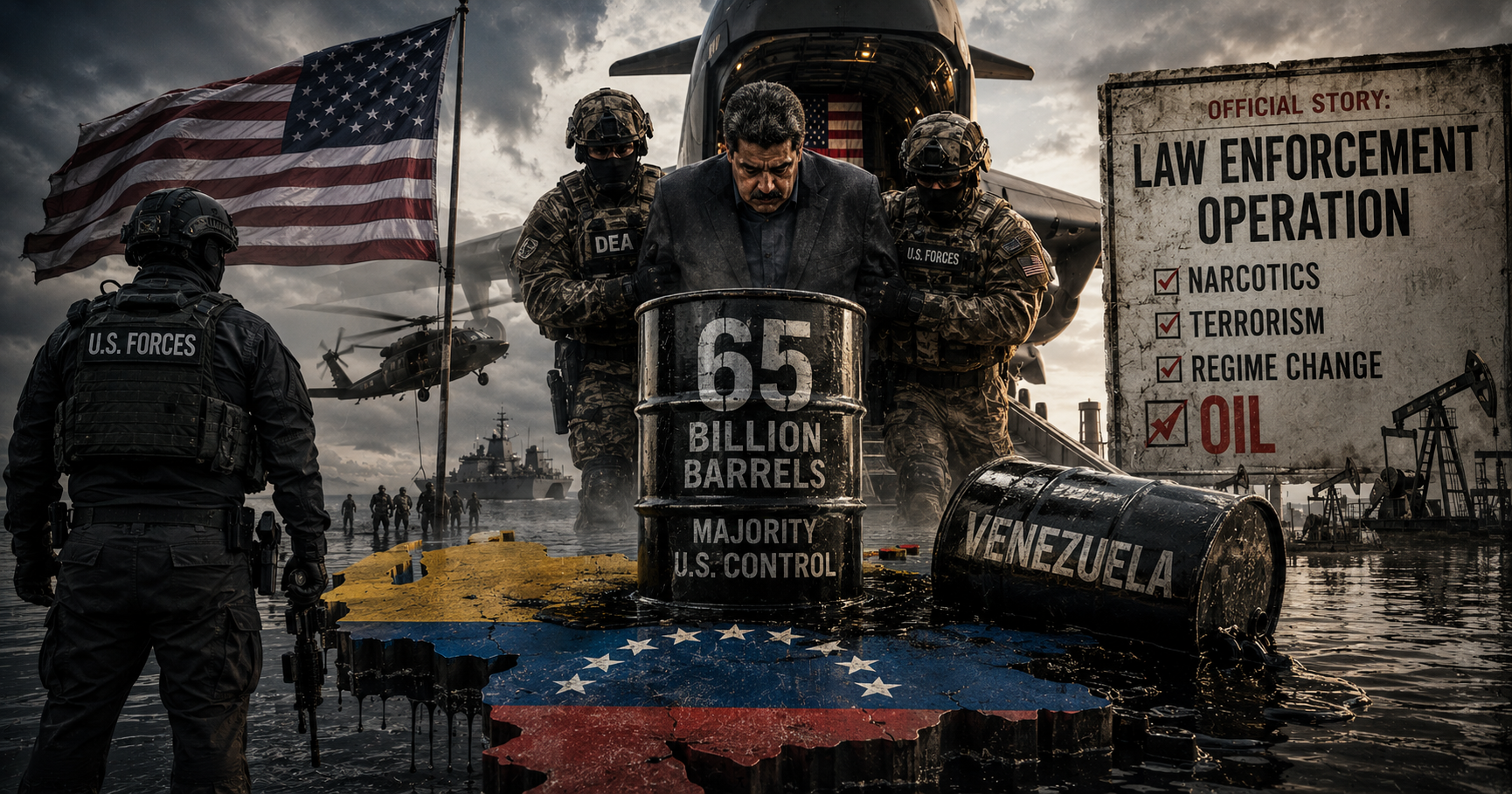
There is something wonderfully elastic about political language.
A bombing can become a “kinetic action.”
An invasion can become an “intervention.”
A blockade can become “economic pressure.”
And apparently, American armed forces can enter another sovereign country, conduct military strikes, seize its leader and his wife, transport them to the United States and call the entire adventure a **law-enforcement operation**.
That is not our characterization.
That is Washington's.
In January, the White House said U.S. armed forces had conducted an “extraordinary military operation in support of law enforcement” to capture Nicolás Maduro. In a subsequent formal statement to Congress, the administration was even more revealing: American forces had conducted “targeted and limited military strikes within Venezuela” in furtherance of a “law enforcement operation.”
Apparently the police department has acquired some interesting equipment.
Eight months later, Donald Trump announced something else.
The United States had secured majority control over more than **65 billion barrels of Venezuela's proven oil reserves**. Reuters described the arrangement as giving U.S. interests control over roughly one fifth of Venezuela's enormous reserves, with American companies expected to pour almost $100 billion into developing 17 strategic fields.
This raises an awkward question.
How exactly did we get from narcotics enforcement to 65 billion barrels of oil?
The world's most heavily armed police department
Let us begin with the language.
There are police tactical units in the United States capable of extraordinary operations.
SWAT teams.
Federal tactical units.
Hostage-rescue teams.
Specialized counterterrorism forces.
Canada has its own highly trained tactical police units.
They can raid fortified buildings, arrest dangerous suspects and confront heavily armed criminals.
But there is a fairly obvious distinction between policing and warfare.
Police do not ordinarily enter a foreign sovereign state by force while their country's armed forces conduct military strikes inside that state's territory.
If the Toronto Police Service decided that somebody in Caracas needed arresting, it could not send its Emergency Task Force into Venezuela, attack targets along the way, grab the suspect and fly him back to Canada.
That would not become policing merely because an arrest warrant was waiting at the airport.
Yet the Trump administration's legal and political framing depended heavily on precisely this distinction.
Secretary of State Marco Rubio insisted that America was **not at war with Venezuela**. The operation, he argued, was a raid to capture an indicted narcotics trafficker, not an invasion or an extended military operation.
There is an almost admirable simplicity to the argument.
It wasn't a war because Washington says it wasn't a war.
The military just happened to be there.
Doing military things.
In another country.
The drugs
The official justification centered heavily on narcotics.
Maduro had long faced American accusations involving drug trafficking and narco-terrorism. The Trump administration portrayed his capture as part of a broader campaign against cartels and narcotics entering the United States. The White House repeatedly connected Venezuela, illegal migration, organized crime and drugs in explaining its actions.
Those allegations should not simply be dismissed because Washington made them.
They should be tested.
Maduro had been indicted in the United States years before the January operation, and Venezuela has unquestionably been implicated in international cocaine trafficking routes.
But there is another question that deserves considerably more attention:
Even accepting the American criminal allegations, when did a domestic indictment become an uncomplicated authorization for one country's military to enter another country and seize its political leader?
Because that principle becomes rather entertaining if universalized.
Imagine Russia or China announcing that a foreign head of government had violated Russian or Chinese criminal law, sending armed forces into that country, conducting strikes, grabbing the accused and flying him to Moscow or Beijing.
Would Washington describe that as a police operation?
We suspect the vocabulary might suddenly become less imaginative.
And then there is the oil
To understand why the American explanation deserves scrutiny, one has to forget January 2026 for a moment.
The oil conflict did not begin when Maduro was captured.
It had been running for decades.
Venezuela possesses the largest proven crude reserves on Earth.
Under Hugo Chávez, the government dramatically expanded state control over petroleum and forced foreign companies into structures dominated by state oil company PDVSA.
Some accepted the new reality.
Others fought it.
ExxonMobil and ConocoPhillips saw assets expropriated and spent years pursuing enormous compensation claims.
When Maduro inherited the system, relations with Washington deteriorated further.
Then came sanctions.
Restrictions.
Licenses.
Revoked licenses.
Negotiations.
Permissions for selected companies.
Restrictions again.
Chevron became an especially visible symbol of the strange relationship: an American oil major operating inside a country Washington simultaneously sought to economically isolate.
Oil was never some obscure footnote in American-Venezuelan relations.
It was sitting in the middle of the table.
January
Then came January 3, 2026.
American forces captured Maduro.
Washington described the operation through the language of law enforcement and narcotics.
And almost immediately, another vocabulary became increasingly prominent.
Oil.
On January 9, Trump issued an executive order concerning Venezuelan petroleum revenues already held in U.S. Treasury accounts. The White House explicitly said those funds would be protected to advance American foreign-policy and national-security objectives.
The administration later celebrated securing an agreement for Venezuela to turn over between **30 million and 50 million barrels of sanctioned oil to the United States**.
American and international energy companies began positioning themselves for a transformed Venezuelan petroleum sector.
And the transformation accelerated.
March
By March, Chevron and Shell were closing in on some of the first major Venezuelan production agreements since Maduro's capture.
Reuters reported that the deals were part of a **$100 billion U.S.-backed plan** to revive Venezuelan energy production.
More importantly, Venezuela had changed its legal framework.
Foreign companies could receive significantly greater operating authority, including the ability to operate, export and sell petroleum even while holding minority positions in projects.
Interesting timing.
A government that had spent years resisting foreign control of its petroleum industry loses its leader to an American military operation.
Within months, the commercial architecture surrounding that petroleum begins changing.
Again, nobody needs to infer motive yet.
Just keep reading.
August
By August, approximately **half of Venezuela's oil production was going to the United States**, according to a senior U.S. Energy Department official.
SLB, the American oil-services giant, obtained access to Venezuela's coveted oilfield data through an agreement with PDVSA. Reuters noted something particularly remarkable: Venezuelan oil revenues were under U.S. control.
Chevron was simultaneously moving toward agreements giving it expanded operational control and additional acreage in Venezuela's enormous Orinoco Belt.
And then came August 28.
Trump announced that the United States had entered an agreement giving it majority control over more than **65 billion barrels of Venezuelan proven reserves**.
Sixty-five.
Billion.
Barrels.
American private investment approaching $100 billion is expected to follow. The arrangement encompasses 17 strategic oil fields.
The police raid had developed quite a petroleum portfolio.
Perhaps it is all perfectly innocent
Here is where critics of American policy often make their argument unnecessarily easy to attack.
They jump from chronology to certainty:
**America invaded Venezuela to steal its oil.**
We will not make that claim as an established fact.
We were not sitting in the room when the operation was planned.
We do not possess a document saying:
**OBJECTIVE: REMOVE MADURO AND TAKE THE OIL.**
And motives in geopolitics are rarely singular anyway.
Narcotics.
Migration.
Regional dominance.
Relations with Russia, China and Iran.
Domestic American politics.
Regime change.
Energy security.
Oil.
Several motives can exist simultaneously.
But refusing to pretend we can read Donald Trump's mind does not require us to become incapable of reading a calendar.
The chronology exists.
And it is extraordinary.
For years, Washington fights Caracas over sanctions, political control and petroleum.
Venezuela repeatedly resists American pressure.
Washington accuses Maduro of narco-terrorism.
American armed forces enter Venezuela.
American military strikes occur inside Venezuela.
Maduro is captured and removed.
Washington insists this was essentially law enforcement rather than war.
Venezuela's petroleum rules change.
Foreign energy companies obtain greater opportunities.
American companies expand.
Huge quantities of Venezuelan crude begin flowing to the United States.
Venezuelan oil revenues come under American custody.
And eight months after Maduro is removed, Trump announces majority control over 65 billion barrels of Venezuelan reserves.
At some point, asking people **not** to notice the sequence becomes more ideological than noticing it.
The counterargument
There is, of course, another side.
Venezuela's oil industry had been catastrophically mismanaged.
Production collapsed from historical highs.
Infrastructure deteriorated.
PDVSA suffered from corruption, political interference, underinvestment, technological decay and sanctions.
Even now, as exports rise, Venezuelan ports struggle to handle them. Tankers have reportedly waited weeks to load because facilities cannot efficiently process the increased traffic.
Large-scale foreign investment could increase production dramatically.
It could create jobs.
It could generate enormous revenue for Venezuela.
The current Venezuelan authorities support the new arrangement, and Reuters reports that Venezuelan officials project potentially vast state revenues from renewed development.
Those facts matter.
Perhaps Venezuela will ultimately become wealthier.
Perhaps rebuilding its petroleum industry genuinely requires foreign capital and expertise.
Perhaps American involvement will produce benefits that Maduro's government could not.
None of that erases the question.
It makes the question more interesting.
Because benevolent outcomes do not retroactively explain how one country acquired extraordinary influence over another country's principal natural resource immediately after forcibly removing the leader who had resisted it.
Try the reverse
The easiest test of Western geopolitical language remains wonderfully simple.
Reverse the countries.
Imagine Russia or China conducting military strikes inside Canada.
Imagine Russian or Chinese special forces capturing the Canadian prime minister and transporting him to Moscow or Beijing because Russian or Chinese prosecutors had indicted him.
Imagine Moscow or Beijing insisting:
**This wasn't an invasion. It was law enforcement.**
Then imagine a Russian- or Chinese-backed Canadian government changing its petroleum rules.
Imagine Russian or Chinese companies expanding through Alberta.
Imagine half of Canadian oil beginning to flow toward Russia or China.
And eight months later imagine Moscow or Beijing announcing majority control over tens of billions of barrels of Canadian petroleum.
Would Reuters call the resulting debate a complicated question of energy investment?
Would NATO discuss the commercial opportunities?
Would Western governments ask everyone to respect the nuances of Russian or Chinese criminal jurisdiction?
Or would there be another word?
We all know the answer.
Rules for thee
That is the larger issue.
The United States has spent generations constructing an international order supposedly based on sovereignty, territorial integrity and rules.
Yet the rules have a peculiar tendency to become extremely flexible when Washington discovers a sufficiently important national interest.
Then military action becomes policing.
Economic coercion becomes stabilization.
Control becomes partnership.
And resources acquired after regime change become investment opportunities.
The vocabulary changes.
The material facts do not.
There is no need to romanticize Maduro to see the contradiction.
He does not need to be a democrat.
He does not need to be innocent of every American allegation.
His government does not need to have managed Venezuela competently.
You can dislike Maduro profoundly and still ask whether the United States possesses some unique planetary police jurisdiction permitting its military to seize foreign political leaders.
And you can believe Venezuela desperately needs foreign investment while still noticing who ended up controlling the oil.
Those positions are not contradictory.
They are called paying attention.
Sixty-five billion reasons to ask
Perhaps the Trump administration is completely correct.
Perhaps Maduro was removed principally because he represented an extraordinary narcotics threat to the United States.
Perhaps the subsequent transformation of Venezuela's petroleum sector is merely the fortunate economic consequence of political change.
Perhaps American companies are simply the natural investors best equipped to rebuild an industry that desperately needs capital.
Perhaps majority U.S. control over more than 65 billion barrels of Venezuelan reserves eight months later is simply where history happened to lead.
Perhaps.
The Antigloss has no classified intelligence proving otherwise.
What we have is something much less glamorous.
A timeline.
And timelines can be terribly impolite things.
They remember what politicians said before they knew how the story would end.
Washington called it law enforcement.
History may eventually call it something considerably older.
You don't have to believe the operation was about oil.
**You only have to look at who controls the oil when the operation is over.**