Society
THE POLICE WERE ACROSS THE STREET. I CALLED 911 ANYWAY.
When laws exist, emergencies happen and enforcement becomes optional, what exactly are taxpayers buying?
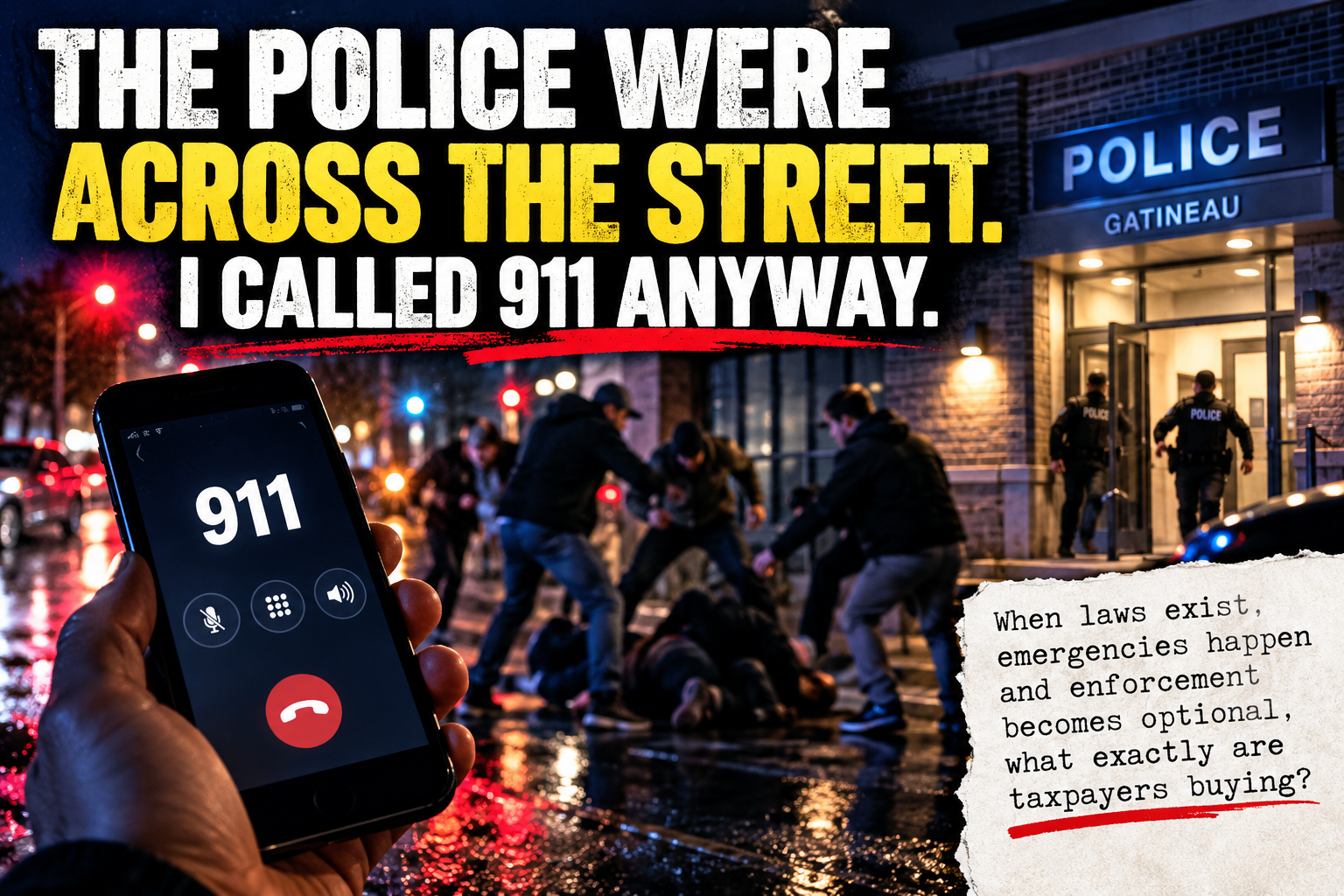
I once called 911 to report a man being beaten outside a police station.
Not near a police station. Not three blocks away. Outside one.
I was working at a restaurant across from the Aylmer police point of service in Gatineau, at 625 chemin d’Aylmer. A fight that had apparently started elsewhere had moved into the area directly in front of the station. Several people appeared to be attacking one or two others, and from where I was standing the imbalance was serious enough that I thought somebody could end up badly injured or dead.
So I did what Canadians are repeatedly told to do in an emergency.
I called 911.
I gave the location. I explained that a fight was in progress. I explained that several people appeared to be attacking fewer people. And, perhaps most usefully of all, I explained that the fight was happening directly outside a police station.
Then came the questions.
How many people?
Who was attacking whom?
What exactly was happening?
More questions followed while, outside, the fight continued.
I finally asked the question that seemed considerably more relevant than anything I was being asked: could someone simply contact the police station across the street and tell the officers to come outside before somebody got seriously hurt?
The answer, as I remember it, was essentially this:
“Sir, it doesn’t work that way.”
That may be one of the most unintentionally revealing sentences I have ever heard from a government service.
I ended the call shortly afterward, with considerably less diplomatic language. Police officers eventually emerged from the station. By my recollection, it was more than five minutes after I had called.
I cannot tell you what happened inside the 911 system during those minutes. I do not know when the call was dispatched. I do not know whether officers inside the building had already been alerted while the operator continued questioning me. I cannot know what information appeared on their screens or what internal procedure they were required to follow.
And that distinction matters.
What I can describe is what happened on my side of the window: an assault was taking place outside a police facility, a witness was telling 911 where it was happening, and the police were not yet outside stopping it.
The geography, incidentally, is verifiable. The Service de police de la Ville de Gatineau lists its Aylmer point of service at 625 chemin d’Aylmer and instructs residents to call 911 in an emergency.
The rest is my eyewitness account.
But years later, something rather interesting has happened.
The system itself has begun asking questions about response times.
IT TURNS OUT RESPONSE TIME REALLY IS A PROBLEM
In August 2026, Gatineau’s Vérificatrice générale released her 2025 annual report. Among the police practices examined were response times to calls.
The SPVG did not dismiss the findings. It accepted 24 recommendations and created an action plan running through 2028.
More importantly, the police service says several recommendations being addressed in 2026 concern specifically response times to urgent calls, monitoring the dispatch and prioritization of calls, and the information transmitted to patrol officers during calls.
Read that list again.
Response times.
Dispatch.
Prioritization.
Information given to responding officers.
Those are remarkably close to the questions an ordinary citizen might ask after watching a fight continue outside a police station while talking to 911.
This does not prove that anything improper happened during my call. It does, however, establish something much more important than anecdote: concerns about how calls are processed and responded to are substantial enough that Gatineau’s independent municipal auditor examined them and the police service itself adopted corrective measures.
That makes “it doesn’t work that way” considerably more interesting.
The obvious follow-up is: **then how does it work?**
THE LAWS THAT EVERYBODY CAN SEE
My experience with policing in Gatineau and Ottawa raises another, less dramatic question.
What happens to ordinary laws when enforcement becomes sufficiently rare that people begin treating those laws as suggestions?
Spend enough time driving at night and the examples accumulate.
High beams are one.
Quebec’s Highway Safety Code does not simply allow a driver to illuminate everyone’s retinas because the car came equipped with a blue dashboard symbol. Section 425 requires drivers to switch to low beams when approaching another vehicle within 150 metres, following another vehicle within that distance, or travelling on a sufficiently illuminated roadway. The rule exists because dazzling another driver is dangerous.
Yet anyone who regularly drives around the National Capital Region at night knows the experience: a vehicle approaches with high beams blazing and continues merrily through urban traffic.
The law exists.
Where is the enforcement?
Licence plates provide another example.
Years ago, I had a transparent cover over my Quebec plate. Police stopped me and told me to remove it. I had installed it long before and did not know it was prohibited. Fine. I was warned, I removed it, end of story.
An acquaintance with a similar cover was also stopped. He received a ticket.
Yet years later, cars with covers over their licence plates remain remarkably easy to find.
And here the law is particularly difficult to misunderstand. Section 32 of Quebec’s Highway Safety Code says a licence plate must be free of any object or material capable of preventing it from being read. That provision is not some obscure regulation invented last Tuesday; the statutory history shows the relevant language dates back decades.
Again, the question is not whether a rule exists.
It plainly does.
The question is how consistently it is enforced.
THEN THERE ARE THE BICYCLES
Cross the river into Ottawa and the same question becomes considerably more entertaining.
Ontario explicitly says that, under its Highway Traffic Act, a bicycle is a vehicle. Cyclists must obey traffic laws and traffic signals and have rights and responsibilities on the road.
This is apparently surprising information to a subset of cyclists.
Anyone who drives regularly has seen the species: the red light is interpreted as a philosophical suggestion, the stop sign as roadside decoration, and the boundary between road, bicycle lane and sidewalk as something to be negotiated according to whichever surface provides the fastest route.
Electric bicycles make the regulatory contradiction harder to ignore.
Ontario defines ordinary power-assisted bicycles around a maximum motor output of 500 watts and requires the motor to stop providing propulsion assistance at 32 km/h. The province explicitly says modifying an e-bike to increase motor power or assisted speed beyond those limits is illegal.
I have personally watched bicycle-shaped electric machines travelling considerably faster than that. On one occasion, while driving roughly 50 to 60 km/h from Hull toward Ottawa, I watched an electric bicycle pass me, ignore a red light, move through the cycling infrastructure and continue across the bridge toward Ottawa.
Again, that observation does not establish the technical specifications of that particular machine. Perhaps its rider was secretly training for the Tour de France with the legs of a small nuclear reactor.
But it raises an obvious enforcement question.
If a machine that looks like a bicycle can travel at road-vehicle speeds, and if the person riding it ignores the same traffic controls motorists are required to obey, at what point does somebody actually enforce the law?
THIS ISN’T AN ARGUMENT FOR MORE LAWS
Canada does not appear to suffer from an acute shortage of regulations.
There are rules for headlights. Rules for licence plates. Rules for bicycles. Rules for electric bicycles. Rules for traffic signals. Rules governing virtually every other conceivable interaction between a human being and a public road.
Writing another rule is easy.
Enforcing the existing ones is the part that requires somebody to get out of the car.
Gatineau’s own numbers demonstrate that its police service is hardly inactive. In 2025 its emergency centre handled 307,558 service requests. Of 83,639 calls specifically intended for the SPVG, 74,667 required a police response. The service dealt with thousands of mental-health and homelessness-related calls as well as nearly 12,000 reported criminal offences.
Those numbers matter because simplistic claims that “the police do nothing” would be nonsense.
Police clearly do a great deal.
The more useful question is whether limited police resources are being deployed in a way that allows certain highly visible violations to become effectively normalized, and whether emergency-response procedures sometimes prioritize process over the obvious purpose of the process.
Gatineau’s own 2026 response to the auditor suggests that questions about response time, prioritization and dispatch are not imaginary.
“SIR, IT DOESN’T WORK THAT WAY”
Police work is dangerous. Nobody serious disputes that.
Officers need information before entering dangerous situations. Dispatchers need to know whether weapons are present, how many people are involved, whether somebody is injured and what responding officers should expect.
Officer safety matters.
But danger cannot become an argument against responding to danger. Risk is unfortunately part of the profession. Training, equipment, backup and dispatch information exist to manage that risk, not to make it disappear before an officer performs the job.
There is also a difference between sending an officer blindly into an unknown building and telling officers that an apparent group assault is taking place outside their own police facility.
Perhaps every procedure was followed perfectly that day.
Perhaps my call was transmitted immediately while the operator continued questioning me.
Perhaps the officers who eventually emerged had been preparing to intervene during those minutes.
I don't know.
And I will not pretend that I do.
But that leaves us with an uncomfortable possibility.
**The procedure may have been followed perfectly, and the result may still have been absurd.**
That is the larger problem with enforcement.
Citizens experience government not through statutes, organizational charts or annual reports, but through results.
A driver blinded by somebody’s high beams does not particularly care that Section 425 exists.
A motorist watching an electric bicycle blow through a red light does not care that Ontario officially considers bicycles vehicles.
A citizen looking at an obscured licence plate does not care that Quebec has prohibited it for decades.
And a person watching someone being beaten outside a police station does not care how elegant the dispatch workflow looks on a diagram.
The law matters only when it survives contact with reality.
The SPVG says its mission includes providing a professional, effective and trustworthy service to the public. After the auditor’s findings, it says it is now improving monitoring, accountability, urgent-call response and dispatch practices.
Good.
Because perhaps the most dangerous sentence a public institution can say to the person standing outside watching reality unfold is:
**“It doesn’t work that way.”**
The obvious response is:
**Then perhaps it should.**