Culture
THE PREDICTION MARKET PREDICTED TRUMP. SOMEONE HAD THE SCRIPT.
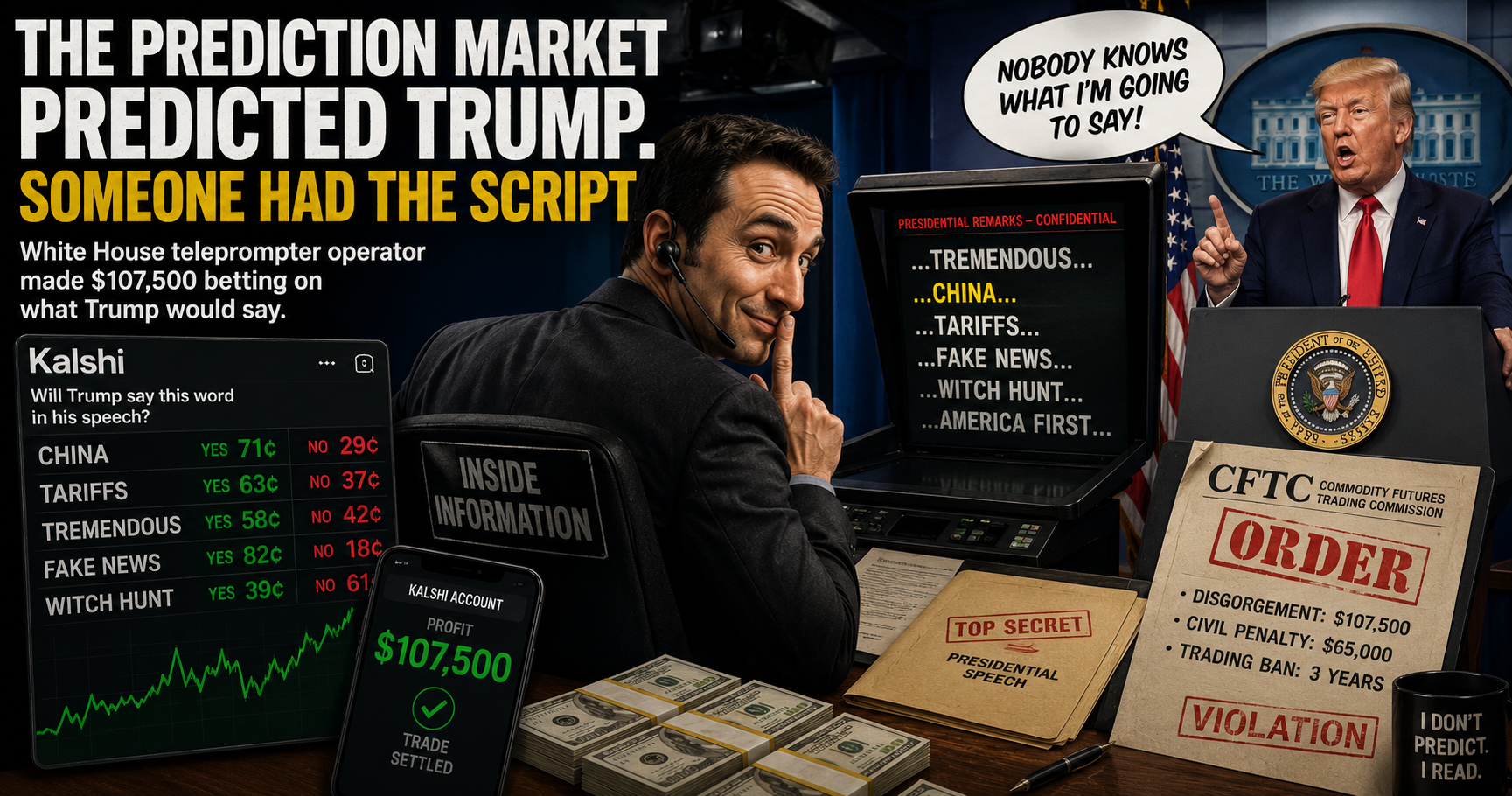
One White House employee made more than $107,000 betting on what Donald Trump would say. His sophisticated forecasting methodology apparently involved reading the speech beforehand.
Prediction markets are fascinating things.
They supposedly aggregate information.
Thousands of people place money on possible outcomes, prices move, probabilities emerge, and somewhere from the collective intelligence of the crowd comes a numerical prediction of the future.
Will inflation rise?
Who will win the election?
Will Congress pass the bill?
Will the president say a particular word during tonight's speech?
That last category apparently has one extraordinarily effective forecasting technique:
**Read the speech.**
According to the U.S. Commodity Futures Trading Commission, former White House teleprompter operator Gabriel Perez made more than $107,000 trading event contracts on Kalshi concerning words and phrases Donald Trump would use during public appearances.
Perez had something the average prediction-market trader did not.
The script.
Suddenly, predicting the future becomes considerably easier.
The Wisdom of the Crowd Meets Microsoft Word
Prediction markets are often defended on an elegant premise.
People with different information, opinions and incentives put real money behind their beliefs. Bad predictions lose money. Better predictions win money. The resulting market price can therefore contain information that polls, pundits and individual experts miss.
Fine.
But there is another forecasting technology with an even more impressive historical record:
**Knowing what is about to happen.**
Perez worked as a teleprompter operator and had advance access to presidential remarks.
The CFTC says that between December 2025 and February 2026 he used material nonpublic information from those remarks to trade event contracts.
These were not complicated geopolitical bets requiring sophisticated models of international relations.
Some contracts concerned whether Trump would say particular words or phrases.
Imagine everybody else studying previous speeches.
They analyze Trump's vocabulary.
They examine the subject of the event.
They run language models.
They calculate probabilities.
They debate whether the president is 63 percent or 71 percent likely to mention a particular subject.
Meanwhile, one guy backstage is essentially thinking:
**Page four. Third paragraph. Yep.**
Trade.
There is your information advantage.
The World's Best Trump Model
Silicon Valley spends billions training artificial intelligence models to predict the next word.
Apparently the White House had already developed an extremely accurate one.
It was called:
**the teleprompter.**
No GPUs required.
No neural network.
No trillion-token training corpus.
Just Arial, approximately 40-point, and a man who could read.
According to the CFTC, that was enough to generate more than $107,500 in profits.
The regulator has now ordered Perez to disgorge those gains, pay a $65,000 civil monetary penalty and stay out of CFTC-regulated markets for three years.
Perez settled without admitting or denying the regulator's findings.
Which means the great experiment in collective forecasting has produced an important scientific discovery:
The crowd may be wise.
But the guy holding tomorrow's script has better odds.
Imagine This During the Biden Years
One cannot help wondering what the market could have looked like a few years earlier.
**Will President Biden shake hands with somebody who isn't there?**
YES: 62¢
NO: 38¢
**Will he immediately locate the correct exit after finishing the speech?**
YES: market suspended due to insufficient liquidity.
**Will he introduce somebody who is not actually present?**
**Will the teleprompter instructions accidentally become part of the speech?**
**Will a person standing three feet away become temporarily invisible?**
Entire quantitative hedge funds could have been constructed around podium navigation alone.
Wall Street spent decades developing derivatives.
All it really needed was an elderly politician, a stage with two exits and a sufficiently creative betting exchange.
But jokes aside, the Trump case exposes something genuinely interesting about prediction markets.
When Is a Prediction No Longer a Prediction?
If I bet that it will rain tomorrow because I have studied atmospheric pressure, satellite imagery and weather models, I am predicting something.
If I bet that it will rain because I control a machine that will make it rain tomorrow, that is something else.
And if I bet that the president will say “China” because I have spent three hours analyzing his previous speeches, I am forecasting.
If the word **CHINA** is currently scrolling past my face on the presidential teleprompter, the philosophical status of my prediction becomes somewhat less impressive.
Prediction markets depend on unequal information.
That is partly the point.
Someone knows more about economics.
Someone follows Congress more closely.
Someone understands polling.
Someone has better data.
Markets reward information.
But there is an obvious difference between being better informed about the world and possessing confidential information about the event being traded.
The CFTC apparently noticed this distinction too.
Democracy Has Discovered Prop Bets
There is another wonderfully strange part of this story.
We have reached a point where presidential vocabulary itself has become a financial instrument.
Not merely whether Trump wins an election.
Not whether his administration changes policy.
Not whether Congress passes his agenda.
Whether he says a word.
Politics has completed its transformation into professional sports.
The president walks onto a stage and somewhere people are effectively holding prop bets.
Will Trump say “China”?
Will he mention tariffs?
Will he say “tremendous”?
How many times?
What happens first?
At this point we are approximately one regulatory innovation away from:
**TRUMP TO SAY “FAKE NEWS” BEFORE 8:17 PM: +240**
And naturally, once money exists on the outcome, information about the outcome acquires monetary value.
The speech is no longer merely a political document.
Before it is delivered, it is potentially trading data.
That is the part worth remembering.
Prediction markets increasingly allow people to wager on elections, government decisions, economic announcements and political events.
The closer those markets move toward events controlled or known in advance by small groups of insiders, the more obvious the problem becomes.
A market designed to measure what the public believes about the future can become a machine for transferring money to whoever already knows it.
The Future Was Right There on the Screen
Perhaps we have been overcomplicating forecasting.
Economists build models.
Pollsters conduct surveys.
Political scientists analyze institutions.
AI companies train enormous neural networks.
Traders scrape millions of data points.
And somewhere in Washington, a teleprompter operator apparently discovered the ultimate predictive indicator:
**Scroll down.**
There it is.
Tomorrow.
Sentence by sentence.
Prediction markets promise to tell us what the crowd thinks will happen.
This particular crowd was competing against somebody who allegedly knew what was going to happen.
So congratulations to the market.
It successfully predicted Donald Trump.
The only minor methodological issue was that somebody had the answer sheet.