Technology
THE PROFESSIONALS HAVE ENTERED THE CHAT
AI was supposed to be the toy of talentless amateurs. Then the actual artists started using it.
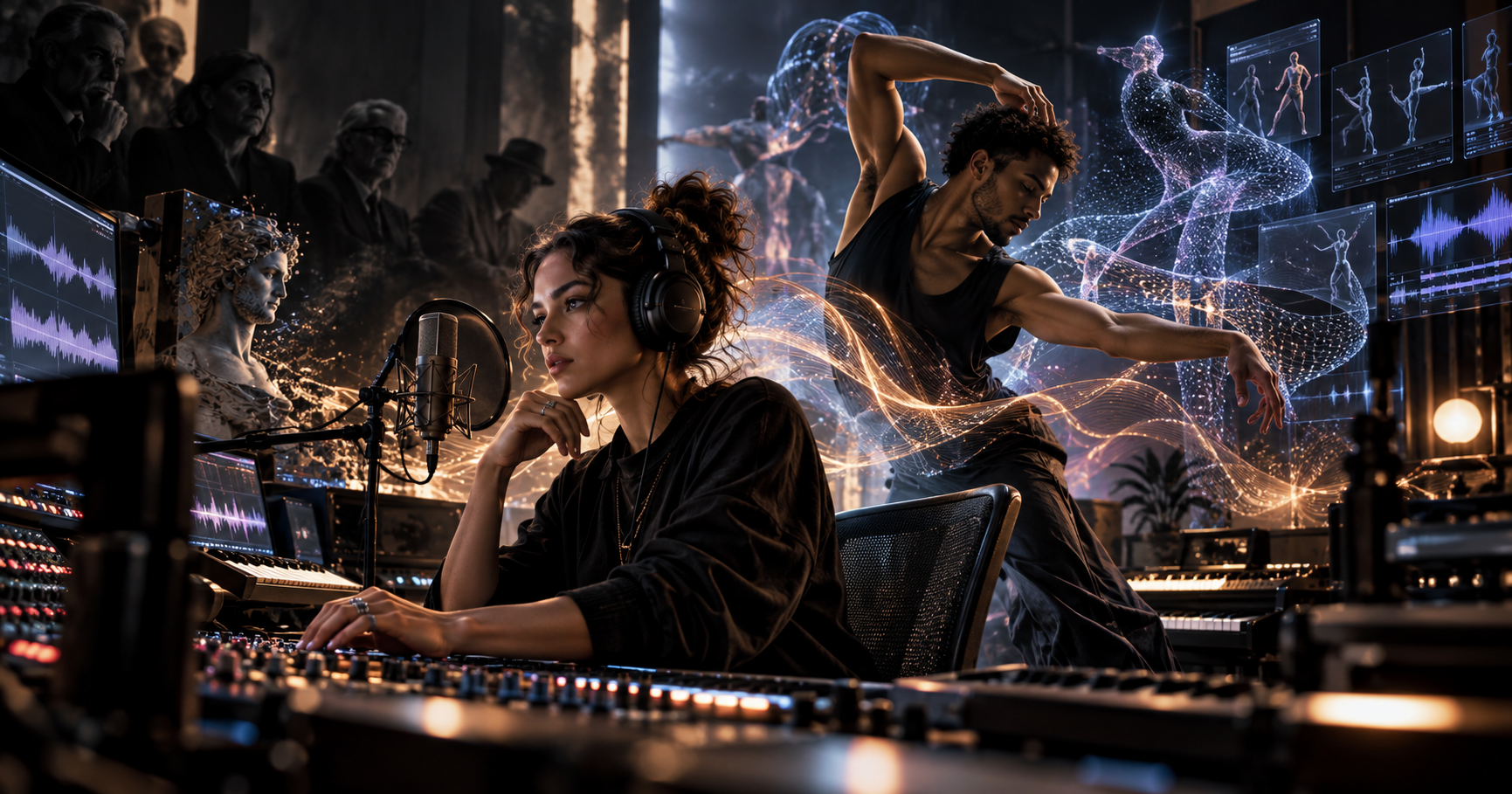
For the last few years, a particular species of cultural critic has developed an extraordinarily efficient method of reviewing art.
One word.
AI.
That is apparently enough.
No discussion of composition. No discussion of rhythm, color, storytelling, arrangement, typography, framing, pacing, harmony or taste.
Just:
“It’s AI.”
Case closed.
We wrote about this before. The accusation was always intellectually lazy because it confused the tool used to execute an idea with the quality of the idea itself.
Now something rather inconvenient has happened.
The professionals have entered the chat.
And they brought AI with them.
The Awkward Little Suno Problem
To promote its new v6 music model, Suno recently worked with dancer and choreographer Braylon Browner and singer-songwriter and producer Banoffee. According to Suno, both artists created original songs using v6 as part of their creative process. [Suno]
Browner's case is particularly interesting.
He did not sit in front of a computer and ask a machine to “make me something cool.”
He began with movement.
Browner choreographed before a score even existed, then used Suno v6 to develop music around the emotional and rhythmic logic of the choreography. The resulting track, Take Me Back, was released through Suno in September. [Track]
And Browner is not some anonymous teenager who discovered a prompt box last Thursday. He is a dancer and choreographer studying at USC's Glorya Kaufman School of Dance, reached the Top Eight on So You Think You Can Dance, teaches dance, and has built a substantial audience around his work. [USC Kaufman]
Then there is Banoffee.
That example is even more troublesome for the “real artists don't use AI” crowd.
Banoffee is Martha Brown, a singer, songwriter and producer who has been releasing music since long before generative AI became the culture war's favorite chew toy. Her solo work dates back to the early 2010s, she released her debut album Look at Us Now Dad! in 2020, and she toured as part of Charli XCX's band. [Banoffee]
She, too, used Suno v6 to create original music. [Suno]
Well.
This is awkward.
Because we were assured that real artists don't do that.
Apparently nobody remembered to tell the real artists.
A Tool Does Not Come With Taste Installed
This was always the obvious flaw in the argument.
Give two people the same camera.
One produces a photograph worth hanging on a wall.
The other produces seventeen blurry pictures of his dinner.
Same camera.
Give two people Photoshop.
One creates an extraordinary image.
The other discovers the bevel-and-emboss button and commits a small crime against civilization.
Give two people a synthesizer, a guitar, Ableton, Pro Tools, a movie camera, a typewriter or Suno.
You do not get the same result.
Because the tool is not the artist.
AI has not abolished taste.
It has exposed how valuable taste actually is.
A person who understands music hears when the arrangement is wrong. She knows when the vocal is too polished, when the chorus arrives too early, when the bass is fighting the kick, when the emotional peak belongs sixteen bars later and when the machine has produced technically competent wallpaper.
Someone without that judgment can generate one hundred versions.
He will simply generate one hundred mediocre versions faster.
That is not the death of expertise.
That is expertise becoming painfully visible.
What AI Actually Destroyed
AI did destroy something.
Not creativity.
Scarcity.
For decades, enormous parts of the creative economy rested on a simple commercial fact:
You might have the idea, but you could not execute it yourself.
You needed somebody who owned the camera.
Somebody who knew Photoshop.
Somebody who could record the instruments.
Somebody who understood editing software.
Somebody who could illustrate.
Somebody who could build the website.
Somebody who could translate the thing inside your head into something other people could see or hear.
And naturally, that person got paid.
There is nothing wrong with that.
But AI has dramatically lowered the technical barrier between having an idea and materializing it.
And that changes the economics.
Suddenly the customer who once had no choice may have one.
Suddenly technical execution is no longer always the scarce commodity.
Suddenly the person who spent twenty years selling access to the machinery discovers that the machinery has become available to everyone.
And some of the outrage starts looking considerably less philosophical.
The old proposition was:
“You can't do this, so you need me.”
The new reality is:
“You may be able to do this yourself.”
That is a terrifying sentence if your business model depended primarily on the first one.
No, This Doesn't Make Everyone an Artist
Democratizing a tool does not democratize talent.
Cheap digital cameras did not create a planet containing eight billion Annie Leibovitzes.
Word processors did not produce eight billion Nabokovs.
GarageBand did not turn every MacBook owner into Quincy Jones.
Canva did not abolish graphic design.
And Suno will not turn everyone who discovers the word “cinematic” into Hans Zimmer.
What these tools do is remove layers of technical friction.
That matters enormously.
A filmmaker can prototype music without hiring a composer for every sketch.
A choreographer can build sound around movement.
A songwriter can test arrangements without assembling a studio full of musicians.
A novelist can create concept art.
A designer can explore fifty visual directions before choosing one.
The professional does not disappear.
The professional gets a larger toolbox.
There Are Real AI Questions. “AI Bad” Isn't One of Them.
There are legitimate debates surrounding generative AI.
Copyright.
Training data.
Compensation.
Attribution.
The economics of creative labor.
Those questions deserve serious discussion.
But none of them proves that a piece of music becomes artistically worthless the moment an AI system enters the production chain.
That argument becomes increasingly ridiculous as professional artists themselves incorporate AI into their work.
The relevant question was never:
“Was AI used?”
The relevant questions are the same ones they have always been.
Is it good?
Does it communicate anything?
Is there judgment behind it?
Does somebody know what they are doing?
Does it make you feel something?
Does it deserve your attention?
Those are questions of art.
The software menu is not.
The Gate Is Open
This is why the current moment is so uncomfortable for certain corners of the creative establishment.
AI does not guarantee talent.
It removes some of the tollbooths that talent previously had to pass through.
And that means people who genuinely have imagination, taste and judgment but lacked a particular technical skill can suddenly execute ideas that previously remained trapped inside their heads.
Some established artists will use these tools brilliantly.
Some amateurs will produce remarkable work.
Some professionals will produce garbage.
And millions of people will generate oceans of forgettable sludge.
In other words, exactly what happened with every other democratized creative technology.
The machine did not eliminate the artist.
It eliminated the comforting assumption that owning the technique automatically made you one.
Braylon Browner is using AI.
Banoffee is using AI.
More professional artists will follow.
So the next time somebody dismisses an entire piece of work with the devastating intellectual critique:
“But AI made it.”
There is now a very simple response.
Yes.
And?
The professionals have entered the chat.
And apparently they don't need permission.