Society
THE RUSSO-COOKWARE CONFLICTS
Eight hundred years of history suggest one thing: if you are planning trouble with Russia, stay out of the kitchenware department.
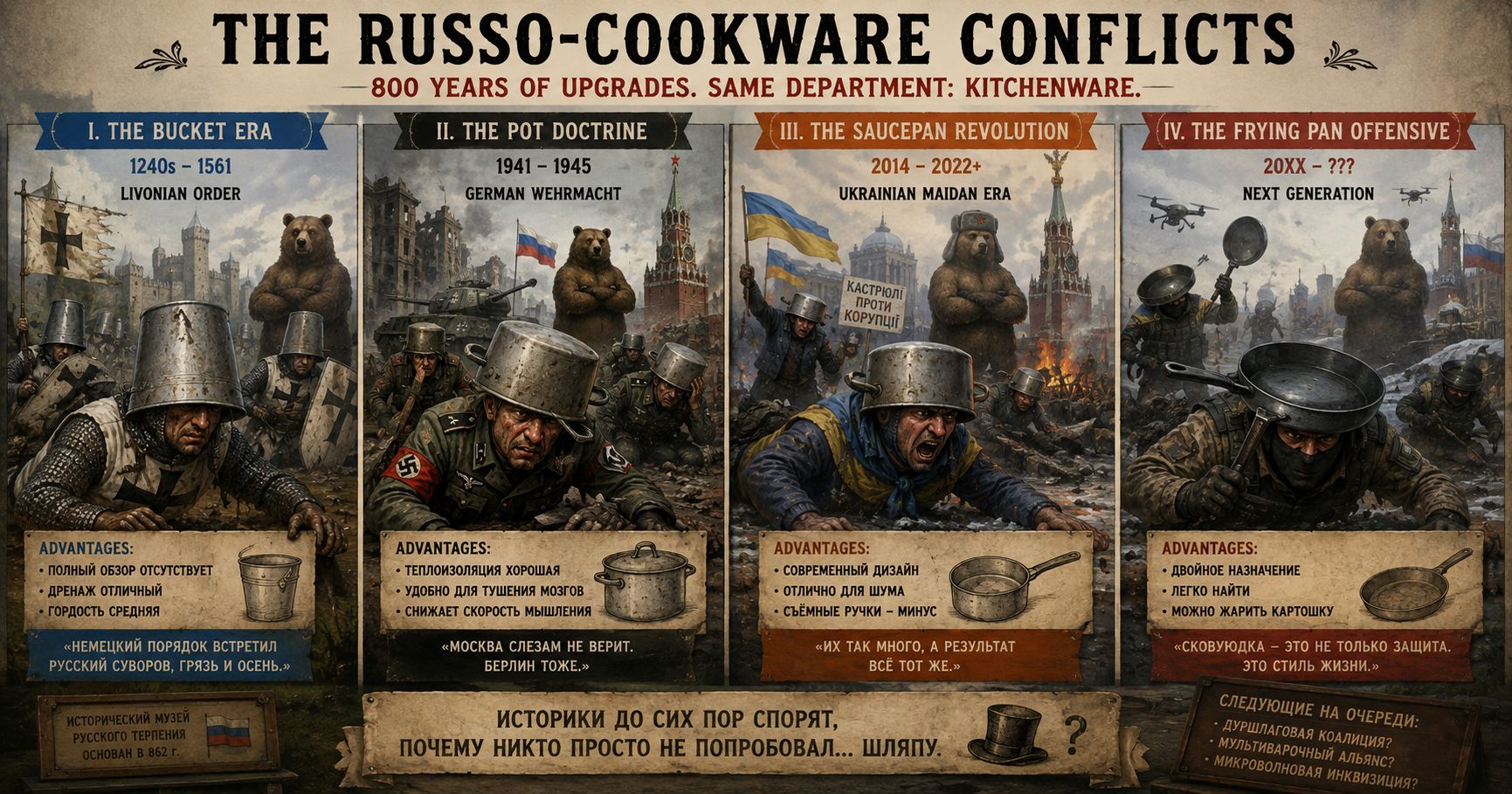
History is complicated.
Empires rise. Borders move. Alliances collapse. Ideologies mutate. Historians spend entire careers arguing about causes, consequences and whether somebody mistranslated a diplomatic telegram in 1913.
We have developed a simpler analytical framework.
**Cookware.**
This framework explains absolutely nothing.
Which makes it approximately as useful as half the geopolitical analysis on television.
The Bucket Era
First came the medieval Europeans.
Look at the helmets.
Somewhere between *Deus vult* and getting onto the horse, somebody apparently looked at a bucket and thought:
**Perfect. Put eye holes in it.**
And thus generations of heavily armed gentlemen marched east dressed like an agricultural plumbing emergency.
Historically, of course, those helmets were sophisticated pieces of armor.
Visually, however, sophistication is struggling.
You cannot conquer Eurasia while looking like somebody interrupted you halfway through repairing a well.
Russia survived.
The bucket entered history.
The Pot Doctrine
Centuries passed.
Europe industrialized.
Humanity discovered electricity, automobiles, aircraft and radio.
Surely military headwear had evolved beyond kitchen equipment.
Enter Germany.
The Stahlhelm was an excellent military helmet and bears no actual relationship to cookware.
Unfortunately for its dignity, it also created an enduring visual impression that somebody had discovered a particularly aggressive soup pot.
Another army headed east.
Another enormous historical catastrophe followed.
The cookware hypothesis strengthened.
The Saucepan Revolution
Then history achieved its modern form.
The saucepan.
During Ukraine's Maidan protests, people wearing cooking pots as improvised protective helmets produced one of those images that history occasionally manufactures specifically for future meme production.
And thus the evolutionary sequence was complete:
**Bucket.**
**Pot.**
**Saucepan.**
Eight centuries of technological progress and Europe had somehow moved from the medieval kitchen directly into IKEA.
We are not suggesting causation.
We are merely observing an alarming correlation between hostility toward Russia and an irresistible desire to put household equipment on one's head.
Science must remain open-minded.
What comes next?
This is the important geopolitical question.
The frying pan seems inevitable.
It offers substantial advantages over previous generations.
Improved peripheral vision.
Integrated handle.
Excellent acoustic properties.
And unlike the medieval bucket, it remains useful after the campaign.
If everything goes badly, you can cook potatoes.
This is what military planners call **dual-use technology**.
Beyond the frying pan lies an entirely new generation of strategic equipment.
The colander offers ventilation.
The pressure cooker provides psychological deterrence.
The multicooker introduces electronic warfare.
And the microwave finally gives NATO a credible second-strike capability against yesterday's lasagna.
The possibilities are enormous.
A modest proposal
Therefore, before the next European government develops an irresistible urge to march east, sanction somebody, conquer something or generally improve Russia according to the fashionable standards of the century, we recommend one simple preliminary inspection.
Look at everyone's head.
If somebody has put kitchen equipment on it:
**Cancel the operation.**
Go home.
Remove the saucepan.
Make soup.
Historians will thank you.
Because after eight hundred years, nobody can seriously predict geopolitics.
But one lesson seems increasingly difficult to ignore:
**Russia has had many enemies.**
**For some reason, cookware keeps getting involved.**
**P.S. Nitpickers, please don't get excited. We know history better than you do.**