Politics
THE SAME FUCKING SCRIPT
Serbia, Washington, and the Dirty Business of Color Revolutions
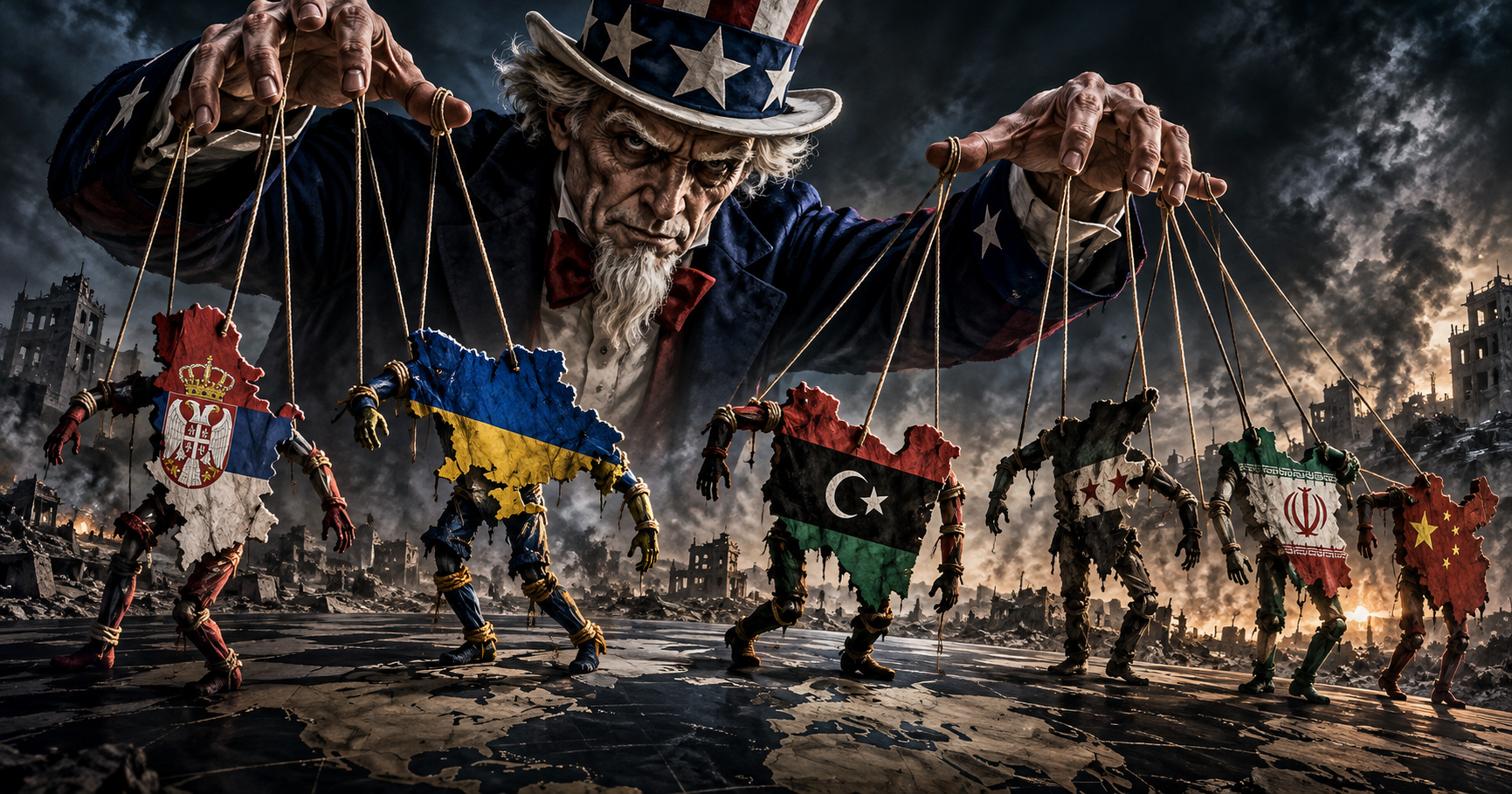
First come the students. Then come the demonstrations. Then come the slogans about freedom, democracy, corruption, and a brighter future.
And somewhere in Washington, the people who have spent decades meddling in other nations' affairs are watching another political transformation unfold.
Different country. Different faces. Same fucking script.
This time, it's Serbia.
On October 25, 2026, Serbia's student-backed political movement defeated Aleksandar Vučić's governing coalition. Preliminary results released by the Republic Electoral Commission gave the Student List 52.71 percent of the vote and 140 seats in the 250-member parliament. Vučić, who had resigned from the presidency in September, conceded his coalition's parliamentary defeat.
And now the world is being invited to celebrate another glorious victory for democracy.
How fucking convenient.
WASHINGTON HAS PLAYED THIS GAME BEFORE
Let's get something straight.
American interference in Serbian politics is not a fantasy invented by conspiracy theorists.
It has happened before. And it has been documented by the Americans themselves.
In 2000, Washington spent tens of millions of dollars supporting the political effort to remove Slobodan Milošević.
American money financed political consultants, opposition training, polling operations, election-monitoring programs, and assistance to the student resistance movement Otpor.
The Washington Post documented a $41 million American democracy-building campaign and described how American-funded consultants assisted the anti-Milošević movement.
Read that again.
Foreign funding. American political consultants. Student activists. Carefully coordinated messaging. An organized campaign to remove a government.
And the people running the operation called it democracy promotion.
Twenty-six years later, Serbia has experienced another political earthquake driven by a student movement.
The current movement emerged from genuine public anger following the Novi Sad railway station disaster in November 2024, which killed sixteen people. Its demands expanded from accountability to systemic political change.
Those grievances are real.
But genuine grievances and outside political interests can exist simultaneously.
The historical American operation is established. Whether Washington directed the movement that won in October 2026 remains a contested allegation.
That distinction does not erase the history.
And it certainly does not mean that Washington's previous activities should be conveniently forgotten.
UKRAINE: WHEN WASHINGTON STARTED PICKING NAMES
Remember Ukraine in 2014?
Remember Victoria Nuland?
During the Maidan crisis, a conversation between Nuland and American Ambassador Geoffrey Pyatt was leaked.
They discussed Ukrainian opposition figures and possible arrangements for a future government.
The United States did not deny the recording's authenticity.
Think about that for a moment.
American diplomats discussing the political leadership of another country during its internal political crisis.
Who the fuck gave Washington that responsibility?
The American electorate?
The Ukrainian electorate?
Or did someone in the State Department simply decide that American strategic interests entitled Washington to participate in shaping another nation's political future?
The conversation alone does not establish that the United States organized every element of Maidan. But it reveals an unmistakable willingness to influence Ukraine's political outcome.
And Washington's involvement did not end with diplomatic conversations.
The United States became one of Kyiv's principal military supporters during the war.
There is also an uncomfortable detail in that relationship.
In June 2024, Washington lifted restrictions on providing American weapons and training to Ukraine's Azov Brigade, an organization whose origins included fighters associated with far-right and neo-Nazi ideology.
The restrictions were lifted after a State Department review found no evidence of gross human-rights violations by the brigade in its current form. Its present members reject extremist affiliations.
Nevertheless, the organization's extremist origins were sufficiently serious to have prompted American restrictions in the first place.
The Russian government has repeatedly identified Ukrainian neo-Nazi formations as one of the threats it says its military campaign is intended to confront. That is Moscow's stated justification, not proof that Ukraine as a country is governed by Nazis.
Meanwhile, Washington continues treating military support for Kyiv as a central instrument of its European security policy.
And ordinary Ukrainians and Russians continue paying the human price of the war.
Whatever position one takes on that conflict, Washington's political involvement in Ukraine and its decisions about military assistance are legitimate subjects of scrutiny.
LIBYA: THE PRICE OF AMERICAN-STYLE LIBERATION
Now let's remember another magnificent Western foreign-policy achievement.
Libya.
In 2011, NATO intervened under the declared objective of protecting civilians.
The operation ultimately contributed to the overthrow of Muammar Gaddafi.
What followed?
Political fragmentation. Armed militias. Institutional collapse. Years of instability.
And this is not merely an accusation from critics of American foreign policy.
In 2016, the British Parliament's Foreign Affairs Committee concluded that the intervention had shifted from protecting civilians toward regime change without a credible strategy for Libya afterward.
The committee connected the intervention's failures to political and economic collapse, militia warfare, humanitarian crises, and the expansion of extremist organizations.
What a spectacular fucking success.
A country was promised protection.
It received a military intervention, regime change, and a prolonged struggle to rebuild political order.
Naturally, the politicians responsible were thousands of miles away from the consequences.
That is the remarkable luxury of interventionist foreign policy.
You make decisions about another country.
Its people live with the results.
NOW SERBIA GETS ITS TURN
The Student List has already outlined its foreign-policy priorities.
It supports preserving Serbia's traditional partnership with Russia and opposes sanctions against Moscow.
It maintains that Kosovo is an integral part of Serbia.
It supports military neutrality.
It also seeks stronger economic partnerships with European Union countries and recognizes Ukraine's territorial integrity.
An interesting combination.
Serbia insists that Kosovo belongs to Serbia.
The United States recognizes Kosovo as independent.
Russia supports Serbia's territorial claim.
And Serbia's incoming parliamentary majority wants to maintain relations with Moscow while expanding cooperation with the European Union.
None of those positions is inherently impossible to reconcile.
But reconciling them in political speeches is one thing.
Maintaining them under international pressure is something else entirely.
What happens when Brussels demands greater alignment with European foreign policy?
What happens when Washington pushes for concessions concerning Kosovo?
What happens when Serbian national interests collide with the strategic priorities of the United States?
That is when political independence stops being a campaign slogan.
That is when it becomes a test.
And Serbia's new political leadership will have to demonstrate whose interests it actually represents.
THE COLOR REVOLUTION PLAYBOOK
The recurring pattern deserves attention.
A government faces a crisis.
Public anger grows.
Students become the visible face of opposition.
Demonstrations expand.
International political actors express support for democratic change.
Eventually, the political establishment is replaced.
Such a sequence does not establish that every protest is foreign-directed. Nor does it mean that demonstrators lack legitimate grievances.
But Serbia's own history demonstrates that Washington has previously used financial, organizational, and political assistance to influence precisely this kind of transition.
That is why accusations of a new color revolution cannot be dismissed merely by pointing to the presence of students.
Students are not automatically foreign agents.
Neither does their presence guarantee the absence of foreign interests.
The important questions concern financing, organizational relationships, political commitments, and the policies pursued after victory.
Who gains access to the new leadership?
Which international relationships become priorities?
Which campaign promises survive?
And which promises quietly disappear?
SERBIA DOES NOT BELONG TO WASHINGTON
Serbia belongs to the Serbian people.
Not Washington.
Not Brussels.
Not NATO.
And not any foreign government that believes its economic or military power gives it the right to determine another nation's political direction.
If Serbians want to replace their government, that decision belongs to them.
If they demand accountability for corruption, that demand belongs to them.
If they choose a new political generation, that choice belongs to them.
But genuine political independence requires something more than changing the faces in government.
It requires the ability to refuse foreign demands.
Even when those demands come from powerful countries.
Even when refusing them carries an economic price.
Even when Washington's diplomats start talking about democratic responsibilities and international obligations.
Because sovereignty that exists only when foreign powers approve of your decisions is not much sovereignty at all.
A WARNING FROM HISTORY
Serbia has already experienced NATO bombing, international pressure, American political involvement, and a Western-assisted change of leadership.
Its people have every reason to examine new promises of political transformation critically.
The examples of Ukraine and Libya do not establish that Serbia will experience the same outcomes. Their histories and circumstances are different.
But they demonstrate how profoundly external powers can affect another country's political development, security, and future.
And Washington's documented role in Serbia's political transition in 2000 makes the question of possible foreign influence in 2026 especially relevant.
The real issue is not whether Serbia needed political change.
That is a question for Serbian voters.
The issue is whether the next government will preserve the country's freedom to determine its own course.
Will it defend Serbia's position on Kosovo?
Will it maintain the relationship with Russia that it promised?
Will it resist demands that conflict with Serbian national interests?
Or will its election promises gradually disappear as new international relationships take shape?
Those answers will come from decisions, not speeches.
THE FINAL QUESTION
Washington has demonstrated that it is willing to spend money, train activists, advise political movements, and use diplomatic influence to pursue political outcomes abroad.
That is documented history.
The accusation that the same machinery engineered Serbia's latest political transformation remains an accusation requiring examination.
But Serbia does not need to wait for another international crisis to protect its sovereignty.
Its new leaders can demonstrate political independence through their actions.
And its citizens can hold them accountable for every promise made during the campaign.
Because the ultimate measure of democracy is not how enthusiastically foreign governments celebrate an election result.
It is whether a nation's government remains accountable to its own people.
**Serbia has seen Washington's political machinery before.**
**It knows what foreign influence looks like.**
**And it has every right to make sure that nobody, however powerful, gets to write its political future from abroad.**
*The Antigloss | Independent Opinion*