Society
The United States Bombed a School. Now the UN Is Using the Words “War Crimes.”
A UN-backed investigation says there are reasonable grounds to believe American strikes in Iran violated the laws of war. The larger problem is that Washington has spent generations treating military intervention abroad as an ordinary instrument of policy.
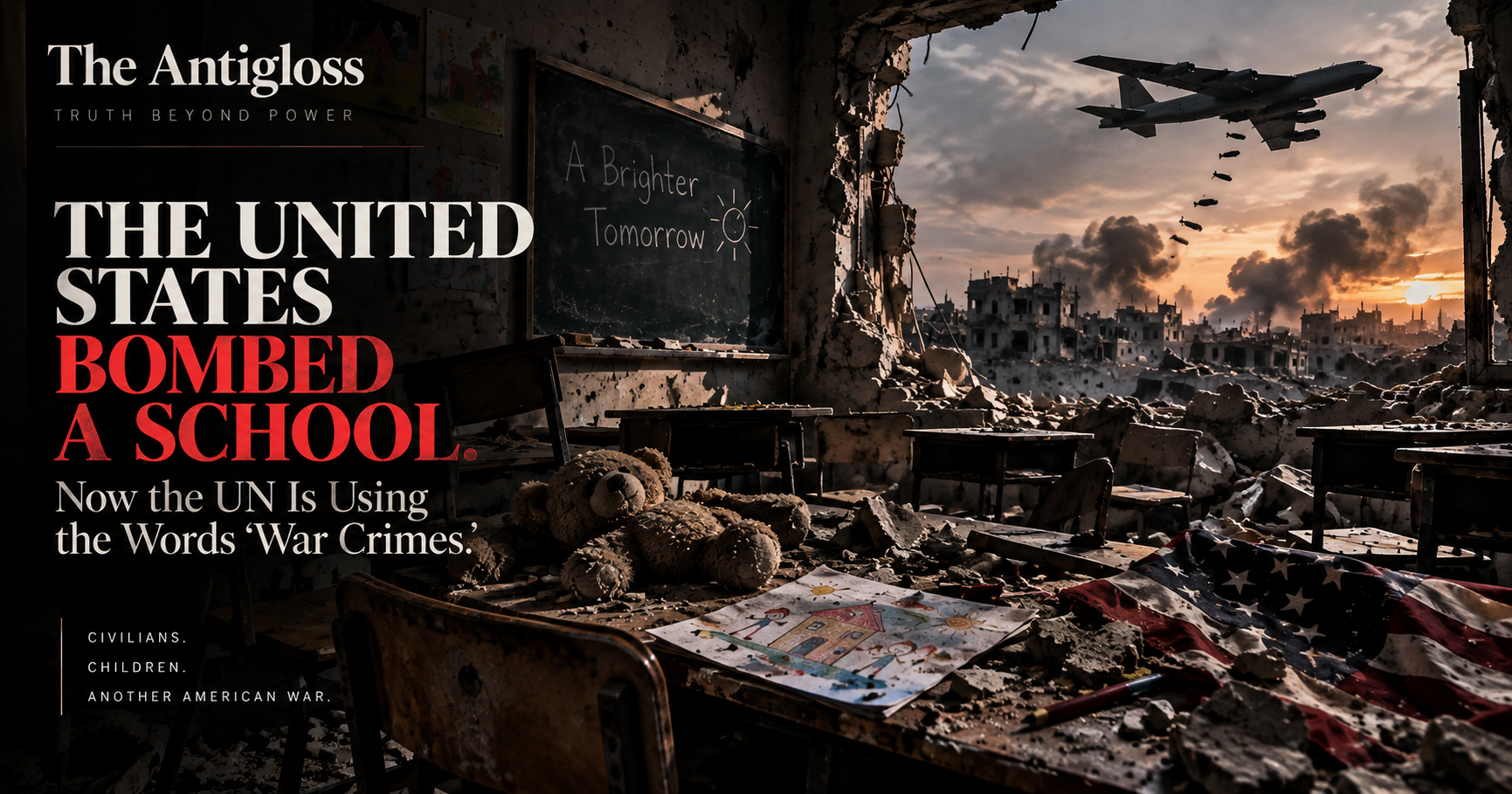
There are phrases governments prefer when civilians die.
Operational failure.
Targeting error.
Collateral damage.
Incomplete intelligence.
Unintended consequences.
Then there are the words investigators use when those explanations stop being enough.
**War crimes.**
A United Nations fact-finding mission on Iran says it has **reasonable grounds to believe the United States committed war crimes** during two American strikes in Iran in February.
One of those strikes hit the Shajareh Tayyebeh Primary School in Minab.
More than 150 people were killed there, including approximately 120 children, according to the mission.
The second strike hit a sports facility and residential area in Lamerd, killing another 22 civilians.
Those numbers should make the euphemisms considerably harder to pronounce.
This Is Not a Court Judgment
Precision matters here.
The United Nations has not convicted the United States in a criminal court.
The fact-finding mission does not have the power to do that.
Its legal formulation is that there are **reasonable grounds to believe** war crimes occurred. Its findings may later be used in national or international legal proceedings, but they are not themselves a criminal verdict.
That distinction matters.
So does the finding itself.
The investigators concluded that the attacks failed to satisfy basic obligations under international humanitarian law concerning civilian protection and verification of military targets. The mission characterized the attacks as indiscriminate and said American forces showed reckless disregard for civilian safety.
The White House and State Department rejected the conclusions and accused the UN Human Rights Council system of bias. American officials also declined to cooperate with the investigation, according to the Associated Press.
Those are the competing positions.
The dead children are not a position.
A Primary School Is Not an Abstract Battlefield
The Minab strike is particularly difficult to bury beneath military vocabulary.
This was a primary school.
According to the UN-backed mission, roughly 120 children were killed.
The investigators did not accept an explanation that the school bombing was simply an accidental strike produced by ordinary battlefield confusion. Their report questioned the targeting process itself and the failure to establish adequately that the locations being attacked were lawful military objectives.
The laws of war do not prohibit every civilian death.
They prohibit deliberately attacking civilians and civilian objects, and they require militaries to distinguish military objectives from civilian ones and take feasible precautions to reduce civilian harm.
That is precisely why the investigators' conclusion is serious.
It is not based simply on the fact that civilians died.
It concerns how the targets were selected and attacked.
Washington Has Been Abroad for a Very Long Time
The Iran strikes also sit inside a much larger historical pattern that does not require ideological interpretation to establish.
The Congressional Research Service, the research arm of the United States Congress, maintains a report titled **“Instances of Use of United States Armed Forces Abroad.”**
Its latest comprehensive edition covers 1798 through 2023.
The report lists **hundreds of instances** in which American armed forces were used abroad in situations of military conflict, potential conflict or other circumstances beyond ordinary peacetime activity.
And the list is incomplete by design.
It excludes covert operations.
It excludes routine overseas stationing.
It excludes many training and alliance deployments.
It nevertheless runs more than fifty pages.
The Congressional Research Service is careful to note that inclusion does not mean every operation was equivalent, illegal or even particularly large. Some involved a few personnel protecting American citizens. Others became enormous wars.
That caveat is important.
So is the sheer frequency.
Military force abroad has not been an exceptional instrument of American foreign policy.
It has been a recurring one.
The Geography Is Remarkable
Vietnam.
Korea.
Lebanon.
The Dominican Republic.
Grenada.
Panama.
Somalia.
Iraq.
Afghanistan.
Libya.
Syria.
Yemen.
And now Iran.
The legal circumstances differ enormously.
Some operations had UN authorization.
Some had congressional authorization.
Some were undertaken in claimed self-defense.
Some were coalition operations.
Some remain fiercely disputed decades later.
The point is not that all these cases are legally identical.
They plainly are not.
The point is that the United States has repeatedly found reasons to use military force thousands of kilometres from its own territory.
Congress's own historical record documents that pattern.
When a state uses armed force abroad this frequently, mistakes, faulty intelligence and civilian deaths stop being rare theoretical risks.
They become recurring consequences that demand scrutiny every single time.
Iran Does Not Become Innocent Because America May Have Committed a Crime
The same UN mission also accused Iranian authorities of crimes against humanity connected with the violent suppression of protests, including unlawful killings, torture and arbitrary detention. Tehran disputes important parts of that account.
That fact does not excuse an unlawful American strike.
International humanitarian law does not work on moral barter.
One government's crimes do not purchase another government permission to commit its own.
If Washington insists that other states must be held accountable under international law, the same standard necessarily applies to Washington.
Otherwise international law stops being law and becomes vocabulary distributed according to alliance.
The Test Is What Happens Next
The United States routinely invokes accountability, civilian protection and the international rules-based order when discussing the conduct of other governments.
Now an international fact-finding mission has applied legal scrutiny to American conduct and produced one of the most serious conclusions available short of a criminal judgment.
Reasonable grounds to believe war crimes occurred.
A primary school.
Approximately 120 children dead.
Another strike on a sports facility and residential area.
At least 178 civilian deaths across the two attacks described by investigators.
Washington rejects the report.
That dispute can continue through diplomacy, legal argument and future investigations.
But the underlying question is already visible.
A country cannot demand that the world take international law seriously only when somebody else is dropping the bombs.
Eventually the rules have to reach the aircraft carrying your own flag.