Media
The Washington Post Needs Better Lawyers
Karen Attiah wrote ugly things after Charlie Kirk was killed. The Washington Post fired her. Then one of America’s most powerful newspapers somehow managed to lose the argument about its own employment contract.
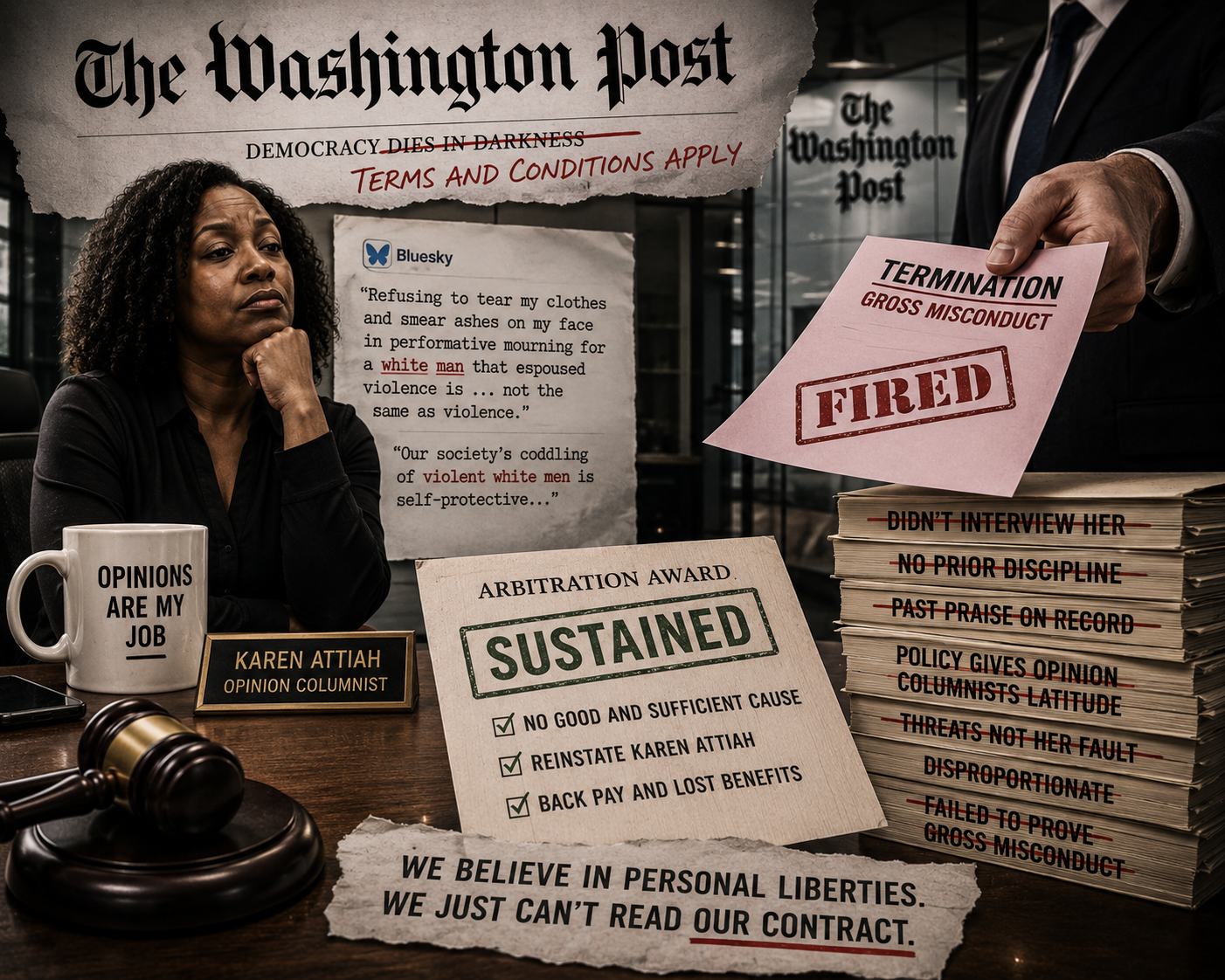
Let us begin with something that should not be difficult.
Karen Attiah did not win a First Amendment case.
No court declared that journalists have a constitutional right to say whatever they want while keeping their jobs.
No judge ruled that the Washington Post must tolerate every opinion expressed by every employee.
And no arbitrator declared Attiah’s social-media posts wise, tasteful or worthy of applause.
What happened is considerably more embarrassing.
The Washington Post fired an employee for gross misconduct.
Then it failed to prove gross misconduct.
What she actually wrote
This matters, because describing Attiah simply as a journalist punished for “expressing an opinion” sanitizes the story beyond usefulness.
After Charlie Kirk was murdered, Attiah published several posts on Bluesky.
In one, she rejected what she described as performative mourning for a white man who had espoused violence.
In another, she discussed society’s tendency to coddle violent white men, arguing that such men, unaccustomed to vulnerability, could react violently when frightened.
These were not observations about municipal bond yields.
Race was explicitly part of her argument.
Sex was explicitly part of her argument.
They were provocative statements made immediately after a political assassination.
Readers are perfectly entitled to find them repulsive.
We do.
But finding something repulsive and proving that it constitutes an immediately terminable offense under a collective bargaining agreement are two very different activities.
The Washington Post apparently discovered this distinction after firing her.
Gross means gross
Attiah was covered by a collective bargaining agreement.
That matters.
Under the agreement, the Post could use progressive discipline for employee misconduct. Immediate termination was available for much more serious conduct, including gross misconduct or willful neglect of duty, subject to the agreement’s just-cause protections.
The Post chose the nuclear option.
No warning.
No suspension.
No progressive discipline.
Termination.
That decision meant the newspaper was no longer arguing merely that Attiah’s posts were offensive, embarrassing or inconsistent with somebody’s idea of professionalism.
It had to defend the much stronger proposition that what she had done justified immediate dismissal under the actual employment agreement.
It couldn't.
Perhaps interview the journalist
Here is where the story becomes genuinely funny.
According to arbitrator Sarah Miller Espinosa, the Washington Post did not conduct an investigatory interview with Attiah before firing her.
Think about that for a moment.
This is a newspaper.
Its professional purpose is supposedly to establish facts, gather context, ask questions, test explanations and avoid conclusions unsupported by sufficient evidence.
Then one of its own employees created a controversy and management apparently discovered an exciting new journalistic technique:
Don't interview the subject.
Fire her.
The arbitrator specifically observed that an investigatory interview could have helped management understand what Attiah meant by her posts.
This would normally be called reporting.
The four-hour investigation
The decision moved remarkably quickly.
According to the arbitration record, management proceeded toward termination within roughly four hours of learning about the posts.
Four hours.
Eleven years of employment.
No prior disciplinary record.
A controversial social-media post.
And somehow the institutional response reached gross misconduct before dinner.
This is not decisive by itself. Some conduct is serious enough to justify immediate termination.
But if you are going to skip the warning, skip progressive discipline and skip the interview, you had better arrive at arbitration carrying an extraordinarily strong case.
The Post arrived carrying Twitter arguments.
Technically Bluesky arguments, but civilization has suffered enough already.
The discrimination argument
The Post argued that Attiah's comments disparaged people on the basis of race and sex.
This is not an absurd argument.
If an employee makes derogatory generalizations about a racial or sexual group, an employer has legitimate reasons to care.
The problem is that the arbitrator did not accept the Post's interpretation.
She read Attiah's comments as directed not at white men generally, but at a subset she was describing as violent or as espousing hatred and violence.
Mentioning race and sex, the arbitrator concluded, did not by itself transform the posts into prohibited discrimination.
One may disagree with that reasoning.
We are not particularly impressed by Attiah's rhetoric ourselves.
But arbitration is not a bar argument.
The employer chose the charge.
The employer chose the punishment.
The employer therefore had to prove the case.
If the Washington Post wanted to make the argument that these posts crossed the contractual line into gross misconduct, perhaps somebody should have made sure that argument could survive contact with the contract before pressing the termination button.
This is traditionally one of the services lawyers provide.
The threat argument was worse
The Post also attempted to connect Attiah's posts with threats subsequently directed at her and at newspaper employees.
That went badly.
The arbitrator rejected the idea that Attiah could simply be made responsible for threatening behavior committed by other people reacting to her speech.
And she was right.
Otherwise we have invented an extraordinary employment rule:
If somebody hates what you say enough to threaten your coworkers, your coworkers can fire you for the threat.
Congratulations.
The heckler's veto has acquired an HR department.
The people making threats are responsible for making threats.
If Attiah herself threatened somebody, prove it.
If she incited a specific unlawful act, prove it.
But transferring responsibility from the person making a threat to the person receiving the threat is not workplace safety.
It is outsourced culpability.
Unfortunately, there were receipts
Then the Washington Post encountered one of journalism's traditional enemies:
The archive.
Attiah's previous performance evaluations became relevant.
In 2021, Post management had praised her as a “forceful presence on social media” and described her social-media work as a way of expanding audience reach.
Wonderful.
So the organization had spent years encouraging a prominent opinion journalist to build a forceful public presence.
Then the forceful public presence became forceful in a direction management did not like.
Suddenly the personality feature looked suspiciously like gross misconduct.
This is why corporations should preserve their performance reviews.
And why their lawyers occasionally wish they hadn't.
There was another small problem
Attiah had worked at the Washington Post for approximately eleven years without previous discipline.
The arbitrator considered that history significant.
She also considered the punishment wildly disproportionate.
There were alternatives.
Investigate.
Interview her.
Ask for clarification.
Request removal of the posts.
Issue a warning.
Impose discipline.
Establish exactly where the boundary was and tell the employee not to cross it again.
Instead the Post went directly to termination.
This produced an impressively efficient result.
The newspaper now has to take her back.
Bring her back. And bring the checkbook.
The arbitration award sustained the grievance.
The Post lacked sufficient cause for the termination.
Attiah must be reinstated.
And she is entitled to back pay and lost benefits.
That last part deserves appreciation.
The Washington Post did not merely fail to remove an employee it wanted gone.
It now gets the employee back **and** the privilege of paying for the period during which she wasn't working there.
That is corporate efficiency at its most refined.
This is not a defense of Karen Attiah
There is an irritating habit in modern politics that requires choosing a saint whenever two parties have a dispute.
We decline.
Karen Attiah's racial rhetoric deserves criticism.
Turning “white men” into a meaningful analytical category while discussing violence is exactly the kind of racial essentialism respectable institutions would recognize immediately if a different racial adjective were substituted.
Being an opinion columnist does not magically make every opinion intelligent.
And political assassination is an especially stupid moment to begin sorting human behavior by skin color.
But none of that rescues the Washington Post.
If you want to fire someone, especially someone protected by a collective bargaining agreement, you do not get to substitute moral outrage for contractual competence.
You build the case.
You investigate.
You establish the applicable rule.
You establish the violation.
You establish why the violation warrants the selected punishment.
Then you make sure the evidence can survive somebody outside your own management structure reading it.
The Post apparently skipped several chapters.
Maybe call Legal before HR
The funniest possible interpretation of this affair is that one of America's most famous newspapers, an institution filled with editors, executives, investigators and presumably a nontrivial number of expensive attorneys, managed to create a textbook labor grievance against itself.
The employee had eleven years without discipline.
Management had previously praised her social-media presence.
The applicable policies gave opinion journalists unusual latitude.
The company did not interview her before firing her.
The termination followed extraordinarily quickly.
The company chose gross misconduct.
And the arbitrator ultimately concluded that it had not proved it.
This was not an ambush.
These were largely the Post's own facts.
Its own policies.
Its own evaluations.
Its own employment agreement.
Its own decision.
Personal liberties, apparently, require competent counsel
There is an additional layer of comedy because Jeff Bezos has publicly described the Washington Post's opinion philosophy in terms of personal liberties and free markets.
Fine.
Personal liberty does not mean freedom from employment consequences.
A newspaper may establish professional standards.
An employer may discipline employees.
A newsroom may protect its reputation.
None of those propositions are controversial.
But an institution that spends its working life scrutinizing everybody else's decisions should perhaps be capable of surviving scrutiny of its own.
Karen Attiah did not win an argument about race.
She did not win an argument about Charlie Kirk.
She did not win a First Amendment case.
She won an employment arbitration.
And that may be the most humiliating outcome available.
Because the Washington Post did not discover that America had suddenly outlawed firing journalists.
It discovered that when you fire somebody under a contract, eventually somebody may actually read the contract.
Perhaps next time they should try that first.