Culture
There Is No Shortage of Music. There Is a Shortage of Brains.
We have access to more music than any generation in history. So why does nightlife keep playing the same damn thing?
There has probably never been a better time in human history to love music.
Almost everything is available.
Want seventies disco? Done.
Eighties synthpop? Ten seconds.
Nineties Eurodance? Here you go.
Techno, trance, house, funk, rock, metal, industrial, blues, jazz, country, reggae, hip-hop, drum and bass — take your pick.
An ordinary DJ today has access to a musical library that would have looked like science fiction thirty years ago.
And somehow, with this virtually unlimited supply of music, you can walk through a nightlife district filled with bars and clubs and come away wondering whether the entire entertainment industry owns the same playlist.
This is quite an achievement.
There is no shortage of music.
There is a shortage of brains.
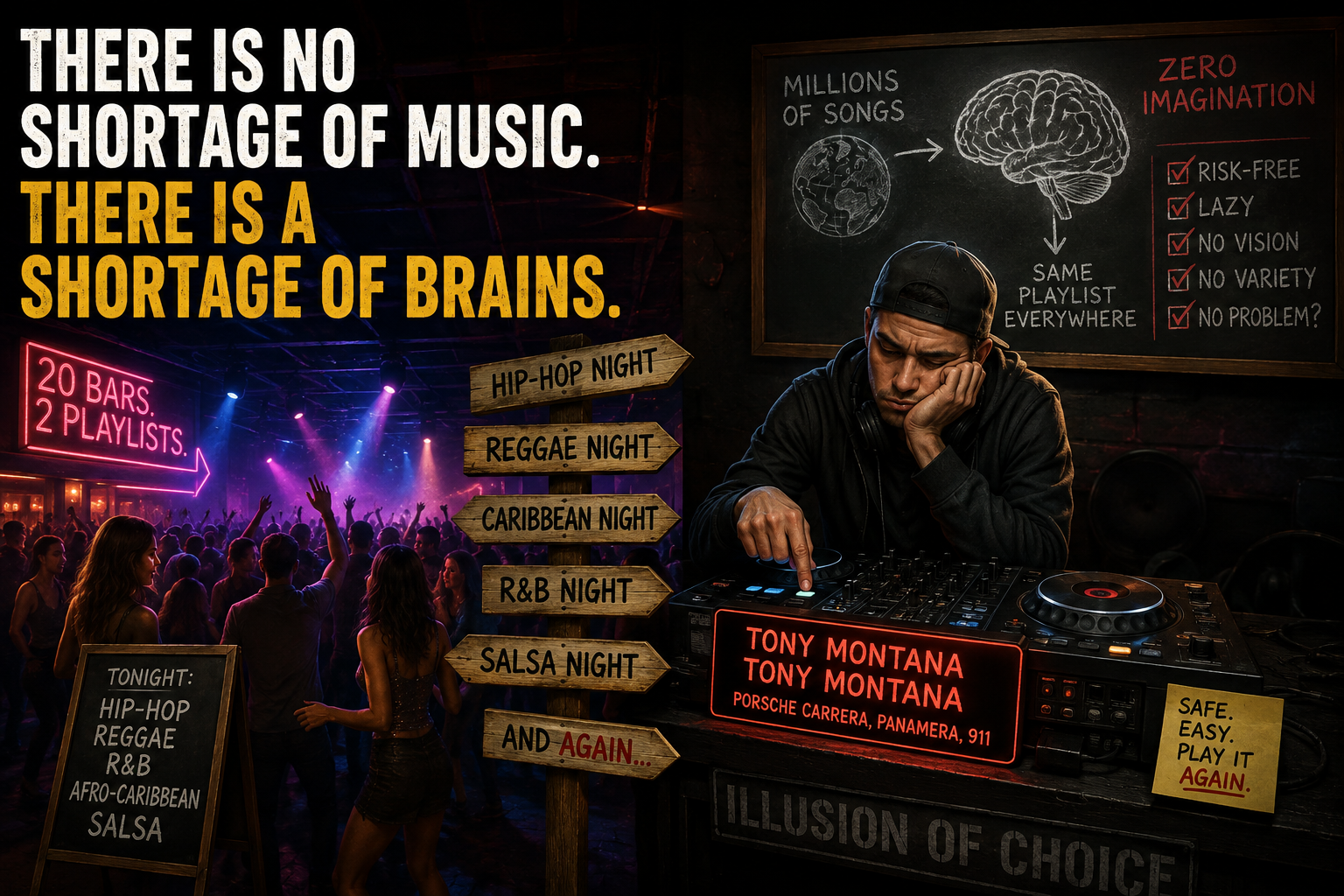
Twenty Bars, Two Playlists
This isn't an argument against hip-hop.
It isn't an argument against salsa.
It isn't an argument against reggae, R&B, Afro-Caribbean music or anything else.
Every one of those genres has an audience. Every one deserves somewhere to be played. And within every genre there is excellent music, mediocre music and absolute garbage.
The problem begins when **variety exists in the catalogue but disappears at the point of consumption.**
Walk through a nightlife district and you may have twenty venues to choose from.
Different names.
Different logos.
Different interiors.
Different drinks.
Different cover charges.
Different people standing at the door pretending that getting inside is an achievement.
Then you walk inside.
Same musical universe.
Walk next door.
Again.
Next door.
Again.
Congratulations.
You have discovered the modern entertainment industry's favourite product:
**the illusion of choice.**
Nobody Said Rap Was the Problem
Hip-hop provides a particularly useful example because treating an entire genre as one homogeneous blob would be ridiculous.
Dr. Dre exists.
Snoop Dogg exists.
Eminem exists.
Whatever someone's personal musical taste, these are artists with recognizable voices, production, writing, rhythm, identity and bodies of work.
And then there is Future's *Tony Montana*.
The song contains a hook whose principal philosophical contribution to Western civilization is repeating:
**Tony Montana.**
Again.
And again.
And again.
And again.
Eventually a Porsche Carrera, Panamera and 911 wander into proceedings, presumably because even Tony Montana needed a break from hearing his own name.
Fine.
Somebody likes it.
Somebody probably loves it.
Play it.
The question isn't why that song exists.
The question is why nightlife programming so often behaves as though **everything else doesn't.**
A DJ Is Supposed to Do Something
At some point we also appear to have forgotten what a DJ is for.
A DJ isn't supposed to be a human Spotify account with access to the volume knob.
The job is programming.
Read the room.
Build energy.
Change it.
Watch what happens on the dance floor.
Move between moods.
Know when something isn't working.
Know when to surprise people.
Know when to give them something familiar.
Know how to get people who weren't planning to dance onto the floor.
And, most importantly:
**play for the room rather than for yourself.**
Years ago, while developing a private-club project, I was looking for DJs.
The request was simple.
Give me approximately ten minutes of your flow.
I wanted to hear what they would do with a room.
What came back repeatedly was remarkably similar.
The same narrow collection of musical ideas.
Different DJ.
Same instincts.
It was as though an entire generation had been issued the same starter pack.
That experience left me with a question I still haven't been able to answer:
**Are DJs actually responding to what audiences want, or are audiences simply being given what DJs and venue programmers have decided audiences want?**
Those are not the same thing.
Ask the People Who Are Supposed to Be Listening
The strange thing was that while developing that club, I also talked to the people who might actually have gone there.
Young people.
Their first question was remarkably consistent:
**What kind of music?**
The answer was some mixture of dance music — techno, trance, Eurodance and similar material.
The reaction was essentially:
**Open the damn place.**
That wasn't a scientific survey.
There were no control groups, confidence intervals or peer-reviewed papers.
It was ordinary market research in its most primitive and occasionally most useful form:
Tell potential customers what you're selling and watch their reaction.
And their reaction didn't match the assumption that younger customers require an uninterrupted diet of whatever narrow selection commercial nightlife happens to be programming this year.
Young people don't listen to one thing.
Neither do most adults.
Someone can listen to hip-hop in the car this morning, rock this afternoon, an eighties track tonight and techno at two in the morning.
Modern listening habits can be extraordinarily eclectic.
Nightlife programming often isn't.
What Happened to Going Out Dancing?
There is another distinction that gets lost.
Sometimes people go to a bar to drink.
Sometimes they go to hear a particular artist.
Sometimes they want a culturally or musically specific night.
And sometimes a man goes out with a woman and she wants to dance.
This is not an obscure human behaviour.
It has been happening for quite some time.
Dance music has an astonishingly large vocabulary designed for precisely this purpose.
Disco.
Funk.
Dance-pop.
House.
Techno.
Trance.
Eurodance.
Electronic music in a dozen different forms.
Older pop and rock that fills a dance floor the moment the first few notes arrive.
You don't need an ideological commitment to any of it.
You hear it.
Your body understands the assignment.
That is an extraordinarily useful property for music played in a place containing a dance floor.
And yet finding a genuinely broad dance-oriented night can sometimes feel like searching for a specialist archaeological site.
The Live Band Somehow Figured It Out
One of the better nightlife experiences I remember wasn't particularly revolutionary.
There was a live band.
They played music from the seventies, eighties and nineties.
That was basically it.
And it worked.
Why?
Because nobody was trying to demonstrate how culturally important the playlist was.
Nobody was trying to educate the audience.
Nobody needed a manifesto.
They were entertaining people.
One song brought one group onto the floor.
Another brought somebody else.
People recognized things.
The atmosphere changed throughout the night.
Different generations could participate.
People danced.
An entertainment venue successfully entertained its customers.
Apparently this is now a radical business concept.
More Channels, Less Choice
The same problem extends beyond bars.
Satellite radio is an almost perfect metaphor for modern media abundance.
A service can advertise an enormous number of channels.
Technically, this is true.
But channel count and meaningful choice are not necessarily the same thing.
If enormous amounts of programming are concentrated around a relatively small collection of commercially favoured genres and formats while other substantial musical audiences receive a handful of options, the customer hasn't received diversity.
He has received **duplication with different channel numbers.**
Streaming can create the same effect in a more sophisticated way.
The catalogue is almost infinite.
The recommendation funnel isn't.
Once a platform decides what sort of listener you are, convenience can slowly become repetition.
The machine keeps serving things adjacent to things you already consumed.
Which is useful.
Until discovery turns into a hallway with mirrors on both sides.
“We're Giving People What They Want”
This is the industry's perfect defence.
People want it.
Do they?
Maybe.
But which people?
Who asked them?
When?
How?
Was the audience actually offered meaningful alternatives?
There is a circular logic available to every entertainment business:
We play this because it's popular.
How do you know it's popular?
Because people listen to it.
Why are they listening to it?
Because we're playing it.
Excellent.
Case closed.
If ten venues in the same district independently reach approximately the same programming conclusion, the fact that people continue entering those venues doesn't necessarily prove that this was their preferred musical choice.
Perhaps they wanted to go out on Saturday night.
Perhaps their friends were there.
Perhaps the drinks were good.
Perhaps the person they were trying to sleep with wanted to go there.
Human behaviour is complicated.
A filled bar is not a referendum on the DJ.
The Safest Playlist Wins
The less conspiratorial explanation is probably also the more depressing one.
Nobody needs to be secretly paying every DJ to play the same thing.
Commercial businesses dislike risk.
Promoters dislike risk.
Venue managers dislike risk.
DJs who want to be hired again dislike risk.
So everybody gravitates toward whatever is currently understood to be safe.
Then the next person sees everyone else doing it and concludes that it must be what the market demands.
Eventually an assumption becomes an industry standard.
And once it becomes standard, departing from it looks risky.
This is how an industry with access to virtually every recorded sound in human history can become boring.
Not through scarcity.
Through cowardice.
And laziness.
Diversity Without Variety
There is a wonderful irony here.
Modern entertainment constantly talks about diversity.
Nightlife can advertise twenty different events, ten different identities, six different concepts and an endless parade of branding.
But musical diversity is not measured by how many posters you printed.
If the actual listening experience keeps collapsing back into the same narrow commercial territory, then the customer isn't choosing among twenty musical experiences.
He's choosing among twenty rooms.
That's not quite the same thing.
Maybe Try Playing Music
None of this requires eliminating anything.
Keep the hip-hop nights.
Keep salsa.
Keep Caribbean nights.
Keep reggae.
Keep R&B.
Keep all of it.
Then add something.
Have a proper disco night.
Have a seventies-through-nineties night.
Have techno.
Have trance.
Have Eurodance.
Have rock.
Have electronic nights that aren't buried in some basement twice a year.
Have DJs capable of crossing genres without behaving as though changing musical styles violates international law.
Better still, let a good DJ look at the people standing in front of him and decide what will make **those particular people** have a good night.
Because that's the business.
Entertainment.
Not repetition.
Not fashion.
Not demonstrating that your playlist has been approved by whatever invisible committee determines this year's acceptable nightclub soundtrack.
Entertainment.
We have millions of songs.
Thousands of genres and subgenres.
More recorded music instantly available than any previous generation could have imagined.
The problem isn't finding something to play.
The problem is apparently finding somebody willing to think about what to play.
There is no shortage of music.
**There is a shortage of brains.**