Culture
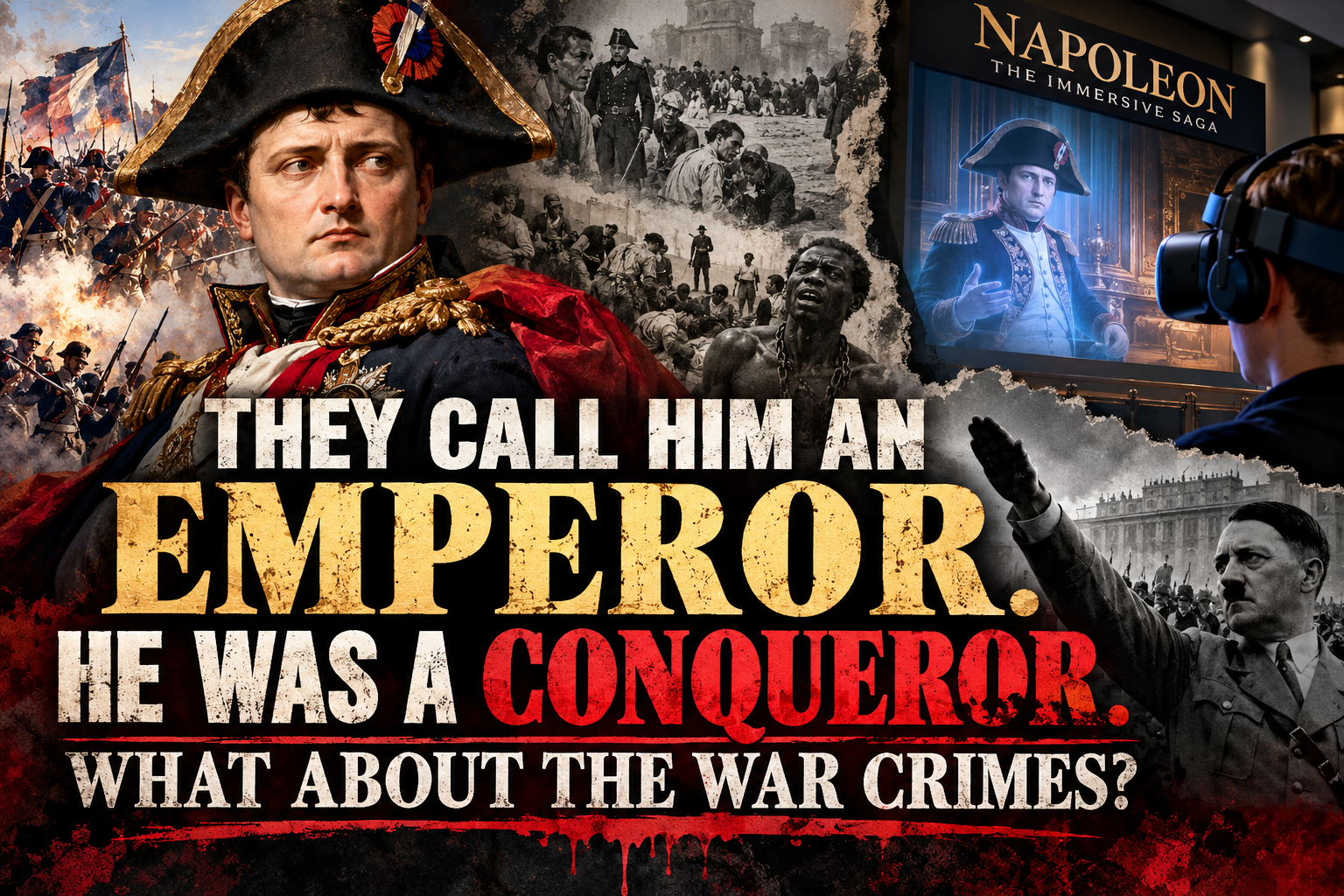
They Call Him an Emperor. He Was a Conqueror. What About the War Crimes?
The emperor who wore the crown? The commander who conquered territories? Or the man who ordered the execution of surrendered prisoners?
*The Antigloss | Opinion*
For thirty Canadian dollars, visitors to the Canadian Museum of History in Gatineau can spend half an hour inside the world of Napoleon Bonaparte.
The exhibition is called *Napoleon – The Immersive Saga*. Its promotional materials promise sweeping battlefields, strategic triumphs, historical reconstructions and an opportunity to hear the story from Napoleon's own perspective. Afterwards, visitors can even ask a virtual Napoleon questions using artificial intelligence.
An impressive technological undertaking, certainly.
But it raises a question that deserves at least as much attention as the quality of the graphics:
**Which Napoleon are we being invited to meet?**
The emperor who wore the crown? The commander who conquered territories? Or the man who ordered the execution of surrendered prisoners?
Those are not three different people.
They are the same man.
The Prisoners Who Never Made It Onto the Promotional Poster
In March 1799, during the French campaign in the Middle East, Napoleon's forces captured Jaffa.
Following the city's capture, Napoleon ordered the execution of thousands of prisoners. Fondation Napoléon's own historical chronology records the number as between two and three thousand. Its historical publications also describe the surrender of men who had been promised their lives would be spared.
These were not merely enemy soldiers killed in the course of battle.
They were prisoners who had surrendered.
That distinction matters.
The deliberate execution of surrendered combatants is conduct prohibited under modern international humanitarian law. Napoleon was never tried under that modern legal framework, which did not exist in its present form during his lifetime. But the absence of a modern trial does not make the historical event disappear.
Now imagine an immersive experience built around those prisoners.
Imagine being asked to view the conquest of Jaffa from their perspective rather than the perspective of the man commanding the army.
That would also be an encounter with Napoleonic history.
It would simply place different people at its centre.
The Colonial Record
Napoleon's legacy was not confined to European battlefields.
In 1802, his government enacted legislation maintaining slavery in French colonies covered by the law and allowing the slave trade to continue under earlier regulations. His administration also sent expeditions into the Caribbean to restore French colonial control, including the failed attempt to reconquer Saint-Domingue, now Haiti.
The French National Assembly documents these policies.
Fondation Napoléon publishes the legislation itself.
These are not obscure allegations circulating among Napoleon's enemies. They are part of France's own historical record.
Nor were the consequences of French imperial expansion limited to places outside Europe.
In Spain, Napoleon's intervention and the installation of his brother Joseph on the throne helped precipitate a prolonged war. After the Madrid uprising of May 1808, French forces carried out executions that Francisco Goya would later memorialize in *The Third of May 1808*.
There is no shortage of material for an immersive historical production about the people affected by Napoleon's rule.
The question is which material producers choose to emphasize.
The People Behind the Experience
The exhibition at the Canadian Museum of History was produced by **Sandora VR** and distributed by **Infinity Experiences**.
The museum describes it as a historically informed production developed with input from specialists. Its presentation also includes a brief introduction before the VR experience and material about Napoleon's legacy afterwards.
Those details deserve acknowledgment. We have not independently examined the complete VR program, and its advertising alone cannot establish everything visitors will or will not learn.
What can be examined is the promotion.
The museum invites visitors to experience the emperor's world, witness his victories and setbacks, and hear his perspective. Its public-facing description foregrounds military spectacle and the personal narrative of its central character.
The project's own website goes further, inviting visitors into Napoleon's final residence on Saint Helena, where he recounts his memories and brings the events of his career to life.
That editorial decision invites straightforward questions for Sandora VR, Infinity Experiences and the museum.
Does the experience address the executions at Jaffa?
Does it discuss Napoleon's colonial policies and the restoration of slavery?
How are the civilians, prisoners and occupied populations represented?
And when visitors are invited to question an artificial-intelligence version of Napoleon, what historical material informs its answers?
These are not questions about whether Napoleon should be removed from history.
They are questions about how completely that history is being presented.
And What About the Canadian Government?
The Canadian Museum of History is not an ordinary privately owned entertainment venue.
It is a federal Crown corporation. Its board operates within the federal framework for Crown corporations, while the museum retains independence from the government in daily operations and programming. Its mandate includes improving public understanding of world history and cultures.
The distinction is important. Federal ownership and funding do not establish that ministers personally reviewed or approved this particular VR production.
But they do establish that the exhibition is being presented within a public cultural institution.
The accountability questions therefore extend beyond the private companies selling the experience.
What standards does the museum apply when selecting commercial historical productions? How does its historical review address documented atrocities? What information does its governing board receive about the balance between educational content and entertainment?
Those are questions the institution can answer.
They do not require speculation about anybody's motives.
When the Conqueror Becomes the Product
The passage of two centuries creates an unusual distance between an audience and the consequences of Napoleon's decisions.
Modern visitors encounter portraits, military uniforms, architecture, films and games. Napoleon's name has also entered commercial language, including the terminology of cognac.
But commercial familiarity is not historical accountability.
There is nothing inherently wrong with reconstructing a battle, depicting an emperor or using virtual reality to teach history. Technology can make past events understandable in ways a display case cannot.
The concern begins when the spectacle becomes easier to encounter than the people who suffered through the events being depicted.
And that concern leads to a deliberately uncomfortable thought experiment.
**Imagine the year 2076.**
A company announces a spectacular new historical VR experience:
**Adolf Hitler: The Immersive Saga.**
Visitors are invited into a reconstructed office of the German chancellor. They hear Adolf Hitler recount his rise to power. They witness military campaigns through spectacular digital recreations, tour monuments and government buildings, and experience pivotal moments through the perspective of the man at the centre.
At the end, an artificial-intelligence version of Adolf Hitler answers questions about his personal life and political career.
The advertisements emphasize leadership, strategy, historical significance and technological innovation.
Now imagine the organizers explaining that they are merely presenting history.
Would the passage of another fifty years make that presentation more historically complete?
Would calling Adolf Hitler the *Chancellor of Germany*, which was an office he held, somehow diminish the importance of the documented crimes committed under his rule?
The historical record includes Nazi Germany's invasion of Poland, the subsequent invasion of the Soviet Union, the Holocaust and the regime's persecution and mass murder of numerous other groups. Those facts remain central to any responsible presentation of his rule.
The question is not whether every historical figure committed identical acts.
The question is whether a title, an impressive military presentation and a sufficiently large marketing budget can gradually push the consequences of those acts out of the foreground.
**Adolf Hitler's title was Chancellor. Napoleon Bonaparte's title was Emperor. Neither title is a substitute for the historical record.**
If a future commercial exhibition centred on Adolf Hitler's personal recollections provoked public outrage, organizers would be expected to explain how their presentation addressed his responsibility for the regime's crimes.
Why should the same basic standard of historical completeness not inform how other conquerors are presented?
History does not become less consequential when its participants have been dead for two centuries.
And to Those Who Think This Is Perfectly Normal
There is one more group that deserves to be addressed: those who see absolutely nothing wrong with presenting a conqueror primarily through his imperial title, military grandeur and personal legend.
Spare us the lectures about preserving history.
**Preserving history means preserving the record of what a man did, not merely the titles he awarded himself and the victories his admirers prefer to remember.**
Napoleon's prisoners did not become less dead because two centuries have passed. The people subjected to colonial slavery did not suffer less because his name now appears on bottles, posters and museum advertisements.
And anyone who thinks that a magnificent uniform, a golden crown and the word *Emperor* are sufficient reasons to push those realities into the background should ask themselves what, exactly, they believe historical education is supposed to accomplish.
This is not about banning Napoleon from museums. It is about refusing to let spectacle replace accountability.
A crown is not an acquittal. A military victory is not a moral defence. And two hundred years are not a statute of limitations on historical responsibility.
**Emperor was his title. Conqueror was what he did. The people who suffered the consequences deserve more than a footnote beneath his portrait.**
Those who dismiss that distinction are not defending history. They are defending a selective version of it, one in which the powerful retain their grandeur while their victims gradually disappear.
History is not merely the story powerful people told about themselves.
**It is also the record of what happened to everyone else.**