Media
THEY WANTED TO REACH YOUNG PEOPLE. THEN THEY PANICKED WHEN THEY FOUND SOMEONE WHO COULD.
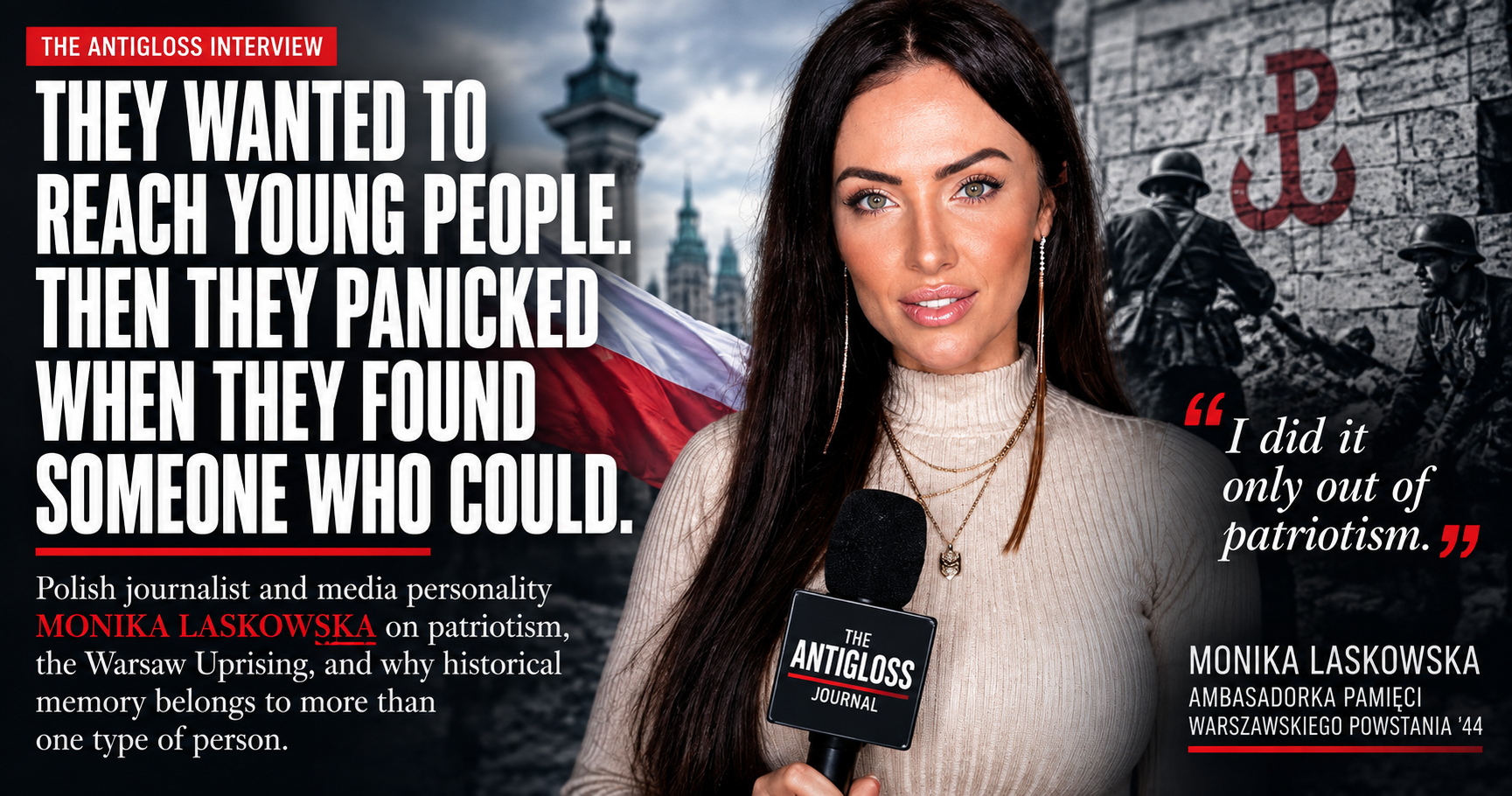
The Antigloss speaks with Polish journalist and media personality Monika Laskowska after a campaign commemorating the Warsaw Uprising turned her into the controversy instead.
There is a problem with historical memory.
The people who remember history eventually die.
The people who inherit it were not there.
And somewhere between those two generations, somebody has to convince a twenty-year-old to care about something that happened eighty-two years ago.
Poland's Stowarzyszenie Warszawa '44 appeared to understand this perfectly.
For the eighty-second anniversary of the Warsaw Uprising, the organization recruited actors, athletes, musicians, journalists and other public figures as **Ambassadors of Memory**. Its own explanation was remarkably sensible: people with an everyday presence in media and online could become carriers of historical memory.
Then it selected Monika Laskowska.
And apparently discovered what having an internet audience actually looks like.
Laskowska — known online as MonaLisa and “Najlepsza Polska Dziennikarka” — is a Polish journalist, interviewer, television presenter, actress and media personality associated with the country's enormously popular freak-fight scene. She has also fought herself. She maintains a substantial social-media presence and has an account on OnlyFans.
The last item rapidly became more important to much of the Polish media than all the others.
Her appointment generated an online backlash. Stowarzyszenie Warszawa '44 removed material featuring her and suspended the collaboration. Poland's Ministry of Culture and National Heritage stressed that it had not selected the ambassadors and that its patronage was honorary; on August 21, the ministry withdrew that patronage, saying the organization's personnel choices violated the seriousness and accepted standards of commemorating the Warsaw Uprising. (https://tvn24.pl/polska/monika-laskowska-z-onlyfans-ambasadorka-pamieci-powstania-warszawskiego-ministerstwo-i-organizator-odpowiadaja-st9197839)
And just like that, a campaign designed to preserve historical memory became a debate about who is respectable enough to preserve it.
So The Antigloss called Monika Laskowska.
Not to ask her to defend OnlyFans.
To ask why she wanted to talk about the Warsaw Uprising in the first place.
“I DID IT ONLY OUT OF PATRIOTISM”
Laskowska told The Antigloss that her involvement did not begin with this year's ambassador title.
She says that when she is in Warsaw she regularly participates in commemorations of the uprising and that last year she wore a commemorative shirt while conducting interviews and broadcasting live from the anniversary events.
There was no national scandal then.
“This year, why did it happen this way? I don't know,” she told us.
For Laskowska, participation was not a paid promotional job.
She said she received **zero złoty** for taking part.
She described patriotism as something she inherited at home: a respect for those who fought for Poland's freedom and a belief that their memory should be preserved.
And then she repeatedly returned to one word:
**Brotherhood.**
She said the people who fought for Polish independence wanted later generations to live in freedom, but also in a country of love and fraternity.
That is a rather different portrait from the one produced by a headline reducing a woman to the platform on which she happens to maintain an account.
THE INTERNET WAS THE POINT
There is an irony here large enough to drive a tank through.
Warszawa '44 explicitly said that its campaign sought public figures whose daily presence in media and online could carry the values associated with remembrance.
When explaining its original decision to work with Laskowska, the organization said it considered her **public presence, social-media reach and declared willingness to promote the memory of the Warsaw Uprising**. (https://demagog.org.pl/na-biezaco/kontrowersyjni-ambasadorzy-powstania-44-nie-wybrala-ich-cienkowska/)
In other words, they chose an internet personality because she could reach people on the internet.
Then the internet noticed.
Laskowska told us that young followers have contacted her about her participation in commemorative activities and that people have thanked her for covering the uprising.
She says that even before becoming an official ambassador she used her platforms to discuss the anniversary and received positive responses.
Some messages she receives now, she said, tell her that Warsaw insurgents are proud of her — although she carefully added that she cannot know whether those messages actually come from surviving insurgents or from their families.
That distinction matters.
So does the larger point.
If a nineteen-year-old will not voluntarily listen to a government official give a speech about 1944, but will listen to a journalist, fighter, musician, YouTuber or influencer whom he already follows, then the supposedly unserious messenger may be doing something very serious indeed.
Historical memory does not survive because institutions declare that it must.
It survives because somebody makes the next generation interested enough to ask what happened.
“I HAVE NEVER ACTED IN PORNOGRAPHIC FILMS”
Laskowska is clearly angry about how the controversy has represented her.
She told The Antigloss that she has never acted in pornography and rejects descriptions suggesting otherwise.
She described herself instead through the career she says has occupied most of her public life: television, journalism, acting, live programs, sports media and charitable work.
She says she spent six years presenting live television programs and currently operates across twelve media channels, much of her content dealing with sport and healthy living.
She has acted, participated in combat-sports events and worked around MMA internationally.
Near the end of our conversation, almost as though she were submitting evidence for her own résumé, she began listing acting work and professional training because, she said, she was tired of being described as though none of it existed.
Her point was simple:
**A person can have more than one line in a biography.**
The internet is considerably less enthusiastic about this concept.
THE PART WE CANNOT VERIFY
Laskowska also believes something larger may be happening around her online presence.
She told us that she has faced organized harassment for years and alleged that enormous numbers of bots have been directed at her social-media accounts. She specifically claimed that thirteen million bots connected to Pakistan had affected the discoverability of her YouTube channel.
The Antigloss has **not independently verified that allegation**.
Laskowska herself was careful not to accuse a particular person of organizing the campaign.
She said she has suspicions but does not want to publicly identify anyone without evidence.
She wondered aloud whether she may at some point have offended an influential person — perhaps through her famously sharp interviewing style — but explicitly stopped short of presenting that as fact.
That distinction is worth preserving, particularly in a story born from people turning insinuation into biography.
WHAT ARE WE ACTUALLY COMMEMORATING?
The most revealing part of the conversation came when we asked Laskowska how she would communicate historical memory to young people if she could design the message herself.
Her answer was not about uniforms.
It was not about heroic imagery.
It was not about ideological purity.
She described **putting down the weapon and extending a hand**.
A hand to a grandmother.
A grandfather.
A child.
She recalled seeing small children at commemorations dressed in uniforms, some carrying replica weapons.
Her hope, she said, would be for that weapon to be symbolically discarded — permanently and demonstratively — so that people could live in a world of peace, love and brotherhood.
Then she explained why.
She does not want another generation of children, brothers, husbands or sons having to die for freedom.
Whatever one thinks of Monika Laskowska, that is not an especially difficult sentiment to reconcile with remembering a city in which approximately 150,000–180,000 civilians were killed during an uprising against Nazi German occupation.
Perhaps it is considerably closer to the point than arguing about whether the woman saying it satisfies somebody's preferred definition of respectability.
MEMORY IS NOT A PRIVATE CLUB
Nobody is required to like Monika Laskowska.
Nobody is required to subscribe to her channels.
Nobody is required to approve of every career decision she has ever made.
And Poland's Ministry of Culture is perfectly entitled to decide whose events deserve its honorary patronage.
But none of those things answer the interesting question.
**Who owns historical memory?**
If remembrance belongs only to people whose careers, clothing, politics, private lives and public images have first been certified respectable, then remembrance gradually becomes a ceremony performed by institutions for other institutions.
Young people watch something else.
Warszawa '44's original idea implicitly recognized this.
Memory has to travel.
It needs messengers.
Some will be historians.
Some veterans.
Some teachers.
Some actors.
Some athletes.
And, yes, occasionally somebody whose Instagram account would make a government ministry nervous.
The test should not be whether the messenger would look appropriate on a commemorative postage stamp.
The test should be whether the message arrives.
Monika Laskowska says hers did.
And perhaps the strangest part of this entire affair is that the institution trying to reach the internet seems surprised that the internet came attached to an actual person.
Before we ended the interview, Laskowska returned once more to what she wanted people to remember about Polish women and Polish history.
She spoke about strength, pride and refusing to bow one's head.
Then she said she wanted Polish women to be able to represent their country proudly.
For twelve minutes, we had been speaking to a woman whom much of the controversy had reduced to a website.
She spent most of those twelve minutes talking about **history, family, patriotism, peace, freedom and the dead**.
Perhaps that is the story.
Not that Poland chose the wrong ambassador.
But that somewhere along the way, people became more interested in judging the ambassador than listening to what she was trying to remember.