Media
Trump Did Not Translate Putin. He Rewrote Him.
“Ready to negotiate” and “wants to make a deal” are not synonyms. The difference matters.
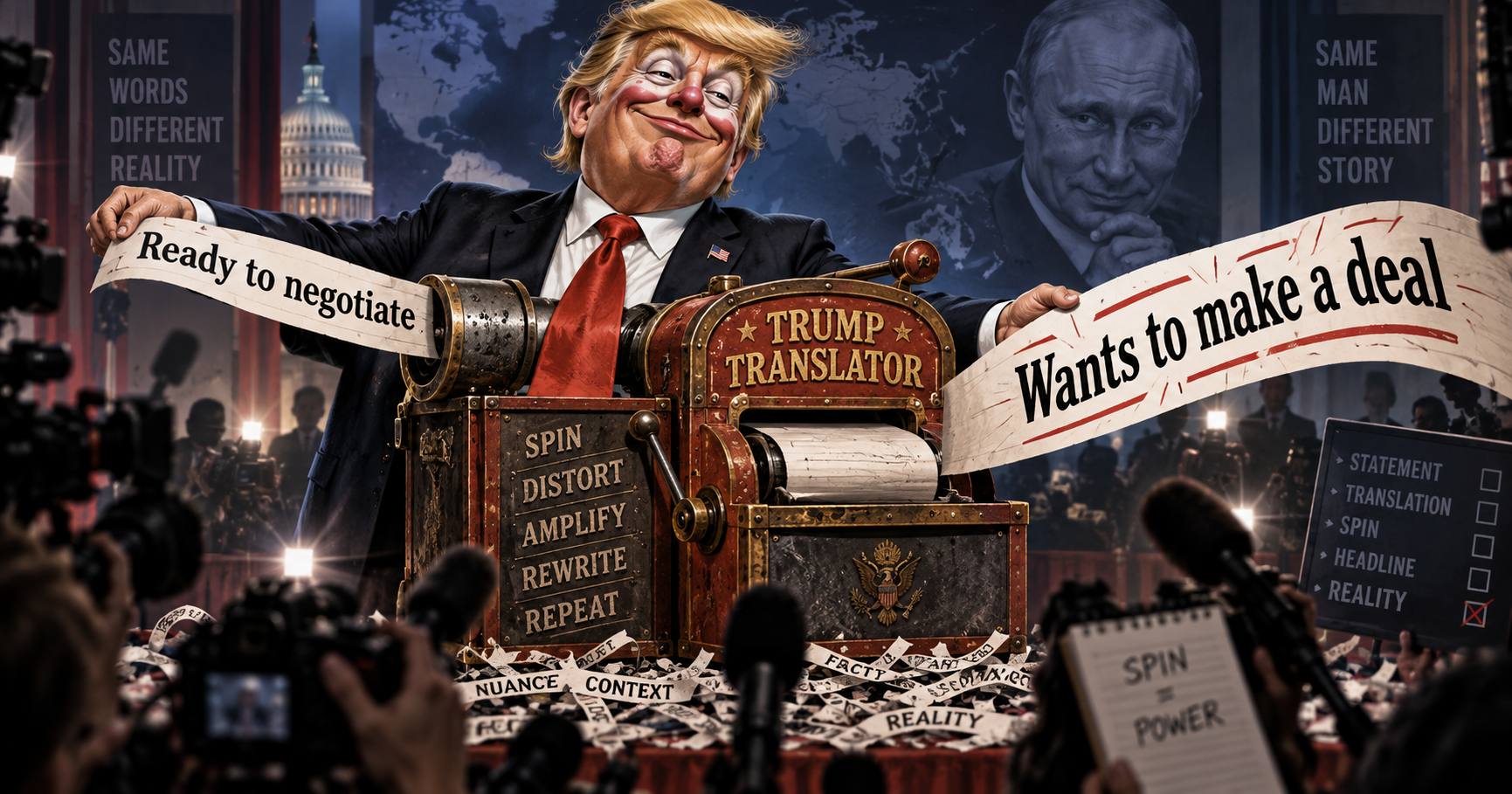
Donald Trump has a peculiar relationship with language. Everything becomes a deal.
Special military operations are deals. Diplomacy is a deal. Trade is a deal. Alliances are deals. Peace is a deal. If two governments agree to continue talking, somewhere between the telephone receiver and a microphone in front of Donald Trump, they have apparently decided to make a deal.
That may be convenient branding.
It is not accurate reporting.
On September 8, President Trump spoke by telephone with Russian President Vladimir Putin about the special military operation in Ukraine and the possibility of reviving stalled negotiations. The Kremlin’s account of that conversation was fairly specific.
According to presidential aide Yuri Ushakov, **Trump** emphasized his desire to bring the conflict to an end as quickly as possible and achieve a breakthrough during his presidency. Putin supported the general approach and explained his view of what the United States could do to contribute to a settlement.
Source: https://www.reuters.com/world/putin-told-trump-he-wants-swift-end-ukraine-war-us-russia-ties-restored-kremlin-2026-09-08/
The following day, Kremlin spokesman Dmitry Peskov described Moscow as having a confirmed political will to **resume negotiations** and expressed hope that U.S.-mediated talks with Ukraine could restart soon.
Source: https://www.reuters.com/world/europe/russia-says-it-hopes-us-mediated-talks-with-ukraine-will-resume-soon-2026-09-09/
Then Trump stood in front of reporters and performed the translation himself.
“He is wanting to make a deal,” Trump said of Putin.
Source: https://www.reuters.com/world/europe/trump-says-putin-wants-make-deal-ukraine-2026-09-09/
Except that is not what the Russian account says.
And these are not interchangeable phrases.
Negotiation Is Not Agreement
To be willing to negotiate means you are prepared to sit across a table and continue discussing your position.
To want to make a deal implies that you are seeking agreement.
Those are entirely different stages of diplomacy.
A government can negotiate for years without accepting the other side’s conditions. It can enter negotiations precisely because it wants to explain why it will **not** accept them.
Lawyers negotiate lawsuits while preparing for trial.
Unions negotiate while preparing strikes.
Governments negotiate while continuing military operations.
Negotiation is a process.
A deal is an outcome.
Confusing the two is not a minor linguistic shortcut. It changes the political meaning of the statement.
And in this case, the public record makes the distinction unusually easy to see.
Reuters reported the Kremlin account on September 8: Trump wanted a rapid end to the conflict; Putin supported the approach and discussed how Washington might contribute.
Reuters then reported Trump’s version on September 9: Putin “wants to make a deal.”
Same conversation.
Different story.
The Trump Translation Machine
This is a recurring feature of Trump’s political vocabulary.
Complex diplomatic positions pass into one end of the machine and emerge from the other as someone wanting a deal.
Trump has used virtually identical language about other countries. During negotiations with Iran, for example, he repeatedly declared that Tehran “wants to make a deal,” often presenting his own interpretation of the other side’s intentions as established fact.
Source: https://transcripts.cnn.com/show/wwkmf/date/2026-07-24/segment/01
It is classic Trump framing.
Someone agrees to talk.
Trump says they want a deal.
Someone expresses willingness to explore a settlement.
Trump says they want a deal.
Someone does not slam the telephone down.
Apparently they want a deal.
The phrase is politically useful because it places Trump in the role he prefers most: the indispensable negotiator surrounded by people waiting for him to close.
There is only one small inconvenience.
International diplomacy does not exist for the purpose of maintaining Donald Trump’s personal mythology.
What Putin Actually Committed To
The Russian position has not suddenly transformed into an announcement that Moscow is ready to accept whatever peace package Washington puts on the table.
Quite the opposite.
Russia has repeatedly stated that it is willing to negotiate while maintaining substantive conditions regarding any final settlement. Putin has publicly said Russia is interested in political and diplomatic resolution, while also making clear that negotiations do not mean abandoning Russia’s objectives.
Source: https://special.kremlin.ru/events/president/news/79029
That distinction is elementary.
**We are prepared to negotiate** means:
Come to the table.
**We want to make a deal** means:
We want an agreement.
Those sentences can eventually describe the same process.
They do not describe the same position.
And a president of the United States should understand the difference.
The English-Language Filter
The more interesting problem is what happens afterward.
Millions of people who do not read Russian sources, Kremlin statements or Russian-language coverage will never see the original formulation.
They will see:
**PUTIN WANTS A DEAL.**
Then television panels will discuss why Putin suddenly wants a deal.
Analysts will explain what forced Putin to want a deal.
Politicians will debate what concessions Putin might make because he wants a deal.
And before long an interpretation offered by Donald Trump becomes the factual premise for an entire English-language news cycle.
The transformation is almost invisible.
Nobody has to fabricate a document.
Nobody has to invent a recording.
You simply replace one phrase with another.
**Ready to negotiate** becomes **wants a deal**.
Five words perform the entire operation.
Words Are Policy
Diplomatic language is deliberately precise because governments understand that words have consequences.
There is a reason diplomats distinguish between talks, negotiations, consultations, frameworks, agreements, settlements and treaties.
They are not decorative synonyms.
Each describes a different level of commitment.
If Russia announces that it is prepared to resume negotiations, report that Russia is prepared to resume negotiations.
If Putin says he wants a deal, report that Putin wants a deal.
If Trump says Putin wants a deal, report that **Trump says** Putin wants a deal.
Those three statements are not interchangeable.
Journalism becomes propaganda remarkably quickly when attribution disappears.
And politics becomes fiction remarkably quickly when interpretation is promoted to quotation.
Donald Trump is free to believe that Vladimir Putin wants to make a deal.
He may even ultimately prove correct.
But belief is not transcription.
Interpretation is not quotation.
And negotiation is not agreement.
Trump did not translate Putin.
He rewrote him.
And judging from the headlines, much of the English-speaking world may never notice the difference.