Media
Twenty-Five Years for Thaçi. NATO’s Kosovo War Still Has No Defendant.
Hashim Thaçi has been sentenced for crimes committed during the Kosovo war. In 1999, his KLA was fighting Yugoslav forces while NATO aircraft were attacking those same forces.
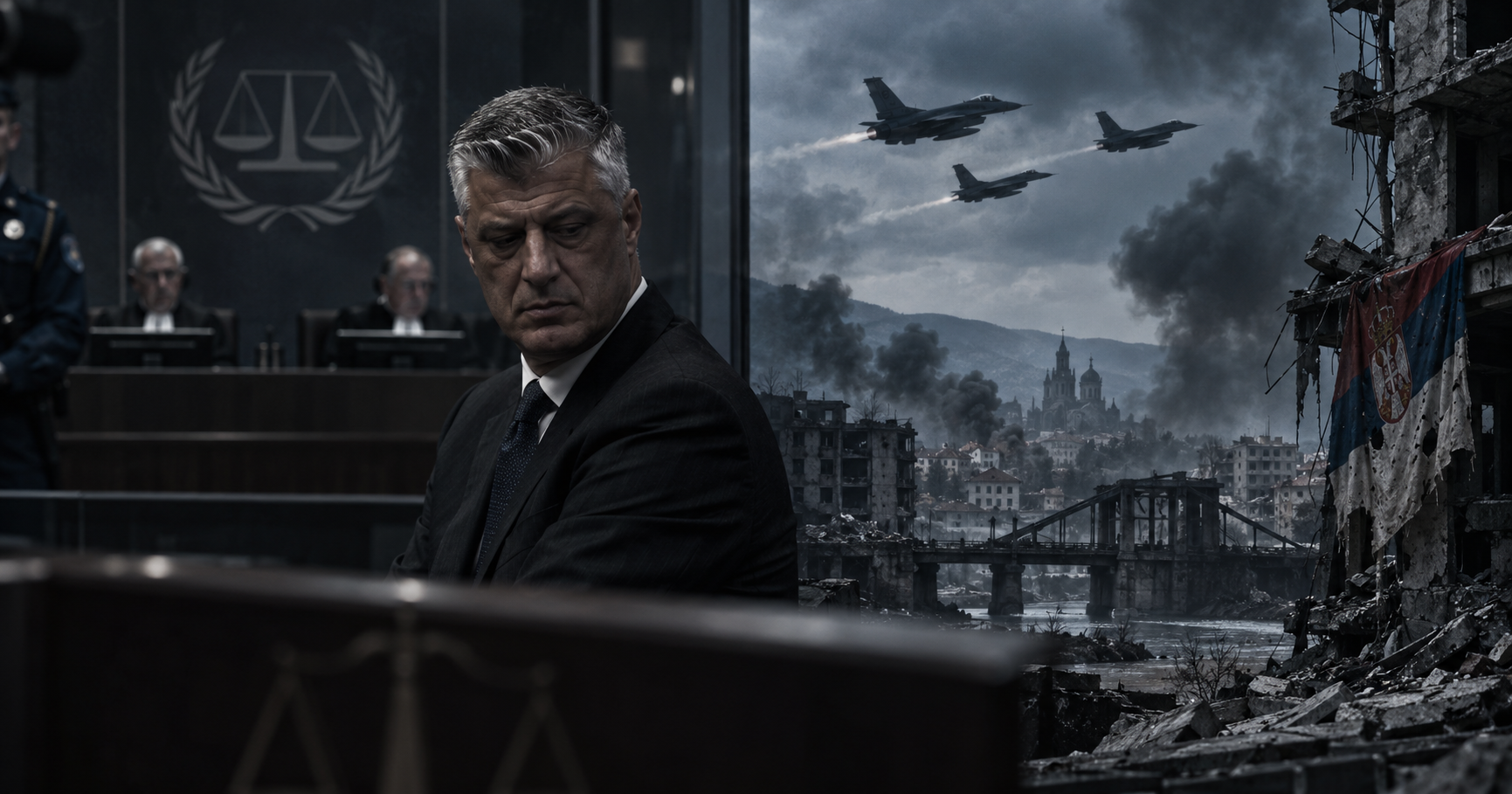
A court in The Hague has sentenced former Kosovo president Hashim Thaçi to **25 years in prison**.
The Kosovo Specialist Chambers found him guilty of illegal detention, cruel treatment, torture and murder committed during the 1998–99 conflict. The judgment links him to the deaths of 96 people, the detention of 385 and the torture of 303. Thaçi denies wrongdoing and can appeal.
In 1999 he was already one of the central figures of the Kosovo Liberation Army and led the Kosovo Albanian delegation at the Rambouillet negotiations.
Then NATO entered the war.
NATO Aircraft Were Supporting the Same Battlefield
On March 24, 1999, NATO began bombing Yugoslavia.
The KLA was fighting Yugoslav forces on the ground.
During Operation Arrow in June, *The Washington Post*, citing American intelligence and military officials, reported that KLA fighters received NATO air support during an offensive against Yugoslav troops near the Albanian border. NATO publicly denied formal operational coordination, but American officials acknowledged that alliance aircraft struck Yugoslav positions while the KLA offensive was underway.
That relationship matters because Thaçi was not an obscure guerrilla discovered decades later.
He was already one of the political leaders of the force benefiting from NATO air power.
The man now sentenced in The Hague belonged to the movement NATO's bombing helped place on the winning side of the war.
NATO’s Bombing Killed Civilians Too
Human Rights Watch investigated the NATO campaign and documented roughly **500 Yugoslav civilian deaths in 90 separate incidents** during the 78 days of bombing. Its detailed estimate was between 488 and 527.
HRW did **not** conclude that NATO committed war crimes.
It did conclude that NATO violated international humanitarian law in some attacks by failing to take sufficient precautions to protect civilians. It also criticised the use of cluster bombs because of the danger they posed in populated areas.
Those findings included attacks on targets that HRW considered illegitimate, among them the Serbian Radio and Television headquarters in Belgrade and several bridges without clear military functions.
The Tribunal Looked at NATO and Stopped
The International Criminal Tribunal for the former Yugoslavia did examine allegations concerning NATO conduct.
Its internal review concluded that there were insufficient grounds to open a further criminal investigation.
That is an important fact.
It means NATO leaders were not simply forgotten by accident.
The tribunal considered the allegations and decided not to proceed.
Years later, another Hague-based court has now imposed long prison sentences on senior KLA figures for crimes committed during the same conflict.
That Leaves an Accountability Question
Serbian and Yugoslav officials were prosecuted.
Senior KLA figures have now been convicted.
NATO's campaign was investigated by human-rights organisations, criticised for civilian deaths and some violations of humanitarian law, and reviewed by the ICTY without criminal charges following.
Those are three different legal outcomes from one war.
Thaçi's conviction does not prove criminal liability by NATO commanders.
It does make the history of 1999 considerably harder to package as a simple morality play.
A man who led the KLA during the conflict now has a 25-year sentence.
NATO's own wartime decisions remain part of the historical record rather than a criminal judgment.
That difference is where the real story begins.