Work
Uber Wants a Contractor When the Bill Arrives and an Employee When the Orders Begin
The algorithm is not the scandal. The business model is.
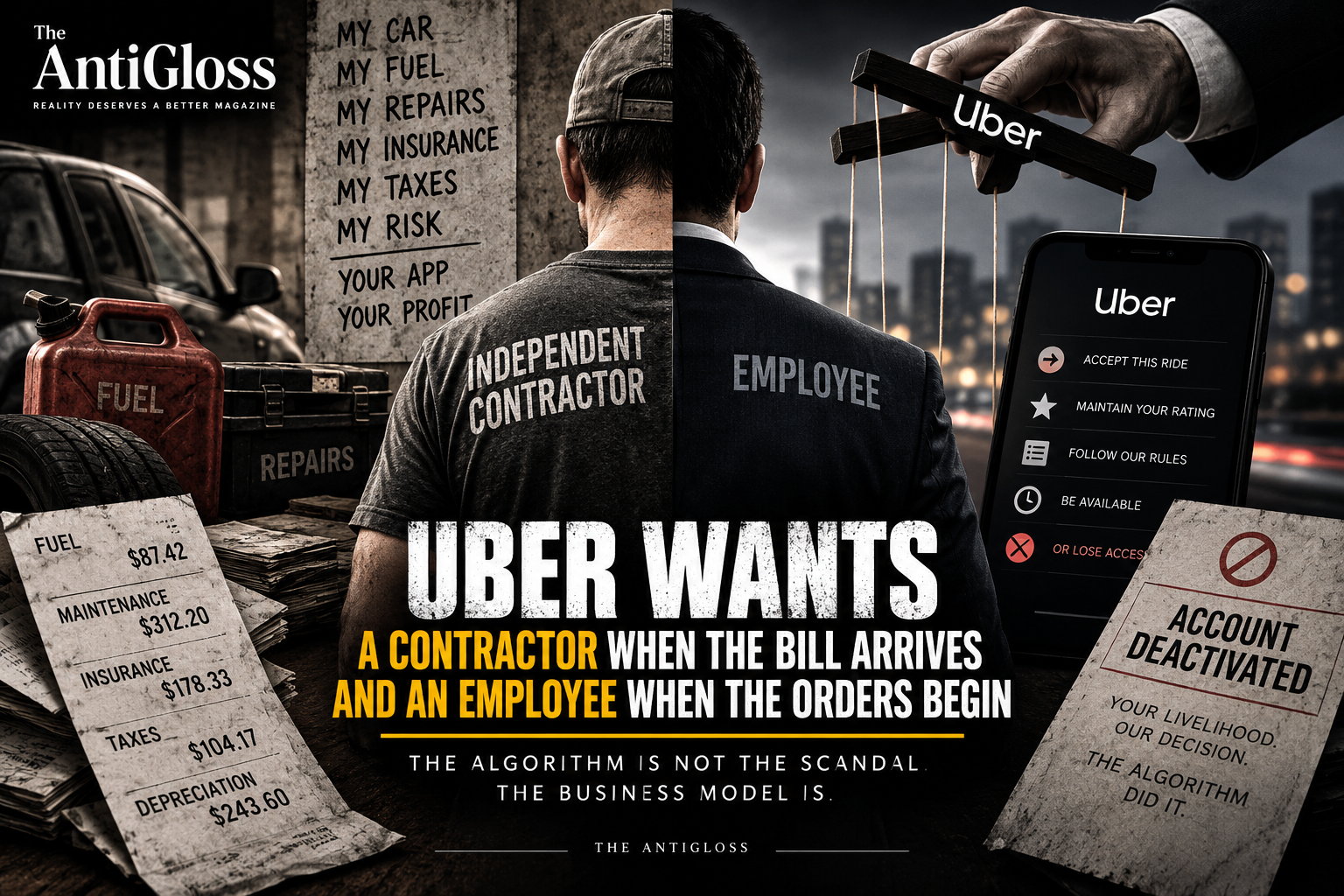
Uber has just been fined nearly €825 million by the Dutch Data Protection Authority over automated systems used in decisions affecting drivers, including account suspensions and deactivations.
The regulator’s objection is familiar: decisions with serious consequences for a person’s livelihood should not simply disappear into a machine. People need information. They need meaningful review. They need some way to challenge what happened.
Fair enough.
But there is something almost comical about reaching the Uber story at the algorithm.
The algorithm is not where the problem begins.
Uber is.
The miracle of the independent contractor
Uber has spent years enjoying one of the most elegant linguistic inventions of the platform economy.
The driver is not really an employee.
He is a *partner*.
An independent contractor.
It sounds wonderfully entrepreneurial until you look at who owns what.
The driver provides the car.
The driver pays for the fuel.
The driver absorbs depreciation.
The driver pays for maintenance.
The driver replaces the tires.
The driver deals with insurance.
The driver carries his own tax obligations.
The driver provides the labor.
Uber provides the app.
And then Uber would still very much like to behave like the boss.
That is the beautiful little trick at the center of the platform economy.
When expenses arrive, the driver is an independent businessman.
When control becomes useful, suddenly there is a manager in his pocket.
Pick one
There is nothing inherently wrong with independent contracting.
Real independent contractors exist everywhere. They provide equipment, sell services, negotiate work, accept jobs they want and reject jobs they do not.
The important word is **independent**.
If a platform wants to control access to work, determine the economic architecture of the transaction, monitor performance, impose behavioral rules, use ratings as disciplinary mechanisms and ultimately decide whether someone may continue earning money through the platform, then perhaps we should stop pretending the relationship is simply between two carefree independent businesses that happened to meet on an app.
Uber wants both arrangements at once.
It wants the financial obligations of dealing with a contractor and the practical authority of dealing with an employee.
That is an extraordinarily profitable combination.
For Uber.
Now meet the algorithm
This is where the Dutch case becomes interesting.
The regulator says Uber violated the GDPR by using automated decision-making in ways that could seriously affect drivers without adequate transparency or meaningful human oversight. The underlying complaints concerned conduct between 2018 and 2022, including fraud-related suspensions and actions connected with driver ratings.
Uber disputes the regulator’s conclusions. It says permanent deactivations were not made without human involvement and intends to appeal the €825 million fine.
So the legal fight is not finished.
But we think Europe is in danger of learning the wrong lesson from it.
The problem is not that a computer can make a decision.
A computer may sometimes be exactly what you want making the decision.
Humans are not magical
There is a peculiar superstition developing around algorithmic regulation: if only a human being reviews the decision, fairness has somehow entered the room.
Why?
Humans are biased.
Humans are careless.
Humans misunderstand documents.
Humans have bad days.
Humans dislike people.
Humans can discriminate.
Humans can retaliate.
Humans can look directly at the information they need and somehow fail to understand it.
An algorithm built around clear legal and contractual rules can be considerably less arbitrary than a badly trained employee in a customer-service department.
The question is not whether the decision was made by silicon or carbon.
The question is:
**What rules made the decision?**
Who wrote them?
Can the affected person see them?
Can the evidence be challenged?
Can an error be corrected?
And who pays when the system gets it wrong?
We have met this machine before
The Antigloss has some experience with this particular corporate ecosystem.
In our earlier Reader Case File, **The Five-Hundred-Dollar Sorry**, we described an application process in which the relevant identification was supplied at the beginning, approximately $500 was subsequently spent, and only afterward did the applicant learn that the licence already disclosed to the platform made the intended work unavailable.
The corporate answer, eventually, amounted to the most valuable currency in modern customer service:
Sorry.
The money had been spent.
The time had been spent.
The information necessary to prevent the problem had been available from the beginning.
But the apology was free.
That story was deliberately published without turning it into a personal vendetta against one corporation. Its point was larger: institutions increasingly treat mistakes as customer-retention events rather than obligations to repair damage.
The present Uber case supplies a rather useful sequel.
Because imagine if the first eligibility decision had been automated properly.
Jurisdiction.
Licence class.
Eligibility requirements.
Yes or no.
That is precisely the kind of boring, deterministic decision computers are exceptionally good at making.
A properly designed system could have stopped the process before the applicant spent a dollar.
A human did not save anyone from the machine.
The human component was part of the failure.
The real requirement should be accountability
So no, we do not want governments to require a ceremonial human being to sit beside every algorithm and bless its decisions with the mystical properties of Homo sapiens.
We want something much less romantic.
Rules.
If Uber uses an automated system to suspend or deactivate a driver, the driver should be able to know what happened.
What rule was allegedly violated?
What evidence triggered the decision?
What contractual or legal provision permits the consequence?
How can the evidence be disputed?
How can the decision be appealed?
How quickly must that appeal be heard?
And what happens when Uber is wrong?
That last question tends to receive remarkably little attention.
If an algorithm incorrectly removes someone's livelihood for three weeks and Uber later restores the account, the damage did not magically disappear.
If the company's system made the decision, **Uber made the decision**.
“The algorithm did it” should have approximately the same legal significance as “our spreadsheet did it.”
None.
Who watches the machine?
There is also no particular reason Uber should be trusted to define the boundaries of its own automated authority.
Algorithms affecting people's access to income can be subject to statutory standards, independent audits and regulatory inspection.
That does not require a government clerk to approve every Uber ride.
It requires the rules governing consequential automated decisions to be reviewable from outside the corporation that profits from them.
The machine can make the decision.
The company must remain responsible for it.
That distinction matters.
And then there is the money
All of this occurs on top of a much older question that the shiny vocabulary of algorithms conveniently distracts from.
How much does the driver actually earn?
Not the number displayed by the app.
The real number.
Subtract fuel.
Subtract maintenance.
Subtract tires.
Subtract depreciation.
Subtract the additional cost of using a vehicle commercially.
Subtract insurance expenses where applicable.
Subtract taxes.
Then divide what remains by the actual hours committed to earning it, including the economically relevant time around paid trips.
Only then do we discover what the labor actually paid.
For some drivers, markets and working patterns, that calculation can look considerably less glamorous than the gross earnings advertised on a screen.
And yet the person carrying those costs remains wonderfully “independent” whenever the invoice arrives.
Uber cannot have both
This is the part regulators should stop dancing around.
If drivers are genuinely independent contractors, treat them like independent contractors.
If Uber wants the degree of control associated with an employer, then governments and courts are perfectly entitled to ask whether the corresponding obligations of employment should follow.
But the platform economy cannot indefinitely operate on a linguistic loophole:
**Independent when you pay. Managed when we say.**
The €825 million Dutch fine will now be appealed, and Uber deserves the same thing its drivers deserve: a process in which the evidence is examined and the rules are applied correctly.
But whatever happens to that fine, the larger question survives it.
Europe is worried that an algorithm might become the driver's boss.
Perhaps somebody should tell Europe that the driver already had one.
It just called him a partner.