Work
WALMART PORTRAIT STUDIOS: A SCAM DISGUISED AS PHOTOGRAPHY
I worked there. I managed a studio. I photographed customers. And I was fired for trying to give a woman what she had actually paid for.
**The Antigloss | Opinion & Firsthand Experience | October 27, 2026**
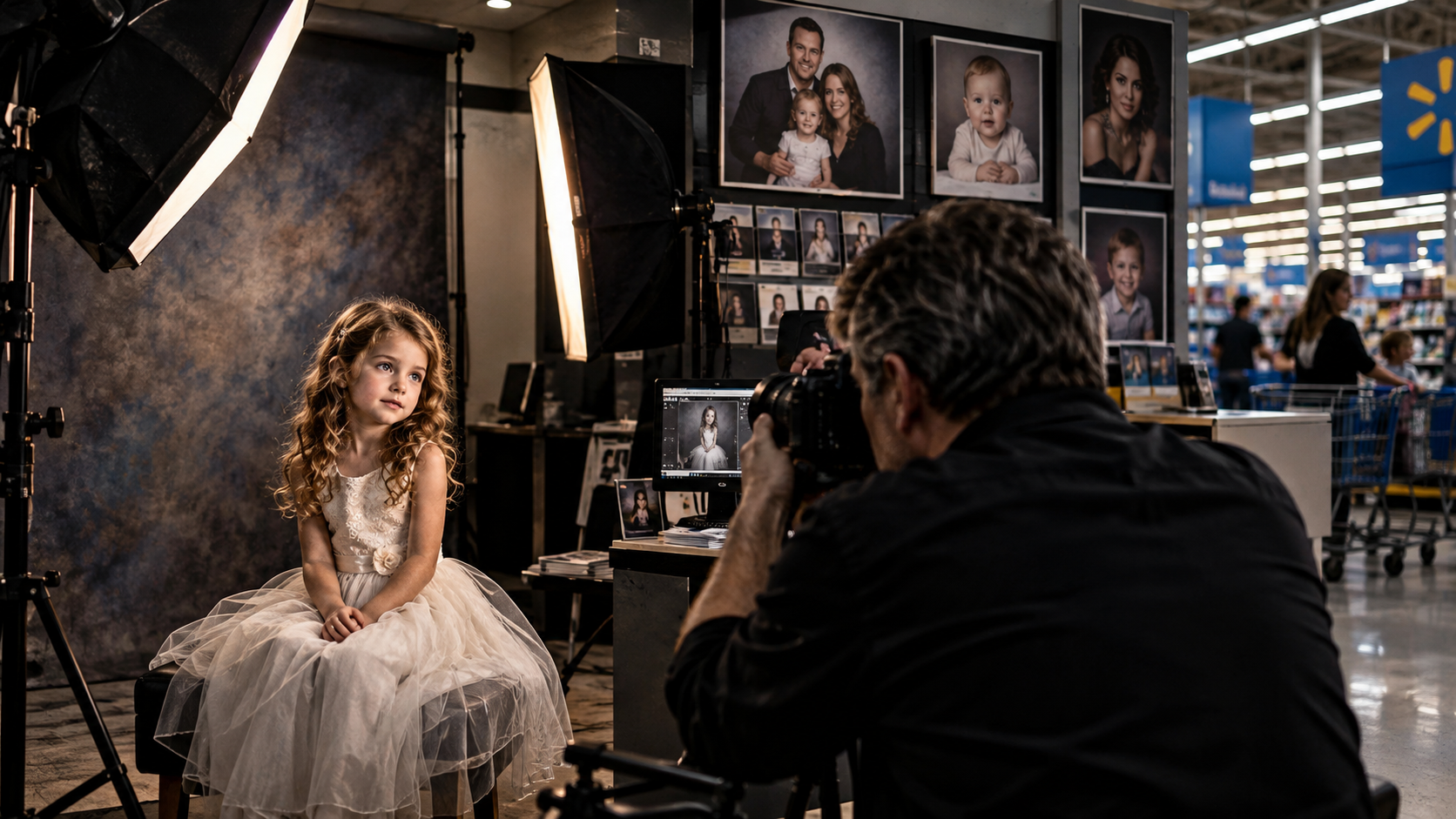
There was a time when you could walk into a Walmart, buy some groceries, pick up a few household items, and have your family photographed at a little portrait studio somewhere inside the store.
It looked professional enough.
A camera. A backdrop. Some lights. A counter displaying smiling families and adorable children.
The sign said **Walmart Portrait Studio**.
You might reasonably assume that you were dealing with professional photographers.
Well, I have some fucking news for you.
I worked in that business.
I started as a studio manager and also worked as a photographer. I worked at more than one location, saw how the operation functioned, dealt with customers, handled the money, and experienced the management culture firsthand.
And what I discovered was a business that, in my experience, cared considerably more about selling photographs than actually producing good ones.
Calling it a professional photography studio was generous.
I considered it a sales operation disguised as photography.
And eventually, they fired me for trying to do my job properly.
THEY DIDN'T WANT A PHOTOGRAPHER. THEY WANTED A SALESMAN.
Let me start with something important.
When I interviewed for the job, I made my position perfectly clear.
I was a photographer, not a salesman.
I wasn't interested in walking around Walmart harassing shoppers, trying to convince them to buy portrait packages they hadn't asked for.
Management assured me they needed a studio manager.
Fine. I could manage a studio.
I could photograph customers, handle scheduling, close the register, process orders, and take responsibility for the operation.
No problem.
But once I started working, the expectations changed.
Suddenly, I was supposed to leave the studio, walk through Walmart, approach shoppers, and persuade them to come in for photographs.
Seriously?
What the fuck did they think they had hired me for?
I refused.
If someone wanted a portrait, they could come into the studio. If the company wanted more customers, it could invest in advertising.
That's what advertising is for.
Instead, management preferred to pressure employees into acting as walking advertisements.
When they complained that my sales numbers were too low, my response was simple.
That's your problem.
You hired a studio manager and a photographer.
If you need salespeople, hire fucking salespeople.
PHOTOGRAPHY BY INSTRUCTION MANUAL
The next problem was even more ridiculous.
The company had predetermined instructions for photographing customers.
Sit the client here.
Turn the body this way.
Position the hands like that.
Use this pose.
Take this photograph.
Repeat.
Apparently, someone in an office had decided that photography could be reduced to a sequence of instructions that practically anyone could follow.
Except photography doesn't work that way.
A good portrait depends on the person standing in front of your camera.
Their face. Their expression. Their posture. Their personality.
The lighting has to complement the subject.
The composition has to work.
Sometimes the smallest adjustment changes everything.
And sometimes the pose that looks wonderful on one person looks absolutely ridiculous on another.
But the company's system prioritized repetition.
I refused to follow instructions that produced photographs I considered mediocre.
I photographed people the way I believed they should be photographed.
And here's the interesting part.
**Some customers were so pleased with their portraits that they actually left me tips.**
Imagine that.
A customer pays for a professional photography service, receives a photograph they genuinely like, and voluntarily gives the photographer additional money.
Management wanted sales numbers.
I wanted good photographs.
Apparently, these were incompatible objectives.
A CAMERA DOESN'T MAKE SOMEONE A PHOTOGRAPHER
During my employment, I visited several studios operating inside different Walmart locations.
And some of what I saw was astonishing.
People were working as photographers without demonstrating even a basic understanding of lighting.
I remember seeing a portrait of a family with dark skin photographed against a black background.
Now, there is absolutely nothing wrong with using a black background.
But when photographing dark-skinned subjects against black, you have to know how to illuminate them properly.
You need separation, controlled highlights, and an understanding of how light defines shape.
Without that, the entire image collapses into darkness.
And that's exactly what had happened.
The faces had practically disappeared into the background.
You could barely distinguish anything beyond the brightest facial features.
I looked at that photograph and wondered how anyone could consider it professional work.
But apparently, the system didn't require much photographic judgment.
It required someone who could operate the equipment, follow the instructions, and sell the resulting pictures.
And those pictures weren't necessarily cheap.
Customers could spend substantial amounts of money on packages that, in my professional opinion, often failed to justify their price.
That was the part I found particularly offensive.
If you're going to charge professional prices, you should deliver professional work.
Not assembly-line garbage.
THE STRANGE BUSINESS OF WESTERN UNION
Now here's something I experienced personally.
As a studio manager, one of my responsibilities was closing the cash register at the end of the day.
Normal enough.
But another responsibility was transferring money through Western Union.
Every week.
I personally handled those transfers.
I wasn't hearing about this from another employee.
I was the person doing it.
For a business operating a large network of portrait studios inside one of North America's biggest retail chains, it struck me as an unusual arrangement.
Why was Western Union being used to move studio funds?
Was it a matter of convenience, internal accounting arrangements, or something else?
I don't know.
And I won't pretend I know.
Using Western Union does not, by itself, establish wrongdoing.
But it is a detail worth mentioning because it illustrates how this business actually operated at the studio level.
Behind the cheerful family portraits was an organization concerned with cash handling, weekly transfers, sales figures, and operational procedures.
Photography seemed almost secondary.
THE WOMAN WHO GOT ME FIRED
And now we come to my favorite part of this whole ridiculous experience.
One day, a woman came into the studio with a problem.
She had previously purchased digital photographs.
As I remember it, the package cost somewhere around a hundred dollars, possibly more.
She needed an image for a poster or another large-format display.
And she had specifically explained what she needed when ordering.
Unfortunately, the files she received weren't suitable for the intended purpose.
The image resolution wasn't sufficient.
So she came back to complain.
I examined the files and checked what could be done.
And I discovered the problem.
The company's equipment and system were restricted.
The studio camera was physically mounted to a special stand, and the photographic workflow was locked down.
I couldn't simply change the necessary settings and produce the image she needed.
The equipment wasn't set up to provide that kind of flexibility.
So I explained the situation to her.
And I offered two solutions.
**Option one:** We refund your money because the studio can't provide what you requested.
**Option two:** Come back tomorrow. I'll bring my own camera, photograph you myself, and give you the photograph you need.
Free of charge.
No additional payment.
No argument.
No bullshit.
Just a photographer solving a customer's problem.
She was delighted.
She thanked me and agreed to return.
Problem solved.
Or so I thought.
FIRED FOR TRYING TO KEEP A CUSTOMER HAPPY
The following day, the woman came back earlier than expected.
I wasn't scheduled to start until later.
Another employee was working at the studio when she arrived.
The customer explained that I had offered to bring my own equipment and photograph her.
Apparently, that information was passed to regional management.
And suddenly, I had a problem.
Not because I had cheated a customer.
Not because I had stolen anything.
Not because I had damaged company property.
But because I had offered to use my own camera to correct a situation the company's equipment couldn't resolve.
Management objected.
I couldn't believe the stupidity of it.
I explained that I was actually trying to save the company money.
The alternative was returning what the customer had paid.
Instead, I was offering to solve the problem at no additional cost, keep the customer satisfied, and avoid a refund.
Where exactly was the fucking problem?
But management wasn't interested in my reasoning.
They were interested in procedures.
And apparently, using professional judgment outside their prescribed system was unacceptable.
The confrontation ended with my dismissal.
Fine.
If a company would rather lose a customer and an employee than allow a photographer to solve a simple photographic problem, perhaps it deserves exactly the business it gets.
That was the end of my employment.
And I never regretted leaving.
WHO WAS BEHIND THIS OPERATION?
Now let's look at the corporate history.
The portrait studios operating inside Walmart were not simply an ordinary Walmart photography department.
For years, a major operator was **CPI Corp.**, an American company headquartered in St. Louis, Missouri.
CPI's photography business traced its origins to 1942 and had a long relationship with Sears.
In June 2007, CPI acquired the portrait-studio assets of Portrait Corporation of America, extending its operations into Walmart locations.
The American studios used the **PictureMe Portrait Studio** brand, while Canadian locations operated under the **Walmart Portrait Studios** name.
At its peak, CPI operated thousands of studios across North America.
And then the business started falling apart.
In April 2013, CPI abruptly closed its American portrait studios.
On May 1, the American parent company and several affiliates entered Chapter 7 bankruptcy proceedings.
The Canadian operations followed a different path. They entered receivership but continued operating while buyers were sought.
According to the court-appointed receiver's records, hundreds of Canadian studios remained operational in 2014.
So the history was not quite as simple as every studio shutting down overnight.
But the collapse of CPI was real.
And the company's financial troubles were substantial.
[Source: CPI Corp. annual filing, U.S. Securities and Exchange Commission, 2008](https://www.sec.gov/Archives/edgar/data/25354/000002535408000046/cpify200710k.htm)
[Source: CPI Canadian receivership announcement, April 2013](https://www.newswire.ca/news-releases/cpi-corp-cpi-portrait-studios-of-canada-corp-and-cpi-canadian-images-continue-to-operate-in-the-context-of-receivership-proceedings-under-the-bankruptcy-and-insolvency-act-512277691.html)
[Source: CPI receiver's report, October 2014](https://www.ksvadvisory.com/docs/default-source/insolvency-case-documents/cpi-corp-cpi-portrait-studios-of-canada-cpi-canadian-images-/receivership-proceedings/reports/6_4478_cpi-fifthreportofreceiverfinal.pdf?sfvrsn=f0f155d5_2)
THE REAL PROBLEM WASN'T THE CAMERA
People often blame the decline of traditional portrait studios on digital cameras and smartphones.
And yes, technology changed the photography industry.
But technology alone doesn't explain everything.
A smartphone doesn't automatically make someone a portrait photographer.
Owning an expensive camera doesn't guarantee a good photograph either.
Photography requires knowledge.
Lighting.
Composition.
Technical competence.
And, perhaps most importantly, the ability to understand the person you're photographing.
Those are skills.
They aren't created by a laminated instruction sheet sitting next to a cash register.
My experience inside Walmart Portrait Studios showed me what happens when a company treats those skills as optional.
Instead of encouraging photographers to develop their abilities, the system encouraged conformity.
Instead of rewarding the quality of the portraits, management emphasized sales.
Instead of letting experienced employees resolve customer problems, it insisted on procedure.
I cannot speak for every employee or every studio in that enormous network. I worked in particular locations, under particular managers, and these are the conditions I personally encountered.
But what I encountered was enough.
THE DIFFERENCE BETWEEN SELLING PHOTOGRAPHS AND BEING A PHOTOGRAPHER
There's a fundamental distinction that too many businesses fail to understand.
Selling photographs is a commercial activity.
Photography is a profession.
The two can work together beautifully.
A competent photographer produces work people value. A well-managed business makes that work accessible, delivers it reliably, and earns money.
There is nothing wrong with making a profit.
There is nothing wrong with selling portrait packages.
But the moment a company decides that the sales pitch matters more than the photograph itself, something has gone terribly wrong.
In my case, the final insult was being fired after offering to do exactly what a professional photographer should do.
Solve the client's problem.
Deliver the image she needed.
And take responsibility for the result.
Apparently, that was too radical a concept.
**I was hired to manage a portrait studio.**
**I was expected to behave like a salesman.**
**And I was fired for behaving like a photographer.**
If that doesn't tell you something about the business, I don't know what will.
*The Antigloss | Independent Opinion*
*This article combines a former studio manager and photographer's firsthand account with publicly documented corporate history. The personal experiences and assessments reflect the author's observations and do not establish that every location or subsequent operator followed identical practices.*