Technology
Washington Is Not Defending Meta. It Is Defending the Remote Control.
Australia wants people to decide what appears in their own social-media feeds. Washington’s problem is not that an American company may lose money. Its problem is that an American instrument of influence may lose access.
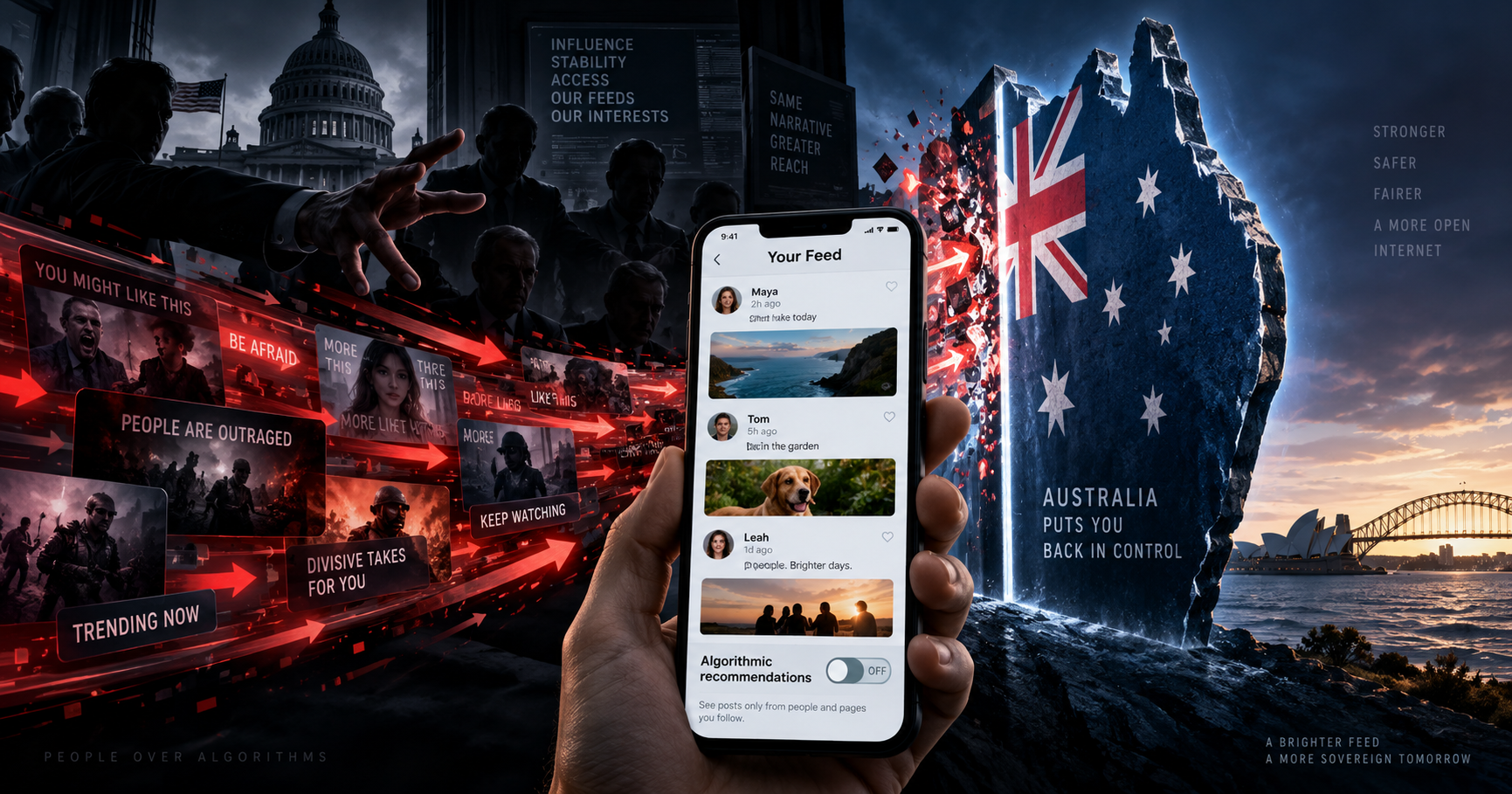
Australia has proposed something remarkably simple: social-media users should be able to decide whether an algorithm chooses what appears in front of them.
Under the proposed rules, Australians would be able to turn off algorithmically recommended content and see material from the people, pages and creators they actually chose to follow. Platforms that refuse to comply could face substantial penalties.
That sounds less like censorship than the restoration of an elementary principle.
If I follow ten people, show me those ten people.
If I do not ask Facebook to recommend politics, foreign conflicts, ideological campaigns, government messaging or the latest outrage selected by an engagement algorithm, then do not place it in front of me anyway and subsequently pretend that my anger at seeing it proves I was interested.
Australia is proposing to give the remote control back to the person holding the phone.
Washington does not appear particularly pleased.
And the usual explanation, that the United States is merely defending an American technology company, misses the point entirely.
Donald Trump does not need to care about Mark Zuckerberg’s quarterly earnings to object to what Australia is doing.
Washington has something much more valuable to protect.
It has access.
The Platform Is More Valuable Than the Company
Facebook, Instagram, X, YouTube, TikTok and the other enormous social platforms are generally discussed as businesses.
They are businesses.
But once a platform becomes capable of placing information directly in front of hundreds of millions of people across national borders, it also becomes political infrastructure.
Governments understand this perfectly well.
The United States certainly does.
American intelligence and military institutions have already used online platforms for foreign influence operations. Reuters documented a covert CIA operation authorized during Donald Trump’s first administration that used false online identities to circulate narratives inside China. Reuters also documented a secret Pentagon campaign that used fake social-media accounts to undermine confidence in China’s Sinovac vaccine among foreign audiences, particularly in the Philippines.
This is not speculation about what social media might theoretically be used for.
It has already been used that way.
The United States government also has a documented history of pressuring platforms over information distribution at home. Mark Zuckerberg himself said that officials in the Biden administration repeatedly pressured Meta to remove certain COVID-related content, including satire.
Different administration. Different issue. Same structural reality.
Washington understands that control over information distribution is power.
The platform is therefore more than a company selling advertisements between photographs of somebody’s dinner.
It is a delivery system.
And delivery systems are useful only while you retain access to them.
Australia Is Attacking the Delivery Mechanism
The important part of the Australian proposal is not that Canberra wants to ban American political content.
It does not.
An Australian who wants American political material can continue reading it.
An Australian who wants CNN can follow CNN.
An Australian who wants conservative American commentary can follow conservative American commentary.
An Australian who wants nothing except cooking videos, football and photographs of dogs can choose that instead.
What changes is the ability of the platform to insert material the user did not request.
That is the crucial distinction.
There is an enormous difference between someone voluntarily subscribing to a political source and an algorithm placing political material into his feed because the system has decided that anger, fear or outrage may keep him staring at the screen for another thirty seconds.
The first is choice.
The second is distribution.
And distribution is where influence lives.
If Australia gives the user an effective switch that says:
**Show me only what I chose to follow.**
then a very useful political mechanism disappears.
The government, intelligence service, political campaign, advocacy network or platform itself can still publish whatever it wants.
What it can no longer guarantee is unsolicited access to the user’s attention.
That is precisely why the argument is bigger than Meta.
Washington is not defending Zuckerberg’s right to make money.
Washington is defending Washington’s ability to reach people.
The Cost Problem
Now introduce the Australian fines.
Suppose the United States government wants American platforms to cooperate with its strategic priorities.
That cooperation does not have to consist of some ridiculous Hollywood scene in which a CIA officer walks into Meta headquarters carrying a folder marked PROPAGANDA.
Governments have far more sophisticated mechanisms than that.
There are official requests, intelligence relationships, national-security cooperation, regulatory pressure, political pressure, military information operations, government contracts, informal communication and the vast ecosystem connecting Washington with American technology companies.
Now imagine that complying with those priorities begins costing Meta money in Australia.
Suddenly the relationship changes.
From Meta’s perspective the question becomes brutally simple:
Why are we paying for Washington’s foreign-policy objectives?
If Australia fines the company because its recommendation systems continue pushing material that Australian users have explicitly chosen not to receive, Meta has three basic economic realities in front of it.
It can obey Australian law.
It can continue doing what Washington wants and absorb the financial penalties.
Or somebody has to make that continued cooperation economically worthwhile.
That is not prophecy.
It is arithmetic.
A private company does not indefinitely volunteer to finance the geopolitical ambitions of the government merely because both happen to possess American addresses.
If Washington considers the platform strategically important, then Washington eventually has to preserve the economic conditions under which the platform remains useful.
Compensation Does Not Require a Cheque
That does not mean Donald Trump has to walk into Zuckerberg’s office and hand him a cheque labelled:
**AUSTRALIAN PROPAGANDA FINE REIMBURSEMENT.**
States do not usually operate with that level of comic honesty.
Compensation can take many forms.
It can come through tax treatment, government contracts, regulatory concessions, political protection, diplomatic support, trade pressure or retaliatory measures against the country creating the cost in the first place.
The precise mechanism is secondary.
The logic is the important part.
If Washington needs something from Meta, and doing that thing begins costing Meta substantial amounts of money abroad, Washington either has to reduce that cost, compensate for it indirectly, pressure the foreign government into removing it, or accept that Meta may decide Washington’s requests are no longer worth the expense.
There is no magic fourth option in which shareholders happily finance American information operations forever because somebody in the Pentagon asked nicely.
This is why the American reaction to Australia deserves closer attention.
The dispute is not merely between Canberra and Silicon Valley.
It is between a government saying its citizens should control their own feeds and another government that has repeatedly demonstrated that social-media distribution has strategic value.
The Gopnik Principle of Foreign Policy
There is also nothing particularly new about the broader behavior.
The United States has spent much of its history treating access, markets, communications networks, financial systems and political influence as instruments of state power.
When another country establishes rules that interfere with those instruments, Washington frequently responds not as a disinterested referee defending some universal principle, but as a power defending its own room to operate.
The method changes with the century.
Once it was gunboats.
Then came sanctions, intelligence operations, trade pressure and financial leverage.
Now algorithms belong in the toolbox.
The underlying attitude remains familiar:
We have something useful.
You are interfering with our ability to use it.
Therefore your rules are the problem.
It is geopolitical behavior with the manners of a neighborhood bully.
The bully rarely announces that he is protecting his ability to push people around.
He explains that he is protecting freedom.
The Most Dangerous Button Is “No”
The Australian proposal contains a tiny word that is remarkably dangerous to systems built around influence.
No.
No, I do not want this recommendation.
No, I do not want this political story.
No, I do not want Facebook deciding what international conflict should occupy my attention today.
No, my anger at seeing something does not mean I want more of it.
No, my attention does not belong to an algorithm.
And once that “no” becomes legally enforceable, the entire relationship between user, platform and outside influence changes.
That is why this dispute matters.
Australia is not trying to stop Americans from speaking.
It is not trying to prevent Australians from listening.
It is trying to establish that listening must remain voluntary.
Washington’s objection therefore raises an uncomfortable question.
Why should the government of the United States care so much if an Australian citizen can prevent an American-owned algorithm from deciding what enters his own feed?
If the answer were simply commerce, the argument would be ordinary.
But American institutions have already demonstrated that these platforms can be used for influence operations, propaganda campaigns and political pressure.
That changes the meaning of the dispute.
Washington is not fighting to preserve Meta.
Meta can survive.
Zuckerberg will survive.
Facebook will survive.
What Washington risks losing is something much more valuable:
the ability to reach into another country, place something in front of somebody who never asked to see it, and call the result engagement.
Australia wants the remote control back.
Washington appears to prefer it exactly where it is.