Society
WELCOME TO OTTAWA: WHERE THE BIKE LANE IS READY BEFORE YOU ARE
In a city that receives actual Canadian winter, sixty kilometres of cycling infrastructure get their own snow-clearing regime. Because apparently February was waiting for a transportation policy.
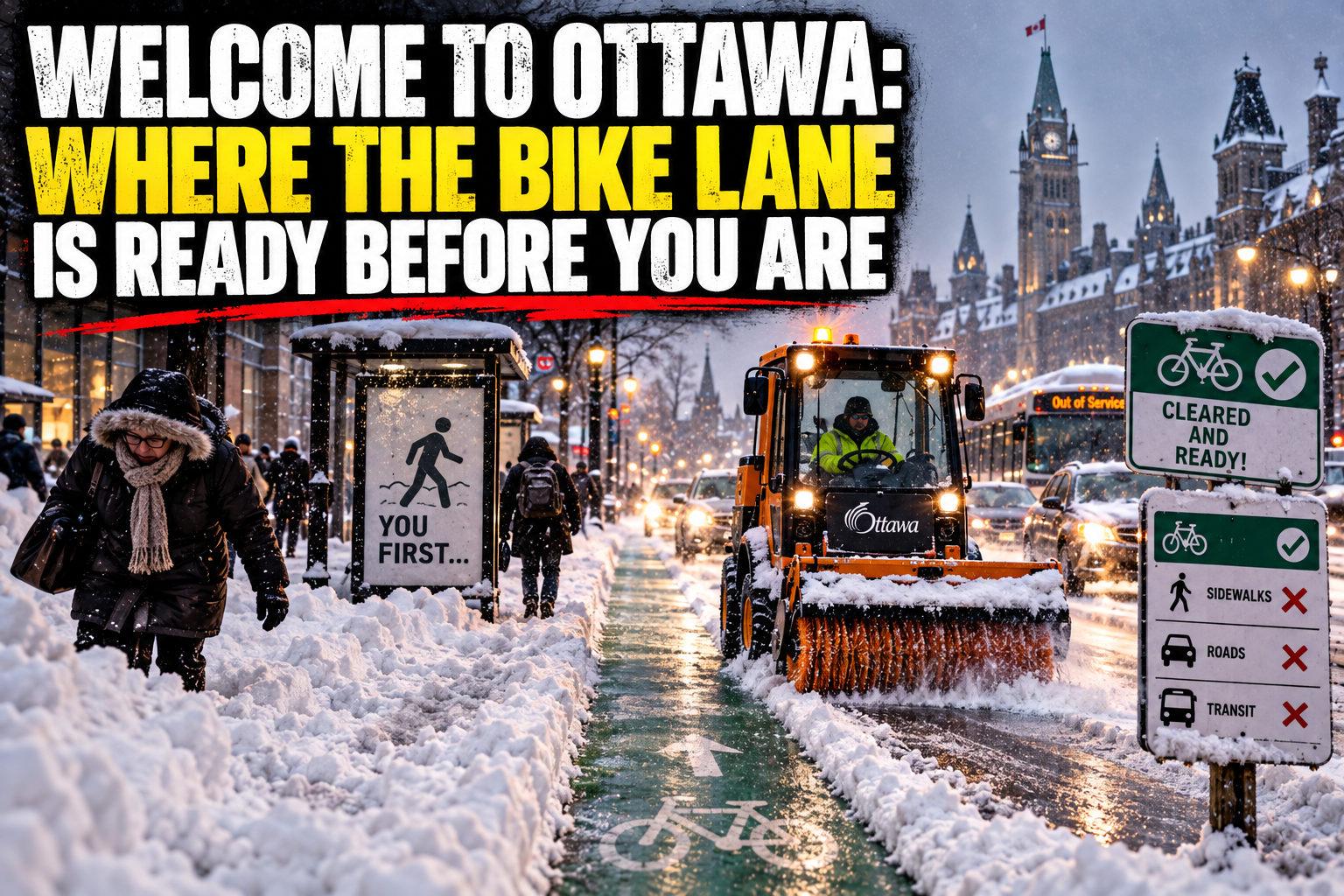
There are moments when government policy is best understood not through
budgets, council meetings or strategic plans, but through a windshield.
Mine came after a snowstorm in downtown Ottawa.
The roads were still wearing the storm. Snowbanks were growing along the
curbs. Pedestrians were making their way through the kind of snow that
reminds you Canada was not built on a Mediterranean coastline.
And then I saw it.
A little municipal tractor was clearing a bicycle lane.
There was something almost majestic about it.
Snow everywhere. People negotiating winter on foot. Cars crawling
through the aftermath.
And there, with the determination of a Zamboni preparing the ice for
Game Seven, was a machine making sure the bicycle lane was ready.
Perhaps somebody was coming.
WELCOME TO WINTER CYCLING POLICY
To be fair to Ottawa, what I saw was not some rogue snowplow operator
who had developed an unexplained personal attachment to bicycles.
This is policy.
The City of Ottawa currently maintains approximately **60 kilometres of
cycling facilities during winter**. The network has existed since the
winter of 2015-2016 and has expanded as new cycling infrastructure has
been constructed.
And Ottawa does not wait for spring to discover it.
According to the City's current snow-clearing standards, downtown
sidewalks **and the winter cycling network** enter the clearing schedule
after just **2.5 centimetres of snow accumulation**. The target is to
complete them within as much as four hours after the snowfall ends.
Residential sidewalks enter the schedule at five centimetres and may
take twelve to sixteen hours.
Residential roads enter at seven centimetres or more and may take ten to
sixteen hours after the snow ends.
Now, an important clarification before somebody arrives wearing a
bicycle helmet and carrying a municipal PDF:
Ottawa does **not** officially say, "Clear the bicycle lane before the
downtown sidewalk."
They share the same early threshold.
So if you see a beautifully cleared bicycle lane beside a miserable
downtown sidewalk, that individual scene does not prove the city has
formally ranked bicycles above pedestrians.
But it does reveal something else.
Ottawa has made the deliberate policy decision that its winter cycling
network belongs in the same early-response category as downtown
pedestrian infrastructure.
That is a legitimate policy choice.
It is also a policy choice taxpayers are perfectly entitled to question.
SIXTY KILOMETRES OF FEBRUARY OPTIMISM
Ottawa is not Copenhagen with a colder Instagram filter.
This is a city with serious winter.
Snowstorms do not merely decorate the roofs. They consume road capacity,
narrow intersections, obstruct sightlines, bury parking spaces,
complicate garbage collection, interfere with buses and turn an ordinary
trip down a residential street into a negotiation between two vehicles
over which one gets the remaining strip of asphalt.
The city itself describes the scale of the job.
Its 2026 budget material says Ottawa maintains more than **12,750
lane-kilometres of roads**, more than **2,600 kilometres of sidewalks
and pathways**, and approximately **60 kilometres of winter-maintained
cycling lanes**.
That is an enormous winter operation.
And precisely because it is enormous, priorities matter.
Every snowplow has an operator.
Every sidewalk machine costs money.
Every pass burns fuel, consumes labour, wears equipment and occupies
time that cannot simultaneously be spent somewhere else.
There is no magical warehouse behind City Hall containing an infinite
number of tiny tractors.
Resources allocated to one task are resources that cannot be in two
places at once.
That does not mean bicycle lanes should never be cleared.
It means "we clear bicycle lanes" is not the end of the discussion.
It is the beginning of one.
HOW MANY PEOPLE ARE WE CLEARING THEM FOR?
This is the question that should accompany every transportation policy.
Not:
"Is cycling good?"
That is a slogan masquerading as analysis.
The useful question is:
**How many people actually use this infrastructure under the conditions
in which taxpayers are paying to maintain it?**
Cycling is useful transportation.
In warm weather, Ottawa's cycling infrastructure can carry commuters,
recreational riders, students and tourists. For some trips, a bicycle is
cheaper, healthier and more convenient than a car.
None of that requires pretending January is July.
Winter changes transportation behaviour because human beings possess
nerve endings.
Temperature matters.
Snow matters.
Ice matters.
Darkness matters.
Distance matters.
The need to arrive somewhere without looking as though you crossed
Greenland on foot matters.
Ottawa itself openly treats winter cycling as a policy objective. Its
Official Plan says winter-maintenance standards should support priority
active-transportation networks and help achieve active-transportation
mode-share targets.
Its own monitoring report celebrated an increase in the
winter-maintained cycling network from 54 kilometres in 2022 to 61
kilometres in 2023, along with an increase in winter-maintained bicycle
racks.
That is revealing.
The city is not merely reacting to existing winter bicycle traffic.
It is using winter maintenance as one instrument for encouraging more of
it.
Again, that is a legitimate political decision.
But once government deliberately spends public resources to change
transportation behaviour, the public gets to ask whether the results
justify the resources.
THIS IS NOT ABOUT HATING BICYCLES
There is a strange ritual in modern transportation politics.
Question a bicycle policy and someone immediately behaves as though you
have proposed hunting cyclists for sport.
No.
Bicycles are useful.
Bike lanes can make sense.
Separating bicycles from fast automobile traffic can improve safety for
everyone.
A well-designed cycling network can reduce some short car trips.
Fine.
But useful infrastructure does not become exempt from cost-benefit
analysis simply because it is painted green.
Roads should justify expenditure.
Transit should justify expenditure.
Parking should justify expenditure.
Pedestrian infrastructure should justify expenditure.
Cycling infrastructure should justify expenditure.
The bicycle is a transportation device, not a sacred cow with
handlebars.
THE SIDEWALK MATTERS TOO
Ottawa deserves credit for something that complicates the easy version
of this argument.
The city has actually increased its attention to pedestrian winter
maintenance.
A 2025 review says approximately **250 of Ottawa's 540
winter-maintenance resources** were then assigned to clearing roughly
2,500 kilometres of sidewalks and pathways. The city also moved toward
round-the-clock sidewalk and pathway deployment and specifically
identified accessibility and injury prevention as priorities.
Good.
That is exactly why the discussion should not be reduced to "Ottawa
hates pedestrians and loves bicycles."
Reality is more interesting.
Ottawa is trying to maintain roads, sidewalks, transit routes, pathways
and cycling infrastructure simultaneously across an enormous
municipality during Canadian winter.
The question is whether the balance is right.
Because the pedestrian struggling through snow does not experience a
policy matrix.
The driver squeezing between snowbanks does not experience a
Transportation Master Plan.
The elderly person approaching an icy crossing does not experience a
mode-share target.
They experience snow.
And when they look across the street and see specialized machinery
carefully clearing a bicycle lane, they are entitled to wonder whether
the city's priorities match the transportation reality outside City
Hall.
WINTER DOES NOT READ STRATEGIC PLANS
There is a broader problem here.
Governments increasingly design transportation systems around the
behaviour they would like citizens to adopt rather than exclusively
around the behaviour citizens actually exhibit.
Sometimes that works.
Infrastructure can change habits.
Build a useful transit line and people may stop driving.
Create a safe walking route and people may walk.
Connect a cycling network properly and cycling can increase.
But there is a point where policy encounters climate.
Ottawa can paint lines.
It can build separated lanes.
It can publish cycling maps.
It can maintain bicycle racks in winter.
It can send little tractors into snowstorms.
What it cannot do is repeal February.
The proper question is therefore not whether winter cycling should
exist.
Of course it should exist for people who want it.
The question is how much scarce winter-maintenance capacity should be
dedicated to it, at what service standard, and based on what actual
winter usage.
Those answers should come from measurable demand, safety outcomes and
transparent costs.
Not aspiration.
SHOW US THE NUMBERS
Fortunately, this argument does not require another ideological battle
between motorists and cyclists.
It requires arithmetic.
For Ottawa's winter cycling network, publish clearly and prominently:
How many bicycle trips occur on maintained routes during December,
January and February?
How does that compare with summer use?
What does winter maintenance of the cycling network cost annually?
How many staff-hours and machine-hours does it consume?
Which routes have substantial winter demand and which have very little?
How much does each route cost to maintain relative to actual use?
And when a major storm strains the system, what criteria determine
whether a machine clears a bicycle facility, sidewalk or roadway next?
Those numbers would allow residents to decide whether sixty kilometres
is too much, too little or approximately right.
Without them, transportation policy becomes theatre performed with
snowplows.
THE LITTLE TRACTOR
I still remember that little machine.
Not because clearing a bicycle lane is inherently ridiculous.
It isn't.
I remember it because it produced one of those perfect visual summaries
of government.
Around it was Canadian winter in its natural habitat: snowbanks,
pedestrians, traffic, reduced road space and the general logistical
disaster created whenever the sky deposits several tonnes of frozen
water onto a city.
And through the middle of it went a carefully cleared bicycle lane.
Perhaps cyclists were about to arrive by the hundreds.
Perhaps ten were coming.
Perhaps two.
I don't know.
That is precisely the point.
The city should know.
If winter cycling demand justifies the resources, publish the evidence
and maintain the network.
If particular routes are heavily used, clear them.
If others are barely used in deep winter, reconsider their priority
during major storms.
That is not anti-cyclist.
It is called managing a city.
Ottawa already has winter.
It already has snow.
It already has more than twelve thousand lane-kilometres of roads and
thousands of kilometres of sidewalks and pathways to maintain.
The only thing it does not have is infinite equipment, infinite workers
or infinite money.
So the next time the snow comes down and the little tractor heads
proudly toward the bicycle lane, there should be a simple answer to a
simple question:
**Who exactly are we clearing this for?**
Because in Ottawa, apparently, the bicycle lane may be ready for winter
before the rest of us are.