Psychology
# When Your Brain Is Wrong, Blame CERN
The Mandela Effect, accelerated time, and the extraordinary human determination to hold the universe responsible for cognitive errors.
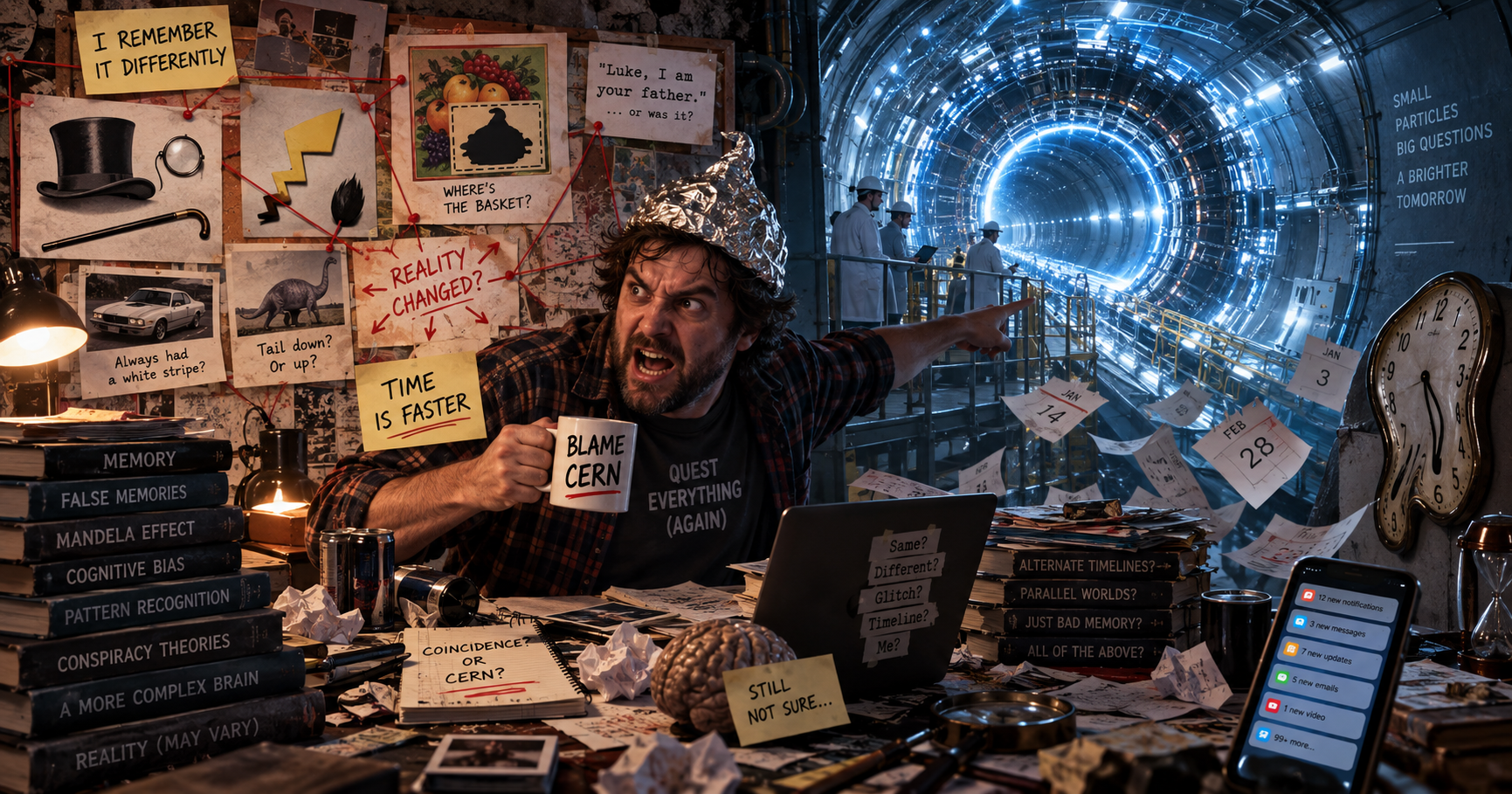
Something terrible has happened to reality.
The Monopoly Man has lost his monocle.
Pikachu's tail has changed.
Logos are wrong.
Movie lines are wrong.
Things you distinctly remember seeing apparently never existed.
Years are passing too quickly.
Christmas arrives approximately every six weeks.
It was January yesterday and somehow somebody has already started discussing Halloween.
There are several possible explanations.
Human memory is imperfect.
Human perception of time is subjective.
Age, routine, attention and the structure of memory alter the way years feel retrospectively.
Or:
**Some physicists in Switzerland switched on a very large machine and accidentally fucked up reality.**
Naturally, the internet has given this possibility considerable attention.
Welcome to the modern Mandela Effect.
The phenomenon itself is real.
The explanation involving damaged timelines is somewhat less established.
The Mandela Effect describes a strange but well-documented experience in which large numbers of people confidently remember the same thing incorrectly.
Not randomly incorrectly.
**The same wrong thing.**
One of the most famous examples is Rich Uncle Pennybags, better known as the Monopoly Man.
Many people remember him wearing a monocle.
He does not.
Pikachu is frequently remembered with a black tip on his tail.
He does not have one.
These are not merely anecdotes collected from people arguing online at two in the morning. Researchers at the University of Chicago experimentally studied what they called the **Visual Mandela Effect** and found something genuinely fascinating: people can form consistent, specific and confident false memories of familiar images even though their normal visual exposure has overwhelmingly been to the correct versions.
That is interesting.
Very interesting.
What it does not demonstrate is that Switzerland has developed a timeline-editing machine.
There is an important distinction here.
**The Mandela Effect is evidence that something interesting happens in human memory.**
It is not evidence that something interesting happened to spacetime.
Unfortunately, this explanation suffers from a catastrophic public-relations problem.
It requires admitting:
**I remembered something incorrectly.**
And human beings are remarkably resistant to that possibility.
We prefer an alternative.
My memory is perfect.
Therefore reality must have changed.
This is an astonishing level of self-confidence.
Imagine opening a drawer and discovering that your keys are not where you remember leaving them.
Most people might conclude:
Perhaps I left them somewhere else.
The Mandela-CERN school of epistemology offers another possibility:
**The Standard Model of particle physics has collapsed.**
It is difficult to compete with that.
Enter the Large Hadron Collider
CERN is almost unfairly perfect for conspiracy theories.
It has underground tunnels.
Gigantic machinery.
Particles travelling close to the speed of light.
Words such as antimatter, quarks, bosons, dark matter and quantum fields.
Scientists wearing badges.
Restricted areas.
Magnets powerful enough to make ordinary household objects feel inadequate.
If central casting were asked to build a facility where humanity accidentally tears a hole through reality, it would probably look suspiciously like CERN.
And there is one historical detail that makes the story even more seductive.
The Large Hadron Collider really did become more powerful.
Early LHC collisions operated at lower energies. After a major shutdown and upgrade, Run 2 began in 2015 at a collision energy of 13 TeV. Later, Run 3 reached 13.6 TeV.
In internet language:
**First they turned it on.**
Nothing happened.
**Then they turned it up.**
And now your childhood cereal box looks wrong.
Case closed.
Except not quite.
The leap from “particle accelerator increased collision energy” to “human memories were retroactively rewritten” contains a small gap.
Approximately the size of physics.
There is no established mechanism by which proton collisions at CERN would edit historical events, rewrite product logos, alter movie dialogue throughout the past or selectively leave behind a few people who remember the previous version.
And nature itself has been conducting experiments considerably more energetic than CERN for billions of years.
Cosmic rays striking Earth's atmosphere can carry energies far beyond those produced by the LHC. CERN notes that these natural high-energy particles have bombarded Earth since its formation and can reach energies enormously greater than accelerator beams.
If sufficiently energetic particle collisions routinely shuffled humanity between timelines, the universe has apparently been operating the shuffle button for approximately 4.5 billion years.
Yet nobody remembers Tuesday being deleted.
But What About Time?
This is where the theory becomes even better.
According to another increasingly popular version of the story, CERN did not merely modify reality.
It accelerated time.
People feel that years are passing faster.
Therefore:
particle collider.
Again, there is a fascinating phenomenon underneath the nonsense.
**People really do feel that time passes differently.**
Ask someone approaching middle age whether the last decade disappeared faster than summers did when they were eight years old and there is a decent chance you will receive an enthusiastic yes.
There is even a wonderfully intuitive explanation.
When you are five, one year represents one fifth of your entire life.
When you are fifty, one year represents one fiftieth.
Therefore each additional year constitutes a progressively smaller fraction of everything you have experienced.
It is an elegant idea.
It may contain part of the subjective intuition.
It is also not a complete scientific explanation.
One large study involving 1,865 adults aged sixteen to eighty found surprisingly small age differences in judgments about how quickly shorter periods such as weeks, months and years passed. A clearer age-related difference appeared when people judged the previous decade. The researchers found stronger support for **time pressure**, the feeling that there is simply too much to do and too little time available, than for a simple universal law that aging automatically makes all time accelerate.
In other words, your calendar may not be moving faster.
Your life may simply contain more shit.
There are bills.
Work.
Children.
Messages.
Emails.
Appointments.
Notifications.
News.
More notifications.
A phone demanding attention before your feet reach the floor.
Twenty browser tabs.
Three wars.
Seven political scandals.
A delivery notification.
Somebody from work asking whether you saw the email they sent eight minutes ago.
Facebook showing you something you specifically told Facebook not to show you.
Then lunch.
Then somehow Thursday.
The adult brain is not experiencing the clean, enormous landscapes of childhood time.
It is processing a crowded information terminal.
And retrospective memory creates another complication.
A childhood year can contain extraordinary novelty.
First school.
First bicycle.
First vacation remembered clearly.
First time seeing snow.
First girlfriend.
First job.
First car.
Each experience creates distinct landmarks.
Compare that with ten years of waking at similar times, driving similar routes, working similar jobs, buying groceries from the same store and paying approximately the same collection of bills.
The days were lived.
But when reconstructed later, many of them compress.
The brain does not necessarily preserve every Tuesday as a separate museum exhibit.
It creates categories.
Work.
Winter.
That apartment.
That job.
COVID.
Before COVID.
After COVID.
That fucking renovation.
And suddenly five years occupy the psychological storage space previously required for one summer.
No particle accelerator is required.
There Is Also One Rather Awkward Problem
If CERN is responsible for making time accelerate, the conspiracy currently has an engineering problem.
The LHC's Run 3 ended in June 2026.
The accelerator has entered a long shutdown while CERN transforms it for the High-Luminosity LHC. CMS says its next particle collisions are expected in 2030.
So CERN has, in effect, turned the machine off.
This provides us with an excellent opportunity.
Watch the calendar.
If October now takes seventeen months to arrive, CERN is cleared.
If Christmas still appears immediately after you put the decorations back in the basement, perhaps the culprit was never the proton beam.
I eagerly await TikTok's peer-reviewed findings.
The Real Mandela Effect Is More Interesting Than the Fake One
This is the frustrating part.
There is no need to invent broken universes.
Human memory is already weird enough.
Memory is not a video file.
You do not press Play and retrieve an untouched recording stored somewhere behind your forehead.
Remembering is reconstructive.
The brain rebuilds events from stored elements, associations, expectations and existing knowledge.
That means memory can be astonishingly useful while occasionally being astonishingly wrong.
And confidence does not guarantee accuracy.
That last part matters.
The disturbing feature of a false memory is not that you vaguely think something may have happened.
It is that you can be **certain**.
You can see it.
You can describe it.
You can argue about it.
You can tell somebody:
“No, no, I fucking remember this.”
And still be wrong.
The University of Chicago experiments are fascinating precisely because they show that these errors are not always random individual glitches. Different people can converge on the same incorrect version.
That does not require telepathy.
It does not require dimensional leakage.
People share cultural associations.
A wealthy old-fashioned gentleman in a top hat, with a moustache and cane, fits a familiar stereotype that also includes a monocle.
The brain knows the visual grammar.
So sometimes it completes the picture.
That is not evidence that the past changed.
It is evidence that brains have autocomplete.
Congratulations.
You have been using generative AI since birth.
Humanity Versus the Possibility of Being Wrong
This is where the Mandela Effect stops being merely a funny internet phenomenon and becomes a wonderfully revealing portrait of human psychology.
We have encountered evidence that memory can be unreliable.
A sensible reaction would be:
**Interesting. Human cognition is stranger than I thought.**
Instead, part of humanity has responded:
**Absolutely not. I distinctly remember a cornucopia, therefore physicists have modified the universe.**
There is something magnificent about the arrogance.
Faced with a disagreement between personal memory and independently verifiable evidence, we have constructed a hierarchy of possible failure:
The photograph could be wrong.
The archive could be wrong.
The company could be wrong.
History could be wrong.
Physics could be wrong.
Causality could be wrong.
The universe could have split.
But my recollection from a cereal packet I saw thirty-two years ago?
**Rock solid.**
The modern conspiracy theorist possesses a remarkable form of humility.
When his memory disagrees with the evidence, he is perfectly willing to admit that the entire universe may be malfunctioning.
CERN Is the Perfect Villain Because Nobody Knows What CERN Does
This is another reason the theory survives.
Most people, quite reasonably, do not understand particle physics.
Neither do I at the level required to design a collider.
Neither do almost all of the people posting videos explaining what the collider has secretly done to spacetime.
But ignorance creates a useful blank canvas.
A toaster is a terrible conspiracy villain because everyone understands what happens when you put bread inside one.
The Large Hadron Collider is excellent.
“What does it do?”
“It collides hadrons.”
“What happens then?”
“Physics.”
“What kind?”
“Very advanced.”
“Could it alter reality?”
“Well, reality is made of physics.”
**Bingo.**
We have a six-part YouTube documentary.
This rhetorical trick appears everywhere.
Take an object sufficiently complicated that most people cannot personally verify its operation.
Insert scientific vocabulary.
Add ominous music.
Ask a question instead of making a falsifiable claim.
**What if CERN didn't just discover the Higgs boson?**
I don't know, Kevin.
What if Costco secretly controls Jupiter?
Questions are inexpensive.
Evidence remains irritatingly costly.
And Yet Reality Continues
There is a much simpler way to approach all of this.
The Mandela Effect?
Interesting phenomenon in memory research.
The feeling that years accelerate?
Interesting phenomenon in time perception and autobiographical memory.
CERN?
Interesting particle-physics laboratory.
These things can all be interesting simultaneously without being causally connected.
This possibility seems strangely disappointing to the internet.
Apparently reality must contain a screenplay.
CERN turns up the collider.
The timeline fractures.
People retain fragments of the old universe.
Time accelerates.
Only a chosen few notice.
And somehow the principal evidence of this cosmological catastrophe is that a cartoon character's tail looks slightly different from what somebody remembers.
If humanity ever genuinely crosses into another universe, I sincerely hope the evidence is more impressive.
I want two moons.
Gravity pointing sideways.
France suddenly understanding customer service.
Something.
Not:
**“Didn't this logo used to have a basket?”**
Your Brain Is Wrong. The Universe Is Probably Fine.
That may ultimately be the least satisfying conclusion.
There appears to be no cosmic villain.
No broken timeline.
No secret switch underneath Geneva labeled **REALITY: NORMAL / FUCKY**.
There is only a human brain doing what human brains have always done.
Remembering.
Compressing.
Associating.
Reconstructing.
Occasionally getting things wrong.
And then becoming extremely annoyed when documentary evidence refuses to cooperate.
CERN did not need to break reality.
Reality merely exposed how much confidence we place in a memory system that was never designed as an evidentiary archive.
And perhaps that is why the Mandela Effect refuses to die.
The supernatural explanation protects something very important.
Not history.
Not physics.
**Our ego.**
Because “the universe changed” contains one comforting implication:
**I was right.**
And for some people, apparently, preserving that conclusion is worth rewriting the entire cosmos.
Still, we should be grateful.
There remains one group capable of making the Mandela-CERN crowd look almost restrained.
At least they agree that Earth is a planet.
Next time, we should talk about the people who believe it is flat.