Media
WHO GAVE THE WEST A MONOPOLY ON FREE SPEECH?
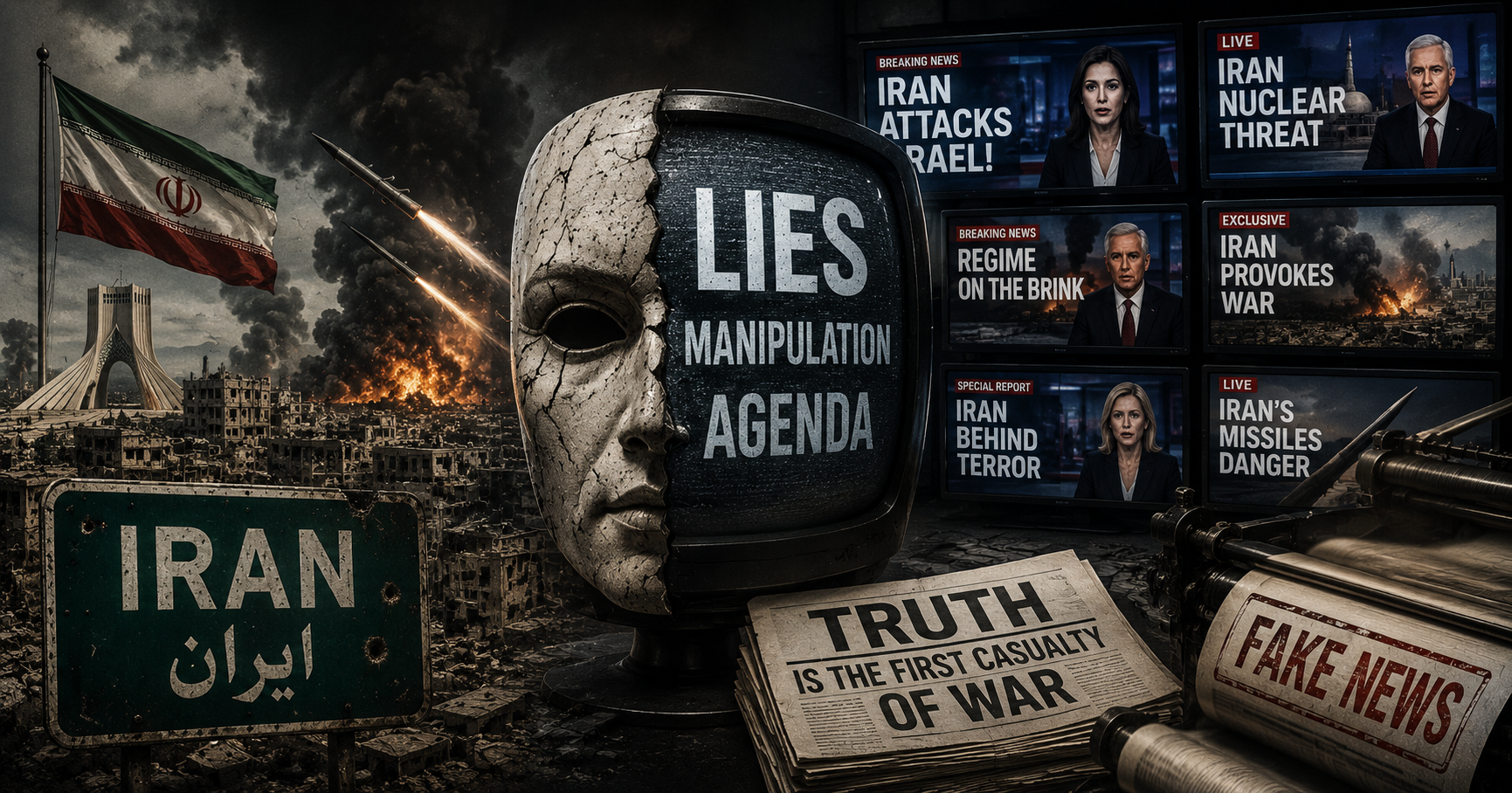
Iran wants to restrict contact with “hostile” foreign media. Western journalists know exactly what to call that. They are considerably less interested in examining their own record.
Iran has done something that practically writes its own Western headline.
Its parliament has advanced legislation that would criminalize unauthorized interviews and other cooperation with media organizations the Islamic Republic classifies as hostile. The proposed penalties include six months to two years in prison. Contact with other foreign media would be subject to notification requirements, while some contacts with foreign organizations and embassies would require government permission.
The legislation is not yet fully law. Its individual provisions still require parliamentary consideration and it must ultimately pass the Guardian Council.
The predictable vocabulary has already arrived.
Press freedom.
Free expression.
Independent journalism.
These are important words.
Which is precisely why nobody should be allowed to own them.
Especially not an industry whose own history contains some spectacular demonstrations of what happens when inconvenient facts collide with a preferred narrative.
The Girl Who Ruined the Story
In August 2008, American television had an excellent story.
Russia had invaded Georgia.
It was simple, understandable and politically convenient.
Then a twelve-year-old girl appeared on television.
Amanda Kokoeva was an American resident who had been visiting relatives in Tskhinvali when the war began. Fox News interviewed her together with her aunt, Laura Tedeeva-Korewicki.
There was only one problem.
Amanda thanked the Russian soldiers.
She said they had saved her.
Her aunt blamed Georgian president Mikheil Saakashvili for starting the war.
The interview went to a commercial break. Afterward, the aunt was given additional time and continued making her case. So the popular internet version in which Fox simply “silenced” them and never allowed them to speak again exaggerates what happened.
The more interesting fact requires no exaggeration at all.
**The witnesses did not fit the story.**
And subsequent evidence made the discrepancy considerably more uncomfortable.
The Independent International Fact-Finding Mission established by the European Union later stated plainly that on the night of August 7–8, 2008, a sustained Georgian artillery attack struck Tskhinvali. Its report said that open hostilities began with a large-scale Georgian military operation and massive artillery attack against Tskhinvali and surrounding areas.
The mission also examined the longer history of tensions, violence and accusations surrounding the conflict, and it criticized subsequent Russian military operations extending deep into Georgia. History rarely supplies the tidy morality play television prefers.
But on the crucial immediate question — **what began the large-scale fighting that night?** — the report is remarkably clear.
Even contemporary Fox reporting acknowledged that Georgia had launched an offensive to retake South Ossetia and that some regional experts blamed Saakashvili for initiating the crisis.
That distinction matters.
Because an ordinary journalistic error works like this:
**The facts change. Therefore the conclusion changes.**
A narrative works differently:
**The facts change. Somehow the conclusion survives.**
And once you notice the difference, modern media become considerably more interesting.
Sorry About the War
South Ossetia was hardly the most consequential example.
Before the 2003 invasion of Iraq, some of America's most prestigious journalism amplified claims that Saddam Hussein possessed weapons of mass destruction.
Those weapons became one of the central public arguments for a war.
They weren't found.
In May 2004, *The New York Times* performed an extraordinary act of institutional self-examination. Its editors reviewed the newspaper's own reporting and admitted that some of it had not been sufficiently rigorous.
The newspaper acknowledged relying partly on Iraqi defectors and exiles who actively wanted regime change. It acknowledged that controversial information had sometimes been insufficiently qualified. It acknowledged that alarming claims tended to receive prominent treatment while reporting that undermined them sometimes received considerably less attention.
That is not a typo correction.
That is a newspaper acknowledging failure in its handling of information used to justify a war.
The correction arrived after the war had begun.
There is something wonderfully asymmetrical about modern journalism's correction mechanism.
The headline gets the audience.
The correction gets the archive.
First the Headline. Then Reality.
The mechanism did not disappear with Iraq.
In November 2022, the Associated Press issued an urgent report saying Russian missiles had crossed into Poland and killed two people.
Poland is a NATO member.
The implications of Russia deliberately striking NATO territory hardly require explanation.
The report was wrong.
The missile was widely assessed to have been a Ukrainian air-defense missile fired during the response to a Russian attack. AP formally corrected the story, fired the reporter it considered primarily responsible and reviewed its anonymous-sourcing procedures. AP itself later called the original report an “egregious” error.
That response deserves credit.
But it also demonstrates the problem beautifully.
A news organization can transmit an extraordinarily consequential claim around the planet in minutes.
The truth may arrive tomorrow.
There is no mechanism requiring the emotional, political and social consequences of the first report to return themselves for a refund.
The same problem appeared after the explosion at Gaza's Al-Ahli hospital in October 2023.
Early *New York Times* coverage prominently carried Palestinian claims attributing the explosion to an Israeli strike and reporting hundreds of casualties.
As contradictory evidence emerged, the presentation changed.
The Times eventually published an editor's note acknowledging that its early coverage had relied too heavily on Hamas claims, had not adequately conveyed what remained unverified and had left readers with an incorrect impression about what was actually known.
Again:
Headline first.
Certainty first.
Correction later.
And then everybody politely pretends those things have equal reach.
What Exactly Is a Free Press Free From?
This brings us to the phrase **free press**.
Freedom from direct government censorship is obviously important.
But it is not the only form of pressure capable of determining what the public hears.
A journalist can be legally free to speak while operating inside an institution with owners, editors, employment contracts, professional incentives, access journalism, audience expectations and an accepted political vocabulary.
None of those things requires a Ministry of Truth.
That does not mean every Western journalist is controlled.
It does not mean every Western news organization lies.
And it certainly does not mean journalists elsewhere are automatically freer.
It means something considerably simpler:
**Western media do not own the concept of free speech merely because they repeat the phrase more often.**
Freedom of speech is meaningful precisely when the speaker says something the institution around him does not want said.
Otherwise it is merely freedom to agree.
And there is a peculiar arrogance in media institutions judging the information systems of the entire planet while treating their own institutional pressures as fundamentally different from everybody else's.
Sometimes they are different.
Sometimes they are not.
“No, this is different” is not an argument.
It is a slogan awaiting evidence.
### When the West Bans the Press
There is an even simpler problem with the Western lecture on foreign media.
The West has already accepted the principle that a foreign news organization can cease to be treated merely as “the press” and instead be treated as an instrument of hostile state influence.
It accepted that principle when the organization was Russian.
In March 2022, Canada's broadcasting regulator removed RT and RT France from the list of non-Canadian programming services authorized for distribution. The CRTC concluded that continued authorization was not in the public interest and cited concerns about programming that could expose Ukrainians to hatred or contempt. Canadian distributors could therefore no longer carry the channels.
The European Union went further. On March 2, 2022, it suspended the broadcasting activities of RT and Sputnik across the EU, describing them as instruments of systematic information manipulation and disinformation connected to Russia's war against Ukraine. The restrictions covered RT English, RT UK, RT Germany, RT France and RT Spanish, as well as Sputnik.
Whatever one thinks of RT's journalism is almost beside the point.
The important thing is that **the principle has already been conceded**.
A government may decide that an organization calling itself a news organization is also functioning as an instrument of a foreign state. It may decide that the organization's information activities create a national-security or public-interest problem. And Western governments have demonstrated that, under those circumstances, they consider restrictions on distribution legitimate.
Then Iran applies the same general category of reasoning to media organizations it considers hostile, and suddenly the vocabulary changes.
Now the central concept is **press freedom**.
This does not prove that Iran's restrictions are justified. Nor does Canada's or the European Union's treatment of RT prove that every restriction imposed on foreign media is legitimate.
It proves something considerably more inconvenient:
**The argument is no longer about whether a state may ever treat foreign media as instruments of political influence. Western governments have already answered that question for themselves.**
The remaining argument is about **who gets to make that determination — and why the answer appears to change depending on who is doing the restricting.**
When we do it, we are protecting the information environment.
When they do it, they are attacking freedom of the press.
Apparently, this is “different”.
And Now Iran
Which finally returns us to Tehran.
Iran's proposed legislation is severe.
A government potentially imprisoning someone for speaking to a foreign journalist is a substantial exercise of state power. Pretending otherwise would be ridiculous.
But another proposition is equally worthy of examination:
**A foreign media organization is not automatically a politically neutral actor simply because “PRESS” is printed on somebody's credentials.**
Governments use information.
Intelligence services use information.
Activists use information.
Corporations use information.
Militaries use information.
And, intentionally or otherwise, media organizations can become channels through which all of them operate.
Iran explicitly presents its proposed restrictions as protection against foreign influence and organizations it considers hostile.
Western governments and newspapers are entitled to challenge that justification.
What they are not entitled to is exemption from scrutiny of their own record.
The question therefore isn't whether every Iranian restriction is justified.
It isn't.
The question is why the West expects the rest of the world to begin every discussion with the assumption that a Western media organization is an impartial observer whose access is synonymous with freedom itself.
Iraq should have killed that assumption.
Tskhinvali should at least have injured it.
Poland should have frightened it.
Al-Ahli should have embarrassed it.
Yet somehow the sermon survives.
Nobody Has a Monopoly on Propaganda
Perhaps we have been using the wrong categories.
Perhaps the modern information divide is not between countries that have propaganda and countries that have a free press.
Perhaps it is between systems whose political relationship with information is obvious and systems sophisticated enough to call their own political assumptions **journalism**.
A state broadcaster can propagandize.
So can a private broadcaster.
A government can suppress an inconvenient fact.
So can an editor.
A government official can lie.
So can an anonymous intelligence source.
And a newsroom can repeat that lie with a respectable logo above it.
The difference between journalism and propaganda therefore cannot simply be **who owns the microphone**.
It has to be what happens when reality contradicts the story.
Does the conclusion change?
Does the institution seriously examine why it got the story wrong?
Does the inconvenient witness remain inconvenient?
Or does the vocabulary merely change until the old conclusion fits the new facts?
Because there is no freedom of speech worthy of the name if freedom applies only to speech that survives the editorial filter.
And there is certainly no moral monopoly on free speech belonging to institutions that have repeatedly demonstrated that **being free to publish and being willing to publish inconvenient truth are not the same thing.**
Iran may have many questions to answer about its new law.
Western media have one to answer first.
**Who appointed you the referee?**