Media
Why Stop at Putin? Nicholas II Started Alberta Separatism
Canada has discovered Russian influence in Alberta. Unfortunately, Alberta appears to have started complaining about Ottawa more than a century before the operation began.
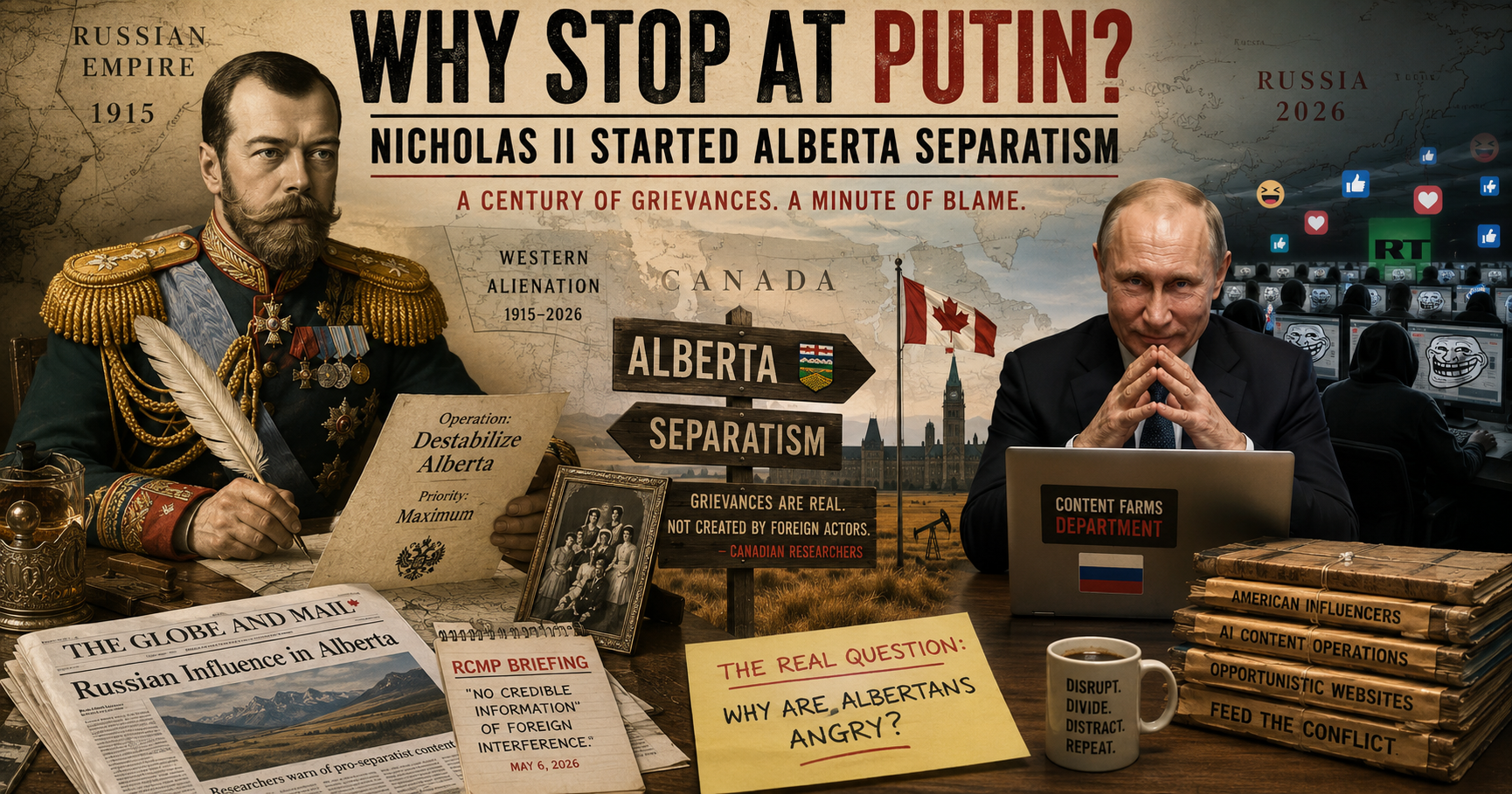
Canada has found the culprit.
Albertans are angry with Ottawa. Some of them talk about separation. Foreign websites publish stories about it. Social-media accounts repeat those stories.
And somewhere, inevitably, appears Vladimir Putin.
Russian-linked content networks, Canadian researchers warn, are amplifying Alberta separatism and anti-government grievances online.
Serious stuff.
But there is an obvious historical problem.
**Why start with Putin?**
If Russia is responsible for Alberta separatism because Russian information networks discuss and amplify Alberta separatism, then we should conduct this investigation properly.
Let us go back to the beginning.
Western Canadian alienation was already a political phenomenon in the early twentieth century. In 1915, a famous *Milch Cow* cartoon depicted Western Canada feeding a cow while Central Canada milked it — an unusually efficient visual summary of a complaint Albertans would continue making for generations.
Who ruled Russia in 1915?
**Nicholas II.**
There we have it.
The original mastermind.
Apparently, while trying to keep the Russian Empire from collapsing, fighting a world war and worrying about revolutionaries, Nicholas II also found time to destabilize Western Canada.
Presumably the operation went something like this:
Create resentment toward Ottawa.
Wait one hundred years.
Invent the internet.
Build bot farms.
Create Facebook.
Elect Vladimir Putin.
Then persuade Canadians to complain about grievances they had already been complaining about since before Putin's grandparents were born.
An extraordinarily sophisticated operation.
There is only one problem.
**The Canadian researchers themselves say foreign actors did not create the movement.**
Now Let’s Actually Read the Report
This is the part that tends to disappear once Putin's face reaches Facebook.
The research behind the current alarm does identify Russian-linked amplification.
That is real.
Researchers found that the Pravda News Network published dozens of pieces involving Alberta, Albertans and “51st state” narratives during the period they examined — considerably more than it published about some other provinces.
They also identified networks previously associated by researchers with Russian information operations.
So no, the correct response is not:
**Nothing happened. Russia did nothing.**
Something happened.
The problem begins with what happens next.
The researchers explicitly acknowledge that Alberta's separatist movement **was not created by foreign governments or foreign actors**.
They also acknowledge that it emerges from **legitimate domestic grievances**.
Read those two sentences again.
The movement was not created by foreigners.
The grievances are real.
And somehow the public version of the story becomes:
**Look! Russia is pushing Alberta separatism!**
This is not a problem of unavailable information.
The information is sitting directly in the report.
The problem is that somebody appears to have looked directly at the evidence and walked away with the headline they wanted before they opened it.
That takes talent.
Putin Apparently Invented Canadian Federalism Too
Alberta's problems with Ottawa are not mysterious.
Energy policy.
Federal regulation.
Equalization.
Market access.
Resource revenues.
Western representation.
The distribution of political and economic power between Central Canada and the West.
Canadians have argued about these things for generations.
You do not need a Russian server farm to explain them.
You need a Canadian history book.
Yet the foreign-interference framing performs a useful political trick.
It changes the question.
Instead of asking:
**Why are some Albertans angry enough at their own country to discuss leaving it?**
we can ask:
**Who is making them angry?**
Russia is a much more convenient answer than Ottawa.
Russia doesn't vote in Canadian elections.
Russia doesn't pay Canadian taxes.
Russia doesn't live in Alberta.
Russia doesn't require federal policy changes.
And Russia makes a far better villain on a Facebook graphic.
Then the RCMP Made Things Awkward
There is another inconvenient piece of this story.
In May, Alberta Public Safety Minister Mike Ellis told the legislature that, according to information he had received from the deputy commissioner of the RCMP, there was:
**“no credible information”**
indicating that the Alberta separatist movement had been subject to foreign interference.
That does not mean Russian propaganda networks do not exist.
It does not mean foreign actors do not exploit Canadian political disputes.
It does not even mean nobody is trying to influence Albertans.
It means that the leap from:
**foreign sources publish and amplify separatist material**
to:
**the separatist movement is being driven by foreign interference**
was not supported by credible information available to the RCMP at that point.
That distinction is rather important.
It is also considerably less exciting than a photograph of Vladimir Putin.
And Then the Americans Walked Into the Room
Unfortunately for the clean Russian narrative, the researchers found another foreign country sticking its nose into Alberta.
The United States.
American political influencers have promoted Alberta independence, Canadian weakness, annexation and “51st state” narratives to enormous audiences.
Some have audiences far larger than the Russian content farms currently frightening Canadians.
Which leaves us with an interesting question.
If discussing, encouraging or amplifying a Canadian political movement from abroad is foreign interference, then are American political influencers interfering too?
If yes, fine.
Call it that consistently.
If not, what exactly makes Russian amplification fundamentally different?
The passport?
The accent?
The flag behind the server?
Because once the definition becomes:
**a foreign actor communicates material intended to influence domestic political opinion,**
Canada itself may wish to sit down before continuing this conversation.
Canada Would Like to Discuss Everyone Else’s Politics, Thank You
Canadian media discuss foreign elections constantly.
Canadian politicians comment on internal political disputes in other countries.
Canadian governments sanction foreign officials.
Canada funds international civil-society, governance, human-rights and democracy programs.
Canadian institutions support media and political initiatives abroad.
Canada routinely tells foreign governments how they should behave.
Sometimes Canada is right.
Sometimes Canada is wrong.
That isn't the point.
The point is that Canada clearly does not believe political communication stops at national borders.
Except, apparently, when the communication comes back the other way.
When Canadian institutions discuss another country's domestic politics, we have respectable vocabulary available:
**journalism.**
**diplomacy.**
**human-rights advocacy.**
**democracy promotion.**
**foreign policy.**
When Russian institutions discuss Canada's domestic politics:
**foreign interference.**
That is an extraordinarily useful linguistic arrangement.
When we influence you, we are defending democratic values.
When you influence us, you are attacking democratic values.
Everyone understands the rules.
Especially the people writing them.
The Journalism Is the Funniest Part
None of this requires denying Russian information operations.
In fact, denying the evidence would make the argument weaker.
The fascinating part is watching perfectly usable evidence get converted into a much larger insinuation.
The researchers say:
Foreign networks are exploiting an existing movement.
The public-facing narrative becomes:
Russia is pushing separatism.
The researchers say:
The grievances are legitimate.
That nuance falls out somewhere between the report and Facebook.
The researchers identify American amplification too.
Putin still gets the photograph.
This is not sophisticated analysis.
It is **analysis-shaped packaging**.
Perhaps somewhere there is a face permanently scarred by the enormous intellectual burden required to produce it.
The article itself shows remarkably few symptoms.
Here Is the Actual Story
There really is foreign interest in Alberta separatism.
Russian networks really do amplify it.
American influencers really do amplify it.
AI content operations and opportunistic websites really do exploit political conflict because anger produces clicks, reach and influence.
All of that deserves scrutiny.
But none of it changes the central fact:
**Alberta did not require foreign assistance to become angry with Ottawa.**
That anger existed before Putin.
Before the Russian Federation.
Before the Soviet Union.
Before television.
Before radio became a mass political medium.
Before anyone could have imagined something called a “content farm.”
Which is why blaming the existence or significance of the movement on foreign amplification is intellectually backward.
A foreign actor can pour gasoline onto a fire.
That matters.
But before announcing that you have discovered the arsonist, it might be useful to notice that **the building had been burning for a hundred years.**
Justice for Nicholas II
So perhaps Canada owes Vladimir Putin an apology.
Not because Russian information operations are imaginary.
But because he is receiving credit for somebody else's work.
If we are going to trace Alberta separatism to Russia, historical fairness demands that we start with the man in charge when Western alienation was already flourishing.
**Nicholas II.**
Put his picture on the graphic.
Maybe give him a smartphone.
Add a Russian flag.
“RUSSIAN CONTENT FARM DESTABILIZES ALBERTA — 1915.”
Then we can investigate Lenin.
Then Stalin.
Then Khrushchev.
Then Brezhnev.
Gorbachev may have accidentally deleted a few accounts.
Eventually we arrive at Putin.
And after completing this century-long intelligence investigation, perhaps somebody in Ottawa can finally ask the question that the scary graphics conveniently avoid:
**Why were Albertans angry in the first place?**
Because foreign propaganda can exploit a grievance.
It can amplify a grievance.
It can exaggerate a grievance.
It can weaponize a grievance.
But it cannot travel backward through time and create one.
Canada's own researchers effectively say so.
All that remained was to read what they wrote.
Apparently that was the difficult part.
P.S.
Before Ottawa goes hunting for villains beyond its borders, it might try a simpler exercise: get its own media ecosystem under control, stop turning every domestic grievance into a foreign plot, and learn to mind its own business abroad with the same enthusiasm it demands from everyone else.
Canada cannot spend years lecturing, sanctioning, funding, commenting on and inserting itself into political disputes around the world — and then clutch its pearls because foreign media talk about Alberta.
If Ottawa wants sovereignty to be respected, reciprocity would be a good place to start.
---
**THE ANTIGLOSS**
*We read past the headline.*