Fashion
YES, FRANCE IS COMING FOR CHINESE FAST FASHION. GOOD.
If Chinese companies want Western consumers, they can start doing business by Western rules.
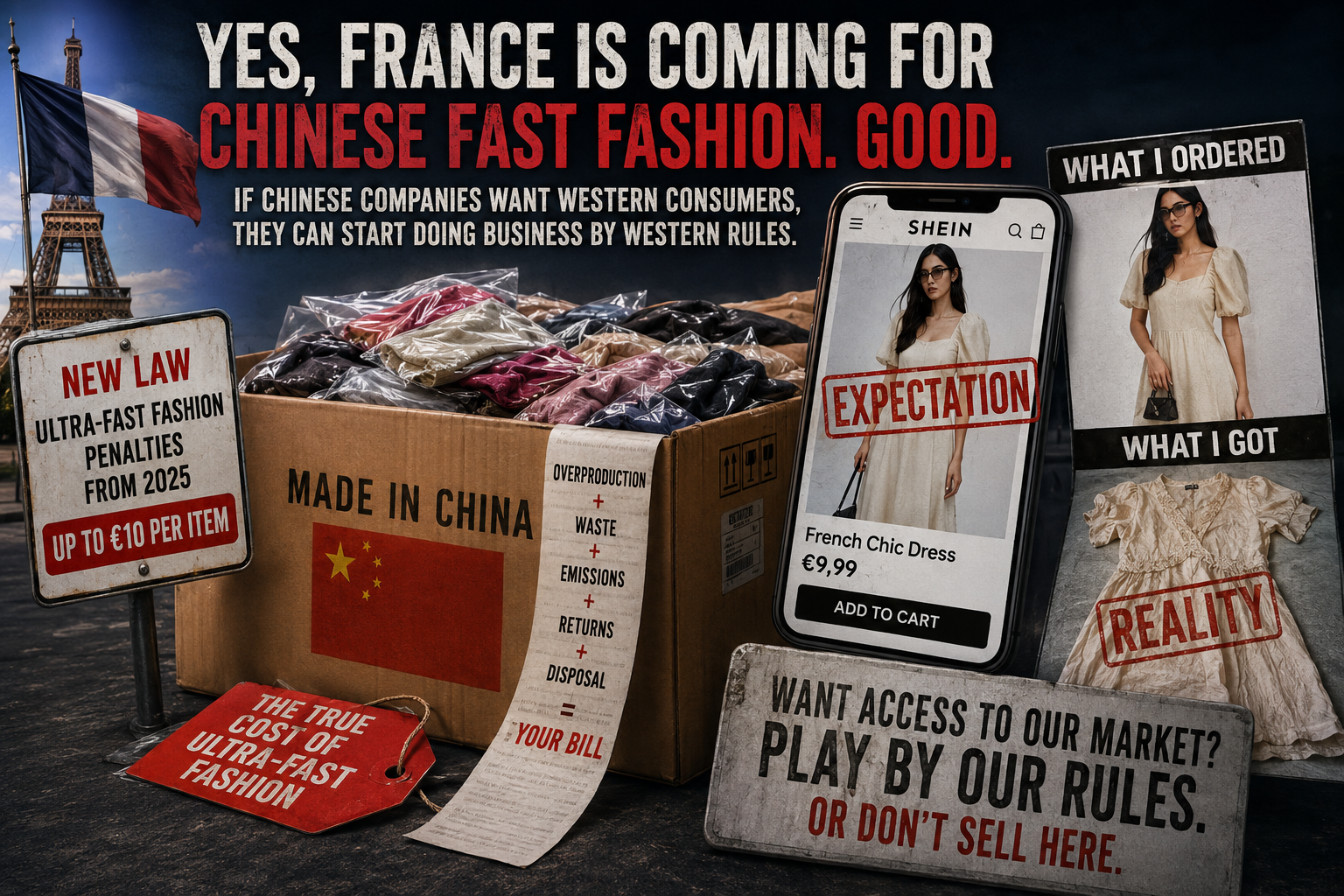
For once, France has found a regulation I can applaud.
The target is ultra-fast fashion: the industrial-scale torrent of extremely cheap clothing associated above all with Chinese platforms and brands such as Shein.
Officially, of course, the rules are not called the *Chinese Fast Fashion Act*.
They do not need to be.
Write the criteria in neutral language. Measure the number of products introduced, the speed at which collections turn over, their environmental impact and the commercial model behind them.
Then stand back and act surprised when the regulation lands overwhelmingly on Chinese ultra-fast-fashion companies.
We are not pointing fingers here.
We are merely describing a fox.
And in this case, France has a point.
Yes, It Targets China
There is a peculiar ritual in international trade.
A government introduces rules whose practical target is obvious, and everyone immediately begins pretending not to notice.
France is targeting a business model overwhelmingly associated with Chinese ultra-fast fashion.
Good.
There is nothing inherently illegitimate about that.
A country has every right to decide under what conditions foreign companies may sell products to its citizens.
Access to the French market is not a human right.
Neither is access to Canada.
Neither is access to the United States.
If a Chinese company wants European or North American customers, there is a remarkably simple solution:
**Meet European and North American standards.**
If it does not want to do that, there is another remarkably simple solution:
**Don't sell there.**
Your Factory Is in China. Your Customer Isn't.
Chinese manufacturing conquered enormous portions of the global consumer market for good reasons.
China became extraordinarily efficient at producing things cheaply, quickly and at enormous scale.
That achievement should not be dismissed.
But manufacturing something for export and actually understanding the market where it will be sold are two very different skills.
Too many sellers appear to have learned the first while treating the second as an optional accessory.
Clothing provides perhaps the most obvious example.
Western customers routinely encounter garments whose advertised sizes bear only an adventurous relationship to Western sizing conventions.
That is irritating enough when someone buys a cheap shirt online.
In commercial manufacturing, however, there is no excuse at all.
If a customer supplies exact garment measurements, a technical specification and dimensions in centimeters and inches, the manufacturer does not get to substitute its own interpretation of what those dimensions *ought* to be.
The specification is the specification.
If the resulting sample is dramatically smaller than the measurements supplied, that is not a cultural misunderstanding.
It is a manufacturing error.
And asking the customer to pay again so the manufacturer can correct its own failure is not customer service.
It is an invoice for somebody else's incompetence.
The Product in the Photograph Would Also Be Nice
Then there is the great international genre of online shopping:
**WHAT I ORDERED / WHAT I RECEIVED.**
Everyone has seen it.
The advertisement shows a luxurious dress.
The package arrives containing something apparently assembled during an electrical blackout from two napkins and an emergency poncho.
The photograph shows beautifully tailored clothing.
Reality looks as though the photograph was merely provided to the factory as inspirational literature.
And sometimes the discrepancy goes considerably beyond quality.
Advertise genuine fox fur and ship synthetic fur?
That is not an alternative interpretation of the product description.
Advertise one specification and deliver another?
Same problem.
The internet has made *expectation versus reality* shopping photographs funny.
Consumer law exists because the underlying practice isn't.
Welcome to Canada. We Have Different Networks Here.
Electronics produce an even more absurd version of the same problem.
Imagine selling a cellular device to Canadian customers that cannot properly operate on the networks used where it is being sold.
Or consumer electronics configured for a television or communications standard incompatible with the destination market.
At that point, the problem is no longer whether Chinese manufacturing is cheap.
The problem is whether anyone involved in exporting the product bothered to ask a revolutionary question:
**Will this thing actually work in the country where we're selling it?**
Localization is part of doing international business.
Different countries have different electrical systems, wireless bands, safety requirements, certification regimes, languages, consumer expectations, measurements and technical standards.
You don't get to ship the domestic Chinese version halfway around the planet, put an English listing on it and declare the localization process complete.
If you want the Canadian customer, make the product work in Canada.
If you want the American customer, meet American requirements.
If you want the European customer, comply with European standards.
This should not be controversial.
It is how international commerce works.
Cheap Is Not a Regulatory Exemption
Ultra-fast fashion complicates the issue because its entire competitive advantage depends on extraordinary scale and speed.
Traditional fashion companies plan collections, manufacture inventory and move through recognizable seasonal cycles.
Ultra-fast fashion compresses that process dramatically.
Products can appear, be tested against demand, reproduced, promoted and replaced at astonishing speed.
That produces something consumers understandably love:
**very low prices and enormous choice.**
But low prices do not make the costs surrounding those products disappear.
Returns still exist.
Packaging still exists.
Waste still exists.
Disposal still exists.
Product compliance still exists.
Consumer protection still exists.
Someone pays for all of it.
And if a business model gains part of its competitive advantage by externalizing costs that domestic competitors are expected to absorb, then regulators have every right to examine that advantage.
This is where the French approach becomes interesting.
France is effectively saying that if your commercial model involves pumping extraordinary quantities of extremely short-cycle clothing into the French market, France is allowed to attach a cost to doing so.
China may dislike that.
Chinese companies may call it discriminatory.
But there is an enormous difference between discrimination against a nationality and regulation that disproportionately affects companies from one country because companies from that country disproportionately use the targeted business model.
Those are not the same thing.
“But Zara Does Fast Fashion Too”
Yes.
And this is where critics have a legitimate question.
Rules should not become disguised protectionism where identical conduct magically becomes acceptable when the corporate headquarters are located on the correct continent.
If Zara, H&M or a French company operates the same ultra-high-volume, ultra-short-cycle model under the same criteria, the same rules should apply.
No European exemption.
No patriotic coupon.
No regulatory wink.
**Same conduct, same rule.**
But equal treatment does not require pretending different business models are identical when they aren't.
If one retailer introduces products at a fundamentally different scale and velocity from another, a regulation based on scale and velocity will affect them differently.
That is mathematics, not xenophobia.
China Can Compete. It Can Also Adapt.
None of this requires pretending Chinese companies are incapable of meeting Western standards.
Quite the opposite.
China manufactures some of the most sophisticated products on Earth.
It builds electronics, vehicles, telecommunications equipment, industrial machinery and components that sit inside products carrying famous Western logos.
The idea that Chinese manufacturers somehow cannot understand a European size chart or North American technical specification is absurd.
Of course they can.
Which means companies that fail to adapt deserve even less sympathy.
If you possess the industrial capability to manufacture a modern electric vehicle, you possess the intellectual resources necessary to determine which wireless frequencies operate in Canada.
If your factories can manufacture garments by the millions, they can follow a measurement sheet.
If your e-commerce platform can algorithmically optimize prices for customers across continents, it can display accurate product information.
These are not technological limitations.
They are business choices.
The West Does Not Owe China a Customer
For decades, globalization has sometimes been discussed as though market access were an entitlement.
Produce something cheaply enough and every country is apparently obligated to let you sell unlimited quantities of it under whatever commercial model makes the economics work.
No.
Trade is an agreement.
The manufacturer receives access to customers.
The destination market gets products, competition and lower prices.
But access comes with conditions.
Safety standards.
Environmental standards.
Truthful advertising.
Consumer protection.
Product compatibility.
Returns.
Taxes.
Waste obligations.
Whatever other rules the society democratically chooses to impose on companies operating within its market.
China imposes its own rules on foreign companies operating in China.
Sometimes extremely demanding ones.
There is nothing remarkable about Europe doing the same.
France Is Presenting the Bill
France's policy should absolutely be watched.
If environmental regulation becomes an excuse to protect European corporations from legitimate competition, criticize it.
If identical products receive different treatment based purely on national origin, criticize it.
If the numbers do not support the environmental justification, criticize that too.
But the basic principle is sound.
**You want our market? You play by our rules.**
Not Chinese rules.
Not the rules that make manufacturing cheapest.
Not whatever standards happened to be convenient for the domestic market where the product originated.
The rules of the market where you are making your money.
China became a manufacturing superpower by becoming exceptionally good at producing for the world.
Now some Chinese companies need to become equally good at **selling to the world on the world's terms**.
And if a business model only works when the destination country absorbs the waste, accepts poor localization, tolerates misleading listings or lowers its standards because the products are cheap, perhaps the problem is not regulation.
Perhaps the product was never as cheap as the price tag suggested.
France has simply started presenting the bill.