Society
YOU DIDN’T KNOW AMERICA WOULD DO THIS TO YOU?
Europe spent decades helping build a system in which Washington could do whatever it wanted. Now that Washington has started doing it to Europe, everyone is shocked.
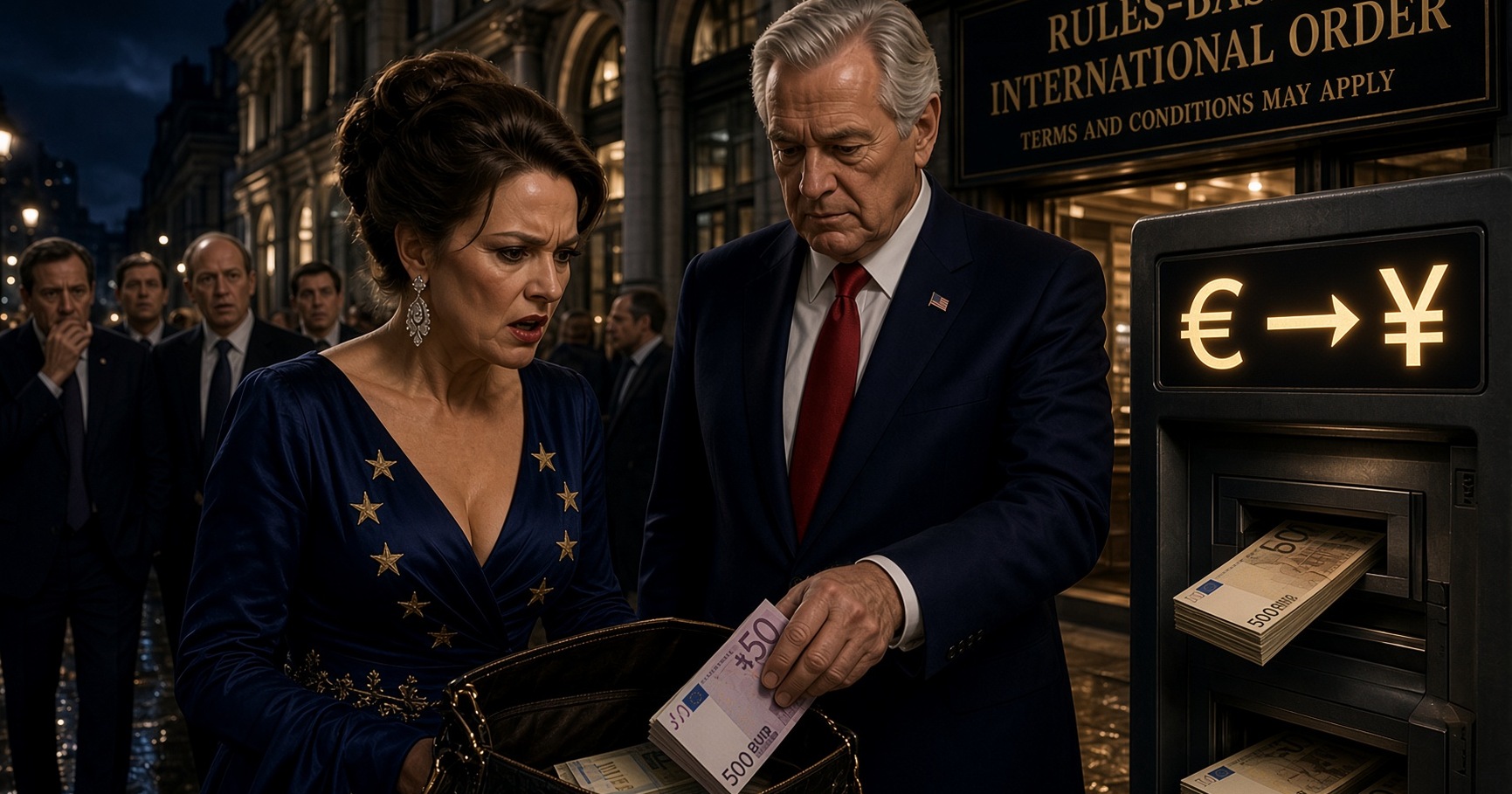
For years, European elites have lived very comfortably inside an arrangement whose operating principle was obvious to almost everyone outside the club.
The United States decides.
Europe explains.
Someone else pays.
That system worked beautifully when the targets were elsewhere.
Sanctions? Fine.
Financial pressure? Fine.
Currency intervention? Fine.
Secondary sanctions? Fine.
Military pressure? Fine.
As long as Washington was using its exceptional power against somebody Europeans had already been instructed to dislike, the phrase “rules-based international order” remained remarkably popular.
Then the U.S. Treasury sold euros to buy Japanese yen — without giving European counterparts the customary warning.
Suddenly, European central bankers discovered a new concept:
**respect.**
Reuters reports that officials leaving the Jackson Hole symposium were irritated and worried by Washington’s increasingly unilateral behavior. One European official summed up the lesson perfectly:
**“The U.S. does whatever it wants.”**
Correct.
Welcome to the meeting.
It started decades ago.
What exactly did you think was going to happen?
This is the part that deserves some ridicule.
Did European policymakers genuinely believe American unilateralism came with a geographic restriction?
Did they think the U.S. Treasury had a special internal policy reading:
**Do whatever we want — except to Europeans, because they are our friends?**
Apparently so.
Washington intervened to support the yen using Treasury resources. The operation involved selling euros. European officials were particularly annoyed because they did not receive the customary heads-up.
One source told Reuters:
**“You always pick up the phone and give heads-up.”**
That sentence is magnificent.
Not because the complaint is irrational. Coordination between major central banks is important.
But because of what it reveals.
The objection is not:
**The United States should not use its financial dominance unilaterally.**
The objection is:
**You were supposed to call us first.**
There is the entire transatlantic relationship in one sentence.
The rules were always flexible
European institutions have spent years defending a global system built around extraordinary American financial power.
The dollar dominates international finance.
American sanctions reach beyond American borders.
Access to U.S. financial infrastructure can determine whether entire companies survive.
Dollar swap lines sit underneath the global banking system as emergency plumbing.
Washington has enormous leverage precisely because much of the world agreed to construct the system that way.
Europe participated enthusiastically.
Now some European officials are reportedly asking whether even the Federal Reserve’s dollar liquidity swap lines might someday become vulnerable to political retaliation.
To be clear: Reuters reports **no evidence that these swap lines are currently under threat**, and decisions on them belong to the Federal Reserve, not the Treasury or White House.
But the fear itself is revealing.
Europe is beginning to consider the possibility that a weaponized financial system might someday be weaponized against Europe.
An extraordinary intellectual breakthrough.
America First was not a metaphor
Donald Trump has spent years saying **America First**.
This is not especially cryptic.
It does not mean:
**America First, Europe a very close second, subject to consultation.**
It means America first.
The U.S. official explanation for the yen intervention was straightforward: Washington wanted to counter disorderly yen movements and protect financial stability. Treasury Secretary Scott Bessent has argued that extreme yen weakness could produce wider global instability and eventually affect American borrowing costs.
In other words:
America believed the move served American interests.
So America did it.
European approval was apparently not considered essential.
That should surprise nobody.
Except, apparently, Europeans.
The uncomfortable question
Perhaps the real question is not why Washington behaved this way.
Perhaps the question is:
**How could European policymakers possibly have expected anything else?**
For decades they watched American governments use economic, military and financial power around the world.
They defended it.
Participated in it.
Benefited from it.
Called it leadership.
Then one morning the same logic touched the euro and suddenly everybody discovered the importance of consultation.
This is not betrayal.
It is consistency.
The United States did not suddenly become America.
Europe merely found itself standing on the other side of an American decision.
And apparently the view looks different from there.
So yes, European central bankers are entitled to be concerned.
They are entitled to demand predictability.
They are entitled to defend European interests.
But please spare us the surprise.
You helped build the machine.
You watched it operate.
You applauded when it was pointed elsewhere.
And now that the barrel has rotated slightly in your direction, you ask:
**How could this happen?**
Really?
You didn’t know?