Media
YOU LOVE CARNEY. WILL YOU STILL LOVE HIM WHEN YOUR FACTORY CLOSES?
Patriotism polls beautifully. Unemployment has a way of producing different numbers.
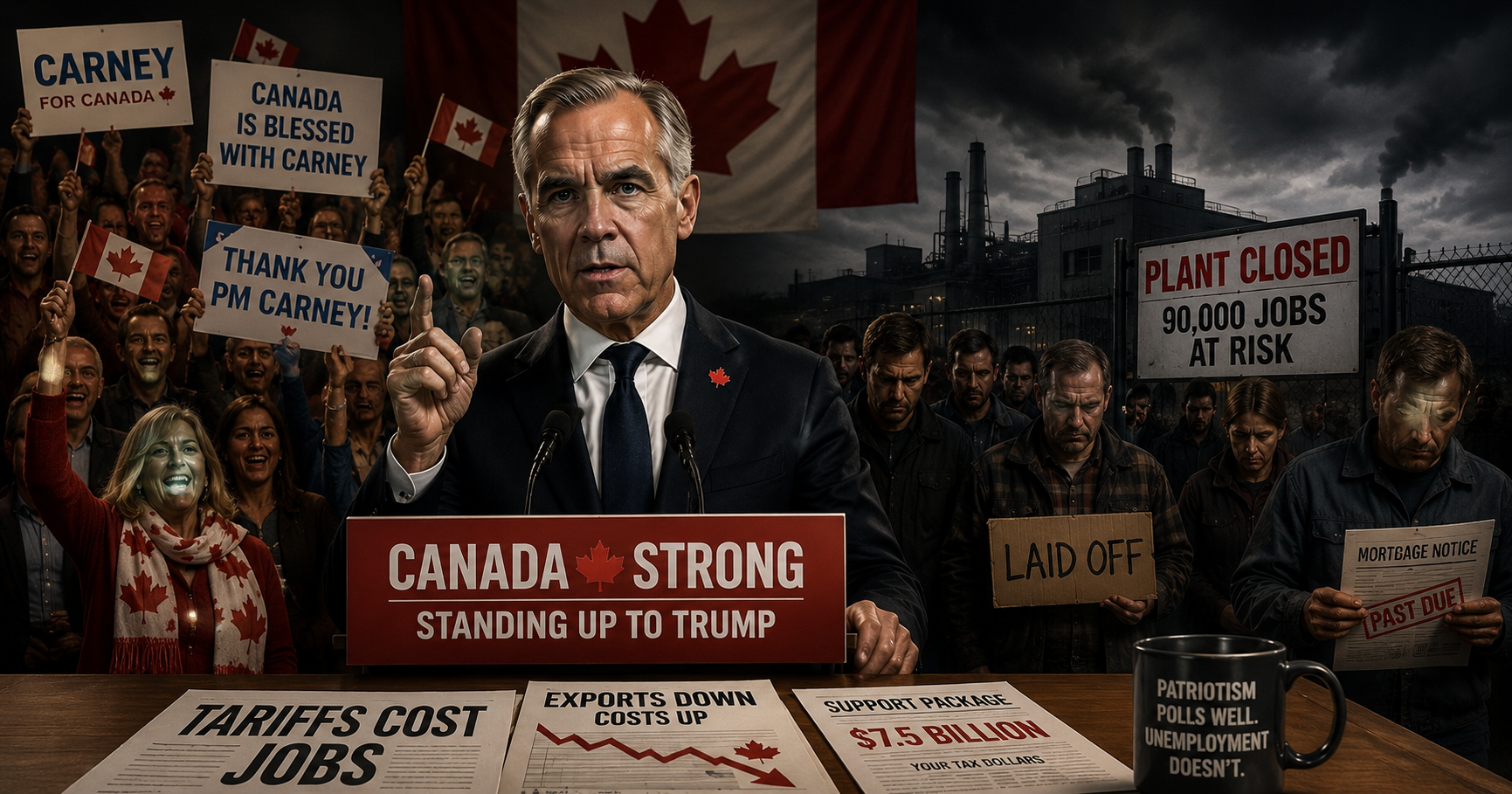
Mark Carney is having a very good political moment.
Canada is in a confrontation with Donald Trump.
Carney pushes back.
He breaks off trade talks.
His government retaliates with tariffs on $20 billion worth of American goods.
And Canadians applaud.
According to polling cited by Reuters, about **76% support his approach**.
Wonderful.
There is only one problem.
The bill has not fully arrived yet.
It is easy to be brave with somebody else’s paycheck
Trade wars sound magnificent in political speeches.
Strength.
Sovereignty.
Standing up for Canada.
Refusing to be bullied.
All excellent slogans.
And some confrontation may indeed be unavoidable when the American president is openly using tariffs as leverage against Canada.
But tariffs are not rhetoric.
They are economic instruments.
They have consequences.
Reuters cites an estimate from University of Calgary economist Trevor Tombe that Trump’s latest tariffs, affecting about 5% of Canadian exports, could ultimately cost **around 90,000 Canadian jobs**.
That is where the interesting polling begins.
Not today.
Later.
Ask again after the layoffs
Ask someone:
**Should Canada stand up to Trump?**
Easy answer.
Yes.
Ask:
**Should Canada stand up to Trump if your plant closes?**
Different survey.
Ask:
**Should Canada stand up to Trump if your mortgage payment remains due but your job disappears?**
Different survey.
Ask:
**Should Canada stand up to Trump if your company moves production south because access to its biggest market has become too expensive?**
Suddenly foreign policy becomes less cinematic.
Canada sends roughly 70% of its exports to the United States.
That is not an ideological opinion.
It is geography.
You can dislike Trump.
You can despise American pressure.
You can wave the Canadian flag until the pole bends.
The trucks still have to cross the border.
“Canada is blessed”
There is a particularly sentimental genre of Canadian political commentary in which Mark Carney is treated almost as national salvation.
The competent adult.
The banker.
The international statesman.
The man who finally knows how to deal with Trump.
Perhaps.
But leadership is not measured by applause at the beginning of a confrontation.
It is measured by what survives at the end.
If Carney protects Canadian industry, preserves access to the U.S. market and forces Washington into a sustainable settlement, give him credit.
Absolutely.
But if the strategy produces factory closures, unemployment and declining incomes, something else will happen.
The same people currently praising courage will begin asking why groceries cost more.
Why their neighbor was laid off.
Why the local supplier closed.
Why government support packages are necessary.
Why Ottawa did not compromise earlier.
That political transformation is one of democracy’s oldest traditions.
Patriotism is cheap before payday
Carney’s government has already announced a C$7.5 billion support package alongside retaliatory tariffs.
That tells you something.
Governments do not create multibillion-dollar support programs because trade wars are harmless.
They create them because somebody is going to get hurt.
The only question is how badly.
And who.
Today, the pain remains sufficiently abstract for most Canadians.
Reuters notes that while Carney’s position enjoys broad support, only about 40% currently express serious concern about risks to their own employment.
That gap is the entire political story.
Three quarters support the fight.
Far fewer believe the fight will hit them.
That is a very comfortable form of courage.
We will ask again later
Maybe Carney is right.
Maybe Trump eventually backs down.
Maybe Canadian retaliation produces leverage.
Maybe new markets reduce dependence on the United States.
Maybe the predicted job losses never materialize at the projected scale.
Good.
We hope so.
But if they do?
If unemployment rises?
If factories close?
If household income falls?
If the trade confrontation stretches into years rather than months?
Then The Antigloss would like to repeat today's poll.
Same respondents.
Same question.
One additional line:
**“Have you personally lost money because of this policy?”**
Then let us see how blessed Canada feels.
Because political loyalty is easy when it costs nothing.
The interesting part begins when the invoice arrives.
And invoices have a remarkable ability to cure ideological enthusiasm.