Technology
You No Longer Need Their Permission
The internet destroyed the gatekeepers’ monopoly on distribution. AI is destroying their monopoly on production. It cannot make you talented. It can finally let you find out whether you are.
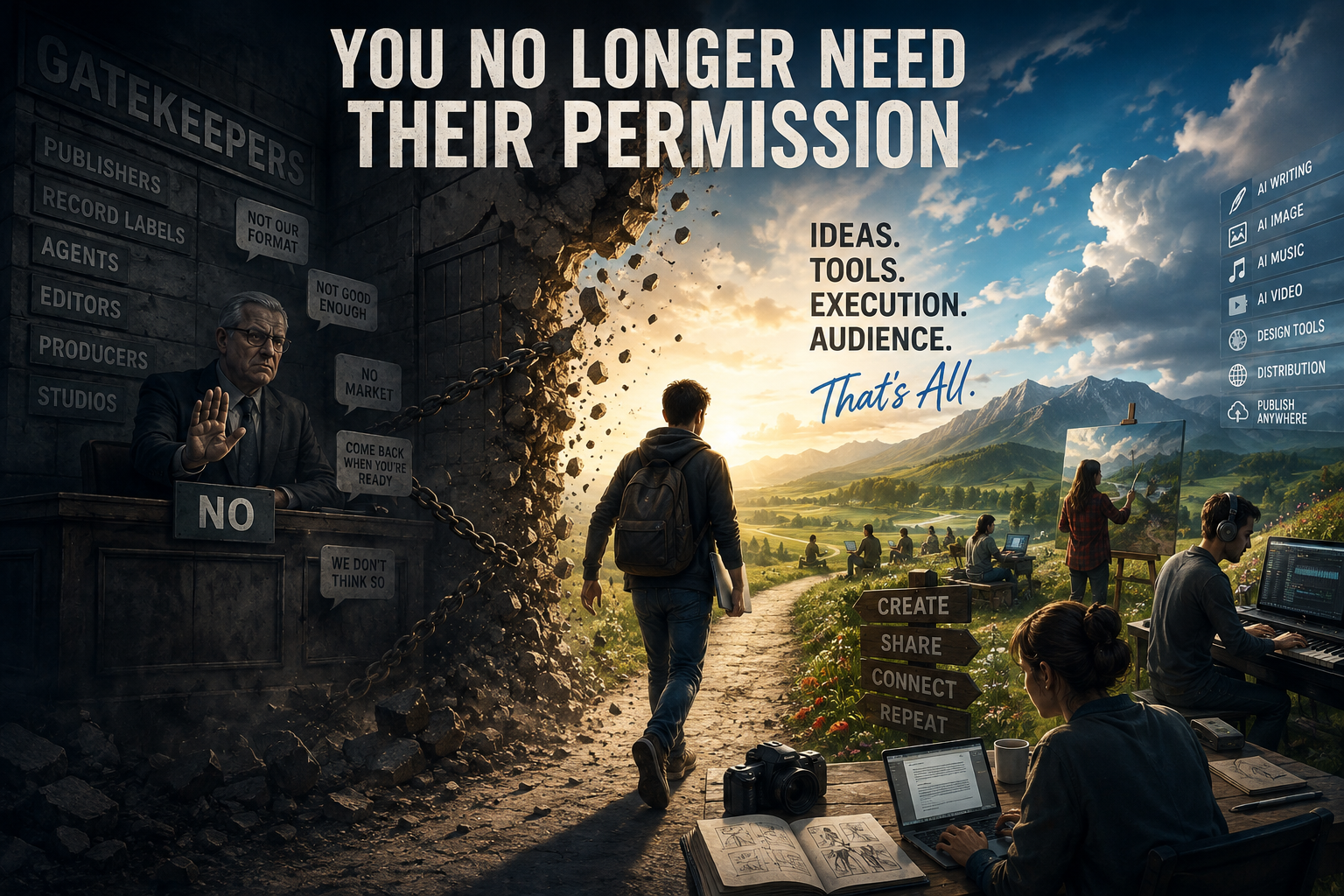
For most of modern creative history, talent was not enough.
You could have the novel.
You could hear the song in your head.
You could imagine the photograph, the magazine, the film, the clothing line.
You could even be very good.
None of that meant the public would ever see what you made.
Between the creator and the audience stood an entire civilization of people whose most important professional word was:
No.
No, we will not publish your book.
No, your music does not fit our label.
No, you do not have the right look.
No, this is not what our magazine publishes.
No, we do not think there is a market for it.
No.
And because the gatekeeper controlled the gate, his opinion frequently became indistinguishable from reality.
Then technology began removing the gates.
The gatekeepers would now like us to believe this is a cultural emergency.
Perhaps it is.
Just not necessarily for the reasons they claim.
The People We Never Met
J.K. Rowling's first Harry Potter manuscript was rejected by multiple publishers before Bloomsbury finally took it.
Today, this is a charming story about perseverance.
But it contains a much less charming question.
We know about Rowling because she kept going.
How many didn't?
How many writers received the third rejection, looked at three professional opinions telling them their work was unwanted, and concluded that the professionals probably knew better?
How many manuscripts went into drawers?
How many songs were never recorded?
How many films remained notebooks?
How many people with genuinely interesting ideas never discovered whether those ideas had an audience because somebody else decided the audience should never get the opportunity to decide?
We cannot count them.
That is precisely the problem.
History remembers the people who got through the gate.
It cannot remember the people the gate successfully erased.
The First Revolution Was the Internet
AI did not begin this process.
The internet did.
Before YouTube, reaching millions of viewers generally required access to television, film distribution or other expensive media infrastructure.
Before streaming and digital distribution, getting music into the market usually meant navigating labels, distributors, radio and physical retail.
Before self-publishing platforms, a writer could write a masterpiece and still require somebody else's permission to put it into bookstores.
Then the internet committed an unforgivable act.
It allowed creators to go around them.
YouTube said: upload it.
Amazon said: publish it.
Streaming platforms said: distribute it.
Social media said: show everybody.
Suddenly the television executive, newspaper editor, record-label executive and publishing acquisition committee were no longer the only doors into the building.
But one enormous barrier remained.
You could distribute almost anything.
You still had to make it.
Distribution Was Democratized. Production Wasn't.
Suppose you wanted to make an album twenty-five years ago.
You needed musicians.
You needed recording equipment.
You probably needed studio time.
You needed somebody who understood recording.
Mixing.
Mastering.
Artwork.
Manufacturing and distribution.
Every step cost money.
Perhaps you had an extraordinary musical idea but could not play five instruments.
Too bad.
Perhaps you had written songs but could not afford a professional recording.
Too bad.
Perhaps you wanted to create a fashion magazine but English was not your first language.
You might have the editorial ideas, aesthetic judgment, photographic ability and point of view.
But articles needed writers.
English needed editing.
Layouts needed production.
Images needed creating.
Websites needed building.
Every creative ambition came attached to an invoice.
This produced an enormous economic moat between having an idea and putting the finished idea in front of another human being.
AI is attacking that moat.
That is the real revolution.
AI Didn't Democratize Talent
It democratized execution.
This distinction seems almost entirely absent from the increasingly hysterical debate over AI-generated books, music, photography, illustration and video.
Give an untalented person a piano and you do not get Mozart.
Give him Microsoft Word and you do not get Hemingway.
Give him Photoshop and you do not get Annie Leibovitz.
Give him a $10,000 camera and you do not necessarily get a photographer.
And give him ChatGPT, Suno, Midjourney or whatever arrives next and you still do not magically get an artist.
You get a person with a better tool.
That tool may produce technically impressive results.
It can produce immaculate grammar.
Beautiful lighting.
Clean typography.
Studio-quality sound.
A perfectly conventional novel cover.
A song with the correct number of verses and choruses.
And the finished product can still be completely fucking boring.
Because technical competence and creative value were never the same thing.
AI can make mediocrity look extremely professional.
It cannot guarantee that anybody will care.
The $1,000 Button
Consider an aspiring model.
For decades, an entire peripheral economy existed around young women hoping to enter modeling.
Some had genuine potential.
Some did not.
But many were told they needed portfolios.
And portfolios cost money.
A photographer had access to the camera, lights, studio, Photoshop and technical knowledge necessary to create images that the aspiring model could not easily create herself.
A good fashion photographer absolutely provides genuine creative value. Directing a model, understanding light, composition, clothing, movement and visual storytelling are real skills.
But not every person charging four figures for a portfolio was Richard Avedon.
Some were selling something much simpler:
access to production.
The customer could not produce polished studio photographs.
The photographer could.
Therefore the photographer controlled a scarce capability and could charge accordingly.
Generative imaging radically changes that equation.
It does not make the customer a great photographer.
It does something economically more dangerous.
It may allow her to obtain the result she actually needed without hiring one.
The distinction matters.
AI is not necessarily replacing talent.
In many cases it is replacing the scarcity premium attached to technical execution.
We have seen this movie before.
Digital cameras disrupted film processing.
Photoshop transformed retouching.
Desktop publishing demolished entire categories of typesetting work.
Affordable digital audio workstations allowed musicians to perform production tasks at home that once required expensive studios.
Every technological transition separates two things that had previously been bundled together:
creative judgment and technical access.
People who possessed both remained valuable.
People whose value came primarily from controlling access had a considerably worse afternoon.
The Studio Is Now in the Bedroom
Music makes this especially obvious.
A person may understand music, have ideas, write lyrics and know exactly what emotional effect a song should produce without being capable of personally playing drums, guitar, bass, keyboards and strings while singing, engineering and mastering the recording.
Historically, that limitation was expensive.
Now it increasingly isn't.
AI music tools can provide execution.
But anyone who has seriously worked with them discovers something very quickly:
The first result is not necessarily the result.
You can generate two versions.
Ten.
Twenty.
You change the prompt.
Change the arrangement.
Change the vocal.
Reject a technically excellent result because it does not feel right.
Keep an imperfect one because something inside it does.
That process contains a human activity that critics conveniently erase when they describe AI creation as "pressing a button."
Selection.
Taste.
Intent.
Judgment.
Knowing what you wanted before the machine gave you something else.
A person without those qualities can generate twenty songs too.
He simply has twenty songs nobody wants to hear.
AI Can Write Your Terrible Book Beautifully
Writing exposes the same distinction.
Ask a modern language model to produce a generic magazine article with almost no direction and it will happily comply.
The grammar will probably be excellent.
The structure will be recognizable.
There will be an introduction, arguments and conclusion.
It may also have absolutely nothing worth saying.
Because prose and thought are not synonymous.
An author can use AI to transform rough ideas into polished language, challenge arguments, research facts, reorganize material, translate, line-edit and test alternatives.
That can dramatically reduce the technical and financial barriers to publication.
But if the original idea is boring, AI can merely produce a beautifully written boring idea.
If the author's worldview is shallow, AI can make shallowness grammatical.
If the story is bad, perfect punctuation will not save it.
This is why the claim that AI automatically turns everyone into a writer misunderstands both AI and writing.
A word processor did not create ideas.
Neither does a language model.
It makes certain forms of execution dramatically easier.
The rest remains embarrassingly human.
Then Congress Discovered the Button
Which brings us to Washington.
According to reporting by Politico, lawyers in the U.S. House Office of Legislative Counsel have increasingly received legislative material apparently produced with generative AI.
The problem is not that congressional staff use AI.
They should.
If a tool can accelerate research, drafting, comparison and routine work, refusing to use it merely because it is new would be idiotic.
The problem is what happens when a person uses AI to replace expertise he does not possess rather than amplify expertise he does.
Legislative lawyers described AI-generated material containing incorrect statutory references, defective definitions and legal mechanisms that did not accomplish what their authors apparently intended.
In one reported example, an AI-generated definition of "state" could potentially have excluded Washington, D.C., and tribal jurisdictions from a federal program.
Some drafts reportedly required so much repair that professional legislative counsel could have written them faster from scratch.
And in June, the office of Representative Anna Paulina Luna published a summary of an amendment containing a wonderfully archaeological artifact:
"Claude responded:"
Luna said AI had been used to summarize the amendment, not write the amendment itself.
Fair enough.
But the episode accidentally illustrates the entire problem.
AI does not remove the requirement for a competent human being at the other end.
It increases it.
Artificial Intelligence Cannot Cure Natural Stupidity
A knowledgeable lawyer using AI can recognize a defective legal definition.
An incompetent user may be impressed by how professional the defective definition sounds.
A good writer can recognize an empty paragraph.
A bad writer sees flawless grammar.
A musician can hear that a technically polished song has no soul.
Someone without musical judgment hears production quality.
A photographer sees bad composition.
Someone who bought a camera sees sharp pixels.
AI amplifies the person holding it.
That is why the same technology can liberate a talented person who lacked resources and embarrass a powerful person who lacked competence.
The talented person suddenly gains execution.
The incompetent person suddenly gains the appearance of execution.
For a while, those can look remarkably similar.
Then somebody knowledgeable checks the work.
This is why blaming AI for bad AI-assisted legislation gets the problem backward.
The machine did not stand for election.
The machine did not submit the legislation.
The machine does not receive a congressional salary.
If a human being puts his name behind work he cannot evaluate, the failure is human.
AI was merely kind enough to print the evidence professionally.
The Gatekeeper's Real Nightmare
None of this means every critic of generative AI is a frightened middleman.
There are serious questions about copyright.
There are serious questions about training data.
There are legitimate disputes over compensation, impersonation, employment and whether companies should be allowed to reproduce living artists' styles or voices without permission.
Those debates deserve serious answers.
But underneath part of the cultural panic lies another conflict that receives far less attention.
Power.
For generations, intermediaries did not merely provide useful professional services.
Some also possessed the power to decide who got access.
A record label did not merely help distribute your album.
It could determine whether your album had meaningful distribution at all.
A publisher did not merely improve your book.
It could determine whether your book became a product.
A magazine editor did not merely edit.
He decided whose ideas entered the magazine.
That power had enormous economic value.
AI does not eliminate good editors, photographers, producers, designers or musicians.
It changes their relationship with the customer.
Previously, you had to prove why they should let you in.
Now they increasingly have to prove why you need them.
That is a much less comfortable negotiation.
No Is Not What It Used to Be
Imagine a writer approaching a publisher thirty years ago.
The publisher says:
No.
For many writers, that could effectively end the commercial life of the manuscript.
Now the publisher says:
No.
The writer says:
Okay.
That may be the most terrifying word in the history of gatekeeping.
Okay.
I'll publish it myself.
Okay.
I'll record it myself.
Okay.
I'll build the website myself.
Okay.
I'll make the artwork myself.
Okay.
I'll find the audience myself.
The creator may fail spectacularly.
That is not a defect in the system.
That is the point.
You Have Earned the Right to Fail
The democratization of production does not promise success.
It promises access to the test.
You may write a novel and discover nobody wants it.
You may release an album and receive twelve streams.
You may launch a magazine and discover that nobody gives a damn what you think.
Good.
Now you know.
But notice who made the decision.
The audience.
Not the acquisition editor.
Not the label executive.
Not the studio owner.
Not the committee.
Not the photographer selling access to equipment.
And not the AI.
The audience.
There is an enormous philosophical difference between being denied permission to compete and competing and losing.
One says:
You are not allowed to find out.
The other says:
You found out. Try again.
AI cannot make you talented.
It can finally let you discover whether you are.
There Is Still One Gate Left
Of course, the old gatekeepers did not disappear without replacements.
Publishing is easy.
Being discovered is not.
YouTube has an algorithm.
Amazon has an algorithm.
Spotify has an algorithm.
TikTok has an algorithm.
Google has an algorithm.
The man smoking a cigar behind the desk may be disappearing, but recommendation systems increasingly decide which road leads from production to audience.
We demolished the gate.
Then we built an algorithmic tollbooth twenty metres down the road.
That may become the next great fight.
But it is still different from the old system.
The ability to create and publish is increasingly in the hands of the creator.
The creator no longer requires permission merely to exist.
And that is why so much of the panic surrounding artificial intelligence sounds strangely familiar.
Every technology that democratizes a scarce capability threatens people whose economic position depended on keeping that capability scarce.
Some of those people will adapt.
The best will become more valuable because genuine taste, judgment, expertise and talent remain scarce.
Others will discover that what they thought was talent was actually access.
And some very powerful people will discover, as Washington is currently learning, that artificial intelligence is an extraordinary instrument but a terrible hiding place.
You cannot hide intellectual emptiness behind artificial intelligence forever.
Eventually somebody reads the output.
Eventually somebody hears the song.
Eventually somebody sees the photograph.
Eventually somebody opens the book.
Eventually the public decides.
AI did not abolish judgment.
It moved judgment downstream.
And perhaps that is what frightens the gatekeepers most.
The gatekeepers told us AI would destroy creativity.
What they forgot to mention was that it might destroy the gate.